Boeuf en Daube a la Provencale from Christine Wilkinson of Lavande French restaurant

BOEUF-en-DAUBE A LA PROVENCALE:
(cooked in a cast iron pot on top of stove.)
Adapted from a recipe from DK Books publication Provence Cookery School by renowned French chef, Gui Gedda and Marie Pierre Moine of Le Lavandou, Baumes-les-Momosas.
Don’t be put off by the four hour preparation and cooking time. It’s actually simple.

INGREDIENTS:
2 kgs chuck steak; 2 tbsp olive oil; 250g thick cut steaky bacon; 1 large onion, chopped; 2 tbsp plain flour; some sea salt and ground black pepper.
MARINADE:
5 garlic cloves; 3 carrots sliced; 2 celery sticks chopped; 2 large onions chopped; 10cm strip of dried orange peel; 3 sprigs of parsley; 2 sprigs of frsh thyme; 2 bayleaves; ½ teaspoon of grated nutmeg; 112 black peppercorns crushed; 4 juniper berries, crushed; 4 cloves crushed; 2 tbs red wine vinegar; 1 bottle of robust red wine.
Some salt and pepper.

METHOD:
Cut beef into 5 cm chunks, place in large bowl add marinade and leave overnight.
Remove beef from bowl and dry with kitchen paper.
Strain marinade through a sieve and reserve liquid and sieve solid ingredients separately .
Use large sauté pan on moderate heat and add oil, bacon and onions. Cook for 5 minutes. Add beef and sprinkle over the flour. Brown for 10 minutes on all sides. Add well drained marinade ingredients. Cook for 5 minutes, add reserved liquid, reduce the heat, cover tightly and cook very gently for 3 hours. Towards the end of the cooking time, taste and adjust seasoning. Remove from heat. Let it go cold. Remove surface fat and then put in the oven at 190 degrees. Heat only.

Serve with creamy potato mash.
Is lovely with wood fire bread or tiny little dum[plings.
If it is all too much trouble, Lavande of Callington will be open again on July 29. 85385 138.

Moving moments

Moving Moments

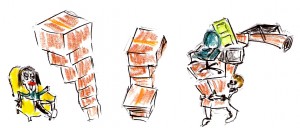
We are on the move.  The time has come after 12 months of the usual harrowing, time-consuming, finicky process of deciding to demolish and build another more functional, safer retirement home on the same site. And each room in our house is a sea of boxes.

We reckon on moving day – two weeks from now – our earthly possessions other than furniture – will be packed and taped away in about 100 boxes. Between us we have enough books to open a second-hand bookshop, enough art to open a gallery and countless china, objets d’art, memorabilia and bric-a-brac.  The question is what do you keep and what do you throw away, or give away, or sell.

Ours is a unique case. We are a blended household anyway with two households of goods and chattels jammed into a smallish, cream brick, four-walled 1960s house in the Mitcham Hills in Adelaide.

Husband Olivier has lived here for 35 years and it was where he and his late wife and their four children settled in Australia after the family migrated here in 1973.

This is my second Belair home and the fourth major move in 10 years when  I left my own marital home in Belair to move into my father’s house. One would imagine it would be a breeze to move out.

Which is why I cannot quite understand these waves of nostalgia sweeping over me as I sit in the midst of boxes, feeling fazed by the piles of folders, photograph albums, paintings, framed awards, notice boards, filing cabinets, and filled book cases. The desks, one for writing, the other for sewing, are  the responsibility of the removalist.  My concern is that every square centimetre of my study is covered with other clutter. All must be packed or discarded – and each item has its own part in the history of my life.

The framed Christening gown on the wall, for instance. I made it as a young woman for the baptism of my first child, daughter Serena. It took so long to make in the mayhem of early motherhood that those tiny elasticised sleeves, now puffed with padding, only just fitted my 6-month-old baby’s chubby arms.

Second daughter Felicia’s embroidered durndle, bought in Germany when she was 7 years old, hangs from the pelmet. She forgot to take it back to Melbourne when she picked out her stuff.  Pillows and cushions are piled up in one corner for packing. I msut admit I am swamped with memorabilia.  Scrap books with 20 years of newspaper cuttings from my time as a journalist at the Advertiser must be kept and not one of the umpteen stacked photograph albums will be discarded. But the stuff overflowing from a handful of in and out trays and myriad colourful vertical plastic folders will all need to be processed.

Method is important, but my mind is too foggy to remember how. Now I do remember I made a cup of tea half an hour ago and forgot about it, so I think I will take a tea break and mull over the problem some more.

Aboriginal Art becomes English class act

By SERENA WILLIAMS

One of the nice things about being a grandparent, I imagine, is watching your children coming to the slow realisation that parenting is a muckup, not a conspiracy!!

By which I mean of course, that most of us do our best and when things go wrong it is most often issues of bad timing, communication or just plain exhaustion.

So it was with joy that I watched my mother (Nadine) have a moment of pure grandy serendipity with my middle son Angus during our last visit  from London.

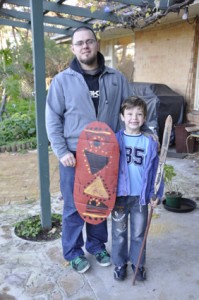
Angus had to do a project for show and tell entitled “I made this!”, while he was on holiday in Australia.  But Angus is not the most hands-on of children. He prefers sports and telling stories, not making stuff.

However,  he had been fascinated by the shields and spears at the brilliant Aboriginal culture exhibit at the Adelaide Museum, and particularly when he saw an old movie of two little boys his age spearing and then barbecuing a small bird.

Now mum is not the making kind of grandma either – I have never seen her with a paintbrush in her hand and she never kept glue either, claiming she was allergic.

So it seemed I was going to have to try to make something while also attending to my sick dad, who was the reason we’d made the trip from London back to Adelaide with my children in the first place.

But that’s when mum had her brilliant idea. One of her grandchildren from Olivier’s side of the family is emerging sculptor  Andre Lawrence, who was doing some work on their house, to ask him for to spend some time helping Angus creating something interesting to take to class.

It all worked out so well, in the way grandparenting ideas do. Andre came over the next day with a dingo tooth to show Angus and the duo examined Papy’s collection of authentic Aboriginal spears and he discussed why they had been designed the way they had.

Because of distances, these two grandchildren had not really had much time together. Andre told Angus many stories of his childhood growing up in the Northern Territory, while showing him how to design and make a shield out of a mailing box.

Angus had an expert art and cultural teacher all to himself (did I mention that Angus also loves to ask questions, millions of them).   Andre left his box of paints and brushes for my 6-year-old son to decorate a beautiful shield, so symbolic of Aboriginal culture.

When we finally left for the airport, Angus gave Andre a hug and said “I’ll never forget you,” Hopefully he’ll never have to, as one day soon we’ll be close enough to see Andre more often.

And Angus’ show and tell in his London classroom was a huge success, too:  “Mum, every single person in the class had a question, they thought it was so interesting.”  He was so pleased with his handiwork. And his teacher thought he was brilliant too.

So thank you Grandma, you’re so much more than a pretty face! And thank you Andre for handing on your knowledge of Aboriginal culture.

Frolic around France

Myriad things trigger Francophilia fever in July, not the least being celebrations of France’s national day Bastille Day on July 14.  Coverage of the Tour de France provides a nightly nostalgia trip and countless Francophila gift shops mean we can drool over myriad clocks, cards, books, glassware and even doormats.

All these things flood my mind’s eye with memories of my times in France.

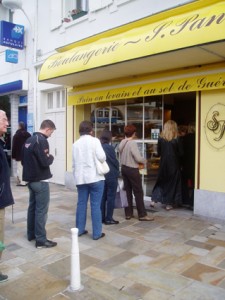
I smell the scent of the pines in Provence, I see countless vineyards, all neatly clipped, crucifixes galore, lavender fields in purple pom-pom rows and I drive by  patisseries with crowds lined up out the door, I pass boulangeries under striped canvas awnings in every village and I stop for any colourful market along the route.

But my favourite activite is sitting sipping coffee au café simply to people watch from la terrace. Read more »

Bastille Day – Heads could roll!

French president Nicolas Sarkozy can’t seem to take a trick right now. About two out of three – 64 per cent of the French public dislike him and disapprove of his actions as President.  Not only did the precious French football team, Les Bleus, implode at the World Cup to bring shame on the whole French nation, but its mutiny and “melt-down’’ mirrored a much wider malaise of France today.

On the cusp of Bastille Day, Sarkozy finds himself floundering in a quagmire of challenging issues if the Republic’s ethos liberte, egalite and fraternite is ever to become reality in what is now recognised as a divided France.

And it seems Sarkozy is slowly sinking into the quicksand of the “
Bettencourt affair’’ as it is known in France, or the L’Oreal cash scandal, whereby  L’Oreal heiress, frail, aged 87-year-old Liliane Bettencourt  could have made possible political donations to Sarkozy minister, high profile Industrial Minister Eric Woerth.

The whole murky issue has hotted up with new material – 21 hours of secret recordings made by Ms Bettencourt’s butler, which reveals a certain “monsieur’’ .

Mme Bettencourt is France’s richest woman and is suspected of giving Woerth, a key Sarkozy ally and treasurer of his UMP party, a donation of  E150,000 in cash in March 2007.

Sarkozy won government in May of that year, but a donation of that magnitude breaks French law which limits political donations to E7,500 to parties and E2,400 to individuals.

Allegations have come at an embarrassing time as Woerth faces calls for his resignation as he struggles to impose the difficult economic reform to raise the retirement age in France from 60 to 62.

Meanwhile, France totters on “national disintegration’’ reflected in “Les Bleus’’ shameful mutiny and woeful spectacle of defeat in the World Cup, according to philosopher and media superstar Alain Finkielkraut.

The soccer fan reckons the football “scum’’ from the banlieu  had “tarnished the image of France’’, and exposed  not a jot of “egalite or fraternite’, but of  ethnic and religious  division. He name-called the whole team “sulking spoilt brats’’.

“ France is contemplating the spectacle of her own disunity and exo9rable decline,’’ he wrote.

“We dreamed with the team of  the Zidane generation; today we are more likely to want  to vomit with this generation of scum.’’

The crises in the poorer Muslim suburbs hs never been resolved since the riots of 2005. Even Sarkozy found his grand idea – a debate on the essence of Frenchness – become too hot a political potato to handle.

Late last year, Sarkozy opened a national debate on what constituted the identity of France.  After four months of political quarrelling, Sarkozy did a Pontius Pilate and washed his hands of the project.

What was intended to be a community based discussion about the essential values of the Republic became a political football and like the World Cup Sarkozy wasn’t going to win.

Sarkozy’s plan was to throw open to debate the “essence of Frenchness today’’ and hopefully inject some measure of national pride into France’s Muslim population (now 15 percent) urging them to be “discreet’’ and assimilate into the French way of life.

Instead, the debate exposed a malaise in France that has been swept under the carpet for decades.

The Times reports French people, while disapproving of the debate, told pollsters that French identity is under threat from immigrants from other cultures.

The emergence of Jean-Marie le Pen, the far right National Front Leader has exacerbated their fear.

“Many French are unsettled by the sense of losing out to globabilisation and the presence of a Muslim population that seems eager to stay outside the local culture,’’  reported The Times.

Enter stage far-right is French intellectual and author Eric Zemmour who writes in his latest gloomy book Melancolie Francaise of a new “barbarism’’ with the rising of Muslim ghettos.

They have broken away from society, he says and quotes Charles de Gaulle as saying mixing Muslims and French Christians was “like blending oil and vinegar’’.

“French culture is not Mohammed,’’  writes Zemmour. “It is Francois, it is Christian.’’

The football debaucle reflected the whole multicultural mess.

“The captain of the French team who does not sing The Marseillaise, that shocks me,’’ said Education Minister, Luc Chatel.

In his private life Sarkozy has faced rumours not his wife has been unfaithful and that he has retaliated.

The French media, never bothered much about the private affairs of Presidents has not touched the matter, but rumours are rife on the net that Carla had an affair with French signer Benjamin Biolay, a long-time friend and that Sarkozy had found solace with right-wing politician Chantal Jouanno – his environment Cabinet minister.

If body talk speaks, then their love has faded of late. The kissy-kissy French, who kiss both cheeks when greeting each other, could hardly have failed to notice that when Sarkozy returned to Paris from Britain, Nicolas smiled at his wife, touching her lightly on her back. Not one peck on the cheek. His wife responded by patting his arm with a wedding ringless hand.

And yet, soon after, Carla (like Princess Diana, who used the media to tell her story) defended her husband against ugly rumour, an unheard-of happening for a First Lady in France. So the jury is out over the marriage.

One last hurdle before Bastille Day celebrations begin on July 14, the lower house of the French National Assembly will vote on banning the burqa in France in July 13.

Debate has raged for a year and Sarkozy has described the Muslim face coverings as degrading to women.

The French  Paper, a new English-speaking paper, reports fewer than 2000 women wear the full-face veil in France.  Muslim leaders warn any ban will escalate tensions by stigmatising France’s estimated five to six million Muslims, many of whom live in volatile suburbs.

Bastille Day could well be quite a sober affair.

My father Frank

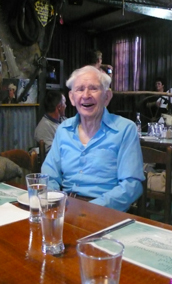
My father, Frank, has reached the grand age of 91, which is the first thing he tells anyone he meets. He immediately follows with the statement “I’m travelling very well for an old bugger.’’ And yes, dad is in excellent health, and God-willing I have inherited those longevity genes (because my mum, Florrie, died at age 77 of heart disease).

Dad is remarkable because he takes no medication whatsoever, a fact which amazes the clinical nurse at the Renmark low care facility where he lives.

He has been known to pop the odd Panadol for “old man’s problem’’ when his hip slips occasionally, but he never complains of pain and has a remarkable constitution.

However, age has left dad profoundly  deaf and he is also seriously visually impaired through advanced glaucoma. He lost his licence at age 70 because of glaucoma and has walked everywhere since, which contributed to his amazing good health and agility now.

Dad is still stick thin. We placed him in low care when he was not eating his Meals on Wheels lunches or anything else much, living on his own.  The Aged Care Assessment Team approved his admittance into low care, despite his protestations that he had no arthritis (true) and didn’t take any pills.

“I’m alright in my own home,’’ he had said.

But, he wasn’t. His blindness meant his environment was deteriorating into squalor and his children are all based in Adelaide.

His life deteriorated after his second wife, Elizabeth, who was profoundly disabled, was placed into high care and dad followed her into the same facility (low hostel care) 18 months later. In that time, without his wife, dad did not care for himself, although he continued to go to church each Sunday and walk to the shops for the paper daily. Read more »