Building Belair

What a process it has been to reach today – the day I accept a quotation from project builder, Stellar Homes to build our retirement home – at a price we can afford.

About 16 months ago, in April last year,we received our proposed plan from building designer David Frazer for a new home to be built on the same hillside site where we now live in a 1960s cream brick home. He had designed a four-bedroom home with a double garage under the main roof, which we do not have at the moment. It had a fabulous open-style floor plan with easy indoor-outdoor living. We fell in love with it in an instant.    

This would be the fourth house I had built and the second where I had demolished the existing dwelling. Husband Olivier had lived in the same cream brick house for 35 years of his life and the really big move had been in his mind – to consider removing his life from the old house where he had raised his children with his late wife, Colette and opening up the notion of building a stylish, new home where we could live out our lives.

David handled the important council planning stages, which includes a building certifier to hasten the process through council.  Eventually, we had building approval and three builders tendered for the job – one award-winning boutique builder and two project builders.

So, after all that, here I am this very afternoon in Stellar Homes’ selections room with Sue, Stellar’s senior consultant who has worked with us to achieve an acceptable price and Michelle, who from now on will be client liaison officer handling selections.

Life has revved up to a harrowing schedule and I must fit in the selection process next week, continue to pack up my home without husband Olivier, (who is in France handling his mother’s untimely death), and catch that overseas flight in two weeks to join him.  I feel somewhat pressured. A Qantas A380  seat has my name on it for  August 19.

Floor and wall tiles, sanitary ware, the electrical plan and the “Smart House’’ electronics planning all need to be wrapped up – because ours will be a fixed price contract.  Only the kitchen selections will be delayed until I return in September.

Birdlife sets peaceful pace on Hindmarsh Island

It is deepest winter on Hindmarsh Island, but the prolific water
birds, are unconcerned this chilly August morning. The swans are
preening themselves, a lone pelican floats along the river, a heron
silently observes and a flock of pristine white Ibis feed among the
reeds.
I have strolled from Arcadia Avenue where my friends have built a new
holiday house, onto the boardwalk which edges the marina, past moored
cruisers, yachts and even the odd houseboat. On my left are rows of
multi-coloured townhomes nudging an expanse of green lawn. We five
walkers veer left and reach the reserve which overlooks the River
Murray and we peer across the water to Goolwa on the other side of
this stretch of water.

Everything about the development of Hindmarsh Island has engendered
community debate and fired heated emotion. The Hindmarsh Island
bridge, for instance, which I drove over last night in about a
minute, split not only the local community, but South Australians and
it rent asunder the Ngarrindjeri Aboriginal women themselves. The
first feisty group of Aboriginal women stalled not only the bridge
construction but plans for the whole Hindmarsh Island Marina for years
before the matter ended up in the Supreme Court. Yet, the environment
where we now walk this icy Sunday morning is simply beautiful as the
River Murray meanders snake-like through the upmarket housing estate,
filling rapidly with cheek-by-jowel apartment blocks and McMansions
each with their own jetties. The controversy was caused not only by a
stoush between the developers, the Chapman family and Aboriginal women
who claimed the region was “secret women’s business”, but by another
group of Aboriginal women who said they knew of no such thing.
When the whole issue was resolved, the bridge was built and the marina
and housin g estate developed quickly.

Recently, there was a small ceremony by the bridge as reconciliation
between the government and the Ngarrindjeri women, with the government
admitting there was substance to their claims of “secret women’s
business” surrounding the land where I now walk.

By the time we returned to Arcadia Avenue for breakfast, I know that I
am going to enjoy my sea-change, because Monsieur and I are going to
live on Hindmarsh Island. We will be moving to our waterfront rental
accommodation with its jetty at the bottom of the garden in September
and life is expected to become as leisurely as the water birds I have
watched so intently this morning.

Goolwa Regatta Yacht Club raises funds for disabled

The Goolwa Regatta Yacht Club was a sea of French-style berets on
Saturday for a fund-raiser for Sailability which featured the very
chic Lisette and Her Faux Manouches.
Fresh from a four and a half star performance at the Adelaide Cabaret,
Lisette, alias Cathy Lawrence, who looks and sounds a little like
Edith Piaf, kept us spell-bound with her soulful renditions of great
French classics.
Buoyed by her little glass of port (to keep her warm in her slinky,
sleeveless gown on the bitterly cold August night) she also sang songs
from other cultures.
We all joined in singing an irrelevant version of La Vie En Pose with
words by Dvishti Rankin made up of lines of nonsensical French words
such as ..fait accompli, maison,. creme de menthe… etc. And the
throng of francophiles (women with their berets, fishnet stockings and
slinky short skirts and men with their cravats) would not have been
out of place in a Paris nightclub.

The fun event was held for a good cause – to help cover costs of
Sailability is sailing for the disabled whereby disabled children and
adults of all ages are taught to sail in dual control 303 access
boats.

FASHION TRENDS

It must be 20 years ago since I interviewed Perri Cutten, who was
still single then and I was impressed by her elegance and style. So
it is not surprising to learn this week at the Lyceum Club’s luncheon
“Perri Cutten- a woman of fashion” that elegance is the key word to
describe Perri Curren’s summer range now in stores. (A few decades
later).

Perri Cutten’s long-time sales manager Suzy Hooper spoke of “:the
Grace Kelly look” and all that refinery of hats, gloves, designer
bags. While classic basic colours of navy and white and black and
white still rule, the Perri Cutten range will include touches of
colour, particularly bright “mango” and yet another perennial
favourite – animal prints in its Safari look.
As a testament to the classic style and endurance of Perri Cutten’s
label, Lyceum Club members were asked to wear some PC numbers from
their wardrobes – and surprise, surprise, Dianne Colton and Judy
Little both wore a dark animal print shirt – and neither gal felt
embarrassed.
Suzy had returned from a day’s briefing in Melbourne and enthused
about the quality cotton and imported linen fabrics, silk and jersey
blouses, stylish buttons and belts which complete the PC tailored
look.

She related a snippet from Perri’s early days when she brought her
first range to Adeliade and booked into the Adelaide Inn in North
Adelaide for appointments with retailers. “No-one showed up the first
day and she thought “Oh, this is it!”, but, in Adelaide style, on teh
second day, they all came and she was on her way here,” recalled
Suzy.

Perri has received an Honorary Doctorate from Swinbourne University
for her outstanding contribution to Australian fashion. She has moved
into a new phase of life with her daughters grown and she and her
partner are “enjoying a more leisurely life”.

Cheryl turns hand to paint

Marie Johnson Harrison

Fine art machine embroiderer and textile artist Cheryl Bridgart has turned her talented hand to painting following a mishap with her ankle which forced her to abandon the sewing machine.

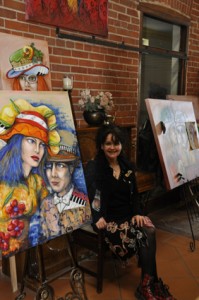
Renowned for her delicate embroideries of portraits and surrealist dream-inspired works, she has been painting vibrant contemporary characters on canvas and will present her collection at this year’s SALA Festival opening on Friday July 29.

In January this year, gloom pervaded beautiful Beltana House in Carrington St Adelaide where Cheryl lives and works and which is also an exhibition space.

 “I injured my ankle at the beginning of this year – I ripped the tendons in my ankle and split the tibular and fibular,’’ she recalls.

“It was a serious injury and I wasn’t to use it at all. I initially didn’t know what to do.’’

So she began to paint figures on canvas, adding tiny understitched embroidered masks to cover one eye of her subjects.

A retrospective of Cheryl’s embroidered and painted art will be exhibited in the Adelaide Town Hall upstairs gallery  from Thursday August 5 as part of SALA Festival.

“My work has always been dream themes which are related to music, and fun and happiness,’’ she said.

Her works will also be on show at the Innovation Science Gallery in Gays Arcade off Adelaide Arcade.

The vast space of Beltana House, with its lofty ancient exposed beam roofline, reveals a congregation of painted faces of both men and women, wearing flamboyant hats, colourful clothes –anda those embroidered masks added yet another dimension of flair.

Her home was once Pikes Brewery’s city stables and much of the renovation was carried out by society couple Lynette and Anton Schmidt.

Each room once housed Clydesdales from Pikes or later, the Police Greys are now converted rooms off the big central space, which was once the carriageway.

Cheryl’s rise to professional status began when she entered a national art competition for tourism in 1996 and titled it Billy Tin’’ and won.

“I went to England on the prize money and in 2000 I left my job teaching children art at  St Andrews School,’’ she says.

“I am now full-time a professional artist and I work seven days a week 10 hours a day.’’

 She attended the North Adelaide Art School, but is self-taught in her embroidery and clothing art.

“I began sewing as a very small child. I would visit my grandmother before I strted school. She had the big Women’s Weekly magazines and I would go through them and cut out pictures. Then I would design clothes for my dolls from the Women’s Weekly.

“I would work on my child’s hand cranked sewing machine.

“My first day at Kindy I drew everyone in the class a horse. So, it has always been playing with fabrics, drawing and making clothes.

“When I began embroidery, I didn’t realise I was embroidering, I was  simply drawing with my machine.’’

Her work is not the traditional embroidery of colouring in with zigzag.  “I would take off the foot of the machine and I used the same techniques by moving the fabric around the needle.’’

Cheryl has exhibited and taught extensively in Australia and overseas. She is the winner of the Australian Council, Qantas and Tourism Australia “Dreamtime Art Competition’’.

“We will be producing a small booklet of both exhibitions.’’

Cheryl Bridgartwill hold a “”meet and greet’’ opening of her exhibition at the Adelaide Town Hall on August 5 from Noon – 2pm until August 22.

One July day- A lesson in tolerance

It’s Saturday morning and I have hair appointment this morning at Gauci hair stylists at Mitcham and a speaking engagement for my book From France With Love at 1pm.

The beautician at Gauci is a recent arrival from New Zealand and offers me a free facial. “We have a new organic range and a beauty therapist is here this morning to demonstrate the product,’’ she says.

The idea to be glamorised for nothing for the gig at the West Beach Novita’ fund-raising afternoon tea  at 1pm is too tempting.

Soon I am perched on a stool before a softly-spoken gorgeous woman, who introduces herself as Miriam, from Iran and that she has migrated here seven months ago. Her thick accent reveals a good command of English and I am fascinated as she powders me up telling me how she and her husband Shahran decided to come to Adelaide through the Internet.

My husband is in IT and we are sponsored her by the State Government because he has a skill which is needed,’’ she said.

“I am an architect and I practiced for 6 years in Iran, but you don’t need architects here, so I studied to become a beautician and did my 12 months practical work in Iran.

We also took English lessons for two years. It took us three years to prepare to come here and to be accepted.

“When we had everything ready it took eight months and we were accepted.’’

Her husband is looking for more part-time work because he needs to fulfil the immigration requirement to work full-time for two years here in Adelaide. He now works part-time in Mt Barker as a networking engineer.

I tell her my son Tyson is in IT and that he is 30 years old.

“My husband is 36 and I have just turned 30,’’ she replies.

To keep conversation flowing to this quiet beautician, I ask her birthday and I cry out in delight when she says “June 12th, just last month’’.

“Wow! I cannot believe it. That’s the same birth date as my own son.’’

And I look at this beautiful, serene young woman, and I absorb the meaning of this exchange, the universality of humanity and I say “Welcome to Australia!’’.

It triggers her to tell more. “After the Revolution, religion came into Iran and then politics and politics has ruined my country,’’ she said.

“We are forbidden to be seen in public without a scarf and fully covered,’’ and she shakes her head in a kind of sadness.

“There is no freedom and we must have freedom to be happy.’’

Did she miss her family? “My mother phones me every two days and we talk for an hour. I miss my sister, too. But we have spent three years of our lives planning to make Australia our home.’’

It is now 7pm and we meet our friend from France, Dominique Bievre, to dine at Le Riad, a favourite Moroccan restaurant in Pulteney Street, City.

We have eaten there before and soon we have colourful  Tajine pots in front of us piping hot with chicken bubbling,  while husband orders chicken hearts and livers with couscous as an accompaniment.

A big television belts out Moroccan programme with  music and exotic girls and sexy men dancing on stage. We enjoy our time, and are about to leave when the owner exhorts us to stay because a belly-dancer is about to perform.

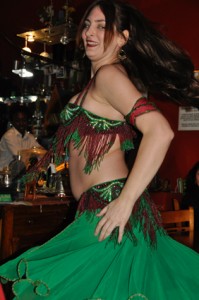
She is Australian and shakes and shimmies in her skimpy embroidered bra top and hipster skirt flowing with chiffon. She dances with a sword on her head and wriggles like a snake.  She pleases us all with her performance, but only my husband, who served in the French army in North Africa knew the custom to slip money into her skirt.

We move on and join a rowdy mob of revellers at the
Comedy Cellars to watch fledgling comedian “the old fella’’ Rodney Gregory,  make us laugh. He is a  big bloke of a certain age, from Yorke Peninsula, a former farmer who has metamorphosed into a comedian.  

However, before his turn, we sit, sip wine and watch a handful of young comedians, who are introduced with slick style by  Mickey Dee as MC.  White Anglo entertainment by 19-year-old comedian/ footballer, Amos Gill hits the spot with jokes about Cougars and the downside of footy culture, but then we cheer Ajit, a traditional Sikh, who may or not have been born in India because his Aussie accent is true blue. His head swathed in a bright orange turban and his swarthy features, black eyes, black moustache and long black beard are dead give-aways of Indian roots. He wiggles  his head in Indian style claiming “Indians really do do this,’’ he says before sending up  Indian telemarketers. He makes cracks at Aussies  who can’t spell his simple four-letter name and reckons he is sick of people calling him “towel-head’’. “This is five metres of wrapped fabric,’’ he says swirling himself down the stage to reflect his point. “Imagine five metres of towelling up there’’, he adds, pointing to his head. He cloaks racism in humour and makes us laugh at ourselves.  Tall, handsome Mahmoud, tells us he is of Egyptian origins and confidently shares that he is studying architecture at university. 

It is fun to watch these young aspirants, some of whom have  done Dave Flannigan’s 10- week comedy course, which includes a gig at Comedy Cellars. The course was also the entrée for Rod Gregory, who at 66, has us roaring with laughter at his self-depricating jokes on the downside of age. (The full story on Rod’s metamorphosis  next month.)

For now, one ordinary day has proven to be a powerful lesson in the success of multi-culturalism, in a hairdressing salon and on stage – young people from other cultures move effortlessly into Australian society and make themselves at home here.

Almost a million people arrived here in the 2000s, bring the tally of 7 million immigrants since 1945. Mirian and her husband were  accepted under the skill and family stream of the migration program which saw 171,000 migrants arrive here in 2008-09, while 13,500 refugees were admitted in the same year.

Whether an Australian girl wants to bellydance in a Moroccan restaurant, or a young Sikh wants to entertain, they are free to do it in Oz.  As Miriam, who forsake all to come here legally, said: “We came here for freedom.’’