The Cullen

They are the last three days of a dismal summer and we are in Melbourne living a lesson in style at the zany boutique hotel, The Cullen.

It is one of the new Art Series hotels, strategically placed on Commercial Road, Prahran, opposite the famous market and a block from fashionable Chapel Street.
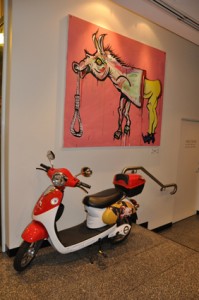
The Cullen - Reception Hall

However, the hotel itself is a delightful artful accommodation experience dedicated to works of the eccentric Australian artist,  Archibald Prize winner Adam Cullen.

His irreverent works plaster the walls of our contemporary hotel room, (those that are not mirrored) and even the frosted glass walls of the en-suite are etched with his extraordinary depiction of Phar Lap with lush eyelashes. Everything about the hotel is a statement of style.

The foyer is a riot of eccentricity with two motor scooters and two red bicycles painted with Cullen’s signature portrait of his dog, Growler. Then there are the two life-sized cows – one of which is covered in blue mosaics, the other decorated with graffiti.

Adam Cullen earned the tag “enfant terrible’’ in  art school and was already renowned as a Sydney grunge artist when he won the controversial Archibald Prize for his portrait of actor David Wenham in 2000.

He also illustrated Mark (Chopper) Reid’s book.  However, behind the bad boy image, his works have brilliant elements reminiscent of Salvador Dali.  Ours is a studio apartment slick and modern with black curtains, dark grey carpet and a grey lounge with orange soft furnishing highlights.

Ned Kelly is on one wall and on another is Lady Luck 2002 reflecting a strong social issues statement about men’s attitude towards women. It’s a fabulous artwork of a bikini-clad blonde girl winking as she sits in a champagne glass and alongside a wicked, lustful  fox/man hellbent on carnal intent!.

“I know these crushed people because I grew up noticing them,’’ says Adam in a book by Ingrid Periz in his biography Scars Last Longer.

“I feel for them, their lives are so hopeless, useless. I see them everywhere and bleeding…..I see the black humour in their stumbling lives as they just endure their package and their pretence.’’
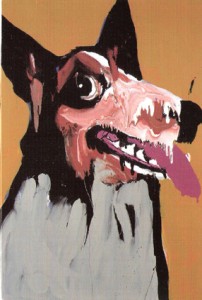
Adam Cullen's dog "Growler"

Edmund Capon director of the Art Gallery of NSW commented on Cullen’s  mid-career survey show in 2008 and wrote of his “inherent disobedience” in the catalogue foreword.
“His ogres, freaks, fantasies and weirdos are the stuff of dreams.’’

But  others describe his works as crude, distasteful and grotesque.

However, the four big Cullen prints in our room bear out  his own testament “I romance the dark side of life.’’

They also an astute social eye when he says “I think Australian men are very disappointed and disappointing. I don’t know why because we have such a great  life.’’

Yet, we are surprised at how uplifting and inspiring artworks can be, even when they are repulsive, even demonic to the eye.  They also enliven our living environment if only for three days and triggered much conversation about art and life.

“It’s a big story from a little finger”.

Monday,  January 24.

In one of the Beatles’ popular songs, there is a line “Life is what happens when you are busy making other plans’’, and this captures the terror of today.

We are sitting in another doctor’s surgery – this time, a renowned Adelaide neurosurgeon. He is the doctor who operated successfully on our friend Mary to rid her of debilitating pain.  Olivier had turned to him before Christmas to discover the cause of chronic pain in his left forefinger, which has had all the symptoms of a neuroma. The doctor had despatched him to have an MRI to determine if his finger pain is not localised to the hand where he has been treated for six years, but the spine – somewhere in the C6/C7 region where the nerves for the left forefinger originate.

We expect an “all clear’’ here because over the past month, miraculously the finger pain disappeared two or three weeks ago following physiotherapy by a renowned sports physiotherapist. Now it is reduced to nothing more than an irritating tingle, rather than the debilitating, excruciating shots of chronic pain.

However, the doctor is sombre. Saying nothing. He is reading intently a long report from the radiologist. And now he takes out the X-rays and slides them one by one up against the illuminated glass panel. The light reveals the outline of Oli’s curved spine and I see that one vertebrae is blacker than the others.  An uneasy feeling creeps across my chest.

The doctor takes his seat and looks at Olivier and says.

“There is nothing here which shows any connection to your finger pain. It has nothing to do with it.

“But these results present more questions than answers.’’

He tells him that there is evidence of metastasis of the spine in three or four vertebrae.

Of course Oli asks “What does that mean, doctor?”

“It’s a kind of spraying cancer and it has metastasised  so what we are looking at here is a secondary cancer.  There must be a primary cancer somewhere else in the body.’’

I stare at him in disbelief.  I sneak a look at Oli who catches my eye and I feel like vomiting.

“I need to find my notebook,’’ I say. “I am a journalist and I must write this down.’’

It is as if I must get the facts here in case I forget them. They won’t be real unless they take form in my shorthand scribble.

And I quickly write down T1, T3, T7, T10, T12: “T” is for “thoracic spine. And then he adds, the shocking sentence.

“What we have here is spinal tumour diagnosis.’’. The doctor is speaking in a kind, low, mellow voice.

“.. A spreading metastatic disease that has gone to the spinal bone in multiple places. Most of the spine has some involvement.’’

There is a moment of absolute stillness. I am sure I have stopped breathing. My beautiful husband has secondary bone cancer. Oli is stone-faced. Emotionless.  My body begins to shake and I fear I will be unable to stop it. Surely my very heart is trembling.  Tears well up and spill down my cheeks and I sob aloud.

“You are allowed that, too,’’ the doctor says. And, he adds, looking compassionately at me. “It’s a very big story from a little finger.’’

He lists a number of tests that Oli must have – and Oli speaks again.

“This will take time, won’t it doctor?’’

“No, this will be very quick. My staff will organise these tests within 24 hours and you should think about an oncologist if you have any preference.

“One of the tests involves a full body bone scan and the dye we inject will light up and sparkle wherever there is a cancer,’’ he continues and he  runs his fingers like I did so many years ago when singing Twinkle twinkle little star to my young children.

Tests are organised for later this evening and 8.45am tomorrow morning.

I go into the toilet, sit down on its lid and feel as if I will pass out in shock.

As my daughter would say, “Put on your big-girl bloomers, mum”.   Olivier is waiting  and speechless we walk to the car, holding hands. The sun still shines in a cloudless sky in a kind of mockery.  At the car, I take his arm and ask him how he feels.  “I feel numb,’’ he replies.  Ironically, the car is parked outside the Memorial Hospital balcony where almost 7 years ago, Oli had visited me there when I had my hysterectomy.  Memories flicker of that Saturday night up there sitting on the balcony, all sore and stitched after the operation, and remembering how he had brought into the room an Esky filled with lobster, aioli and salads and how he had opened up its lid with so much style,. And how impressed I was that he had sliced already the lobster into two halves and arranged them on two plates at home and sealed them up. And into the pervading sadness of the present, I remember a delicious moment of the past and how we devoured it all from its red shell, and drank from two crystal wine glasses some French white wine he had carried in a bag over his shoulder into that hospital.

I knew then he would be a  tour de force in my life.

So our romance evolved into a wonderful marriage and life since with Oli has been such an extraordinary adventure and a wonderful loving human experience, that this one memory brings some comfort. Yet, today, on the pavement, no more than 30 metres from that balcony,  my happiness bubble burst. My husband has lost something so precious – his health.

Feminism fails girl in the telephone box

International Women’s Day, when we celebrate the economic, political and social achievements of women, calls to mind an incident yesterday.

I had called into a supermarket close to the controversial The Parks Community Centre in Mansfield Park, one of Adelaide’s western suburbs where the Westwood inner urban housing redevelopment is transforming large tracts of public housing into privately-owned new housing.

I noticed a skinny young woman making a call in the public telephone box with a boy of about six years old hanging around outside.  When she turned around to check up on the child, I was shocked at her drawn, tense appearance. She looked unkempt with untidy long hair, black stovepipe tights and flimsy top, but it was her face which told the story of a hard life. She had few front teeth and her complexion was sallow. It was hard to imagine she was only about 30 years old.  A male partner was close by and after she had finished the call, the duo sat on the cement curb running alongside the shopping centre.  The scenario dripped with despair and disillusionment.

And I wonder today, on the 100th anniversary of the founding of  International Women’s Day, what needed to happen in this woman’s life to break out of that poverty cycle, to change her outcome to achievement, home ownership, career or vocational success and accumulation of wealth. These, by the way are the fruits of feminism wrought in our lifetime. We have lived through the days when women had to make a choice – marriage or a career – when their fortunes were tied to men – to when our female Governor-general, Quentin Bryce officially launched UN Women Australia this morning.

At one end of the equality spectrum we have much to be proud of and newspapers have been filled with congratulatory statements and praiseworthy facts and figures this week. Yes, we have a female Prime Minister, an achievement I didn’t expect to see in my lifetime. Three states have female premiers and here in South Australia, the Leader of the Opposition is Isobel Redmond.  Professional women can be found in management positions in many industries – and Heather Ridout is chief executive of the Australian Industry Group.
And even the old boy club of corporate Australia, that rock-solid male bastion, has mounted a new focus on the promotion of women into top management roles, which is beginning to bear fruit. Numbers of women on boards of the top 200 companies listed on the Australian Stock Exchange has move upwards from 8 per cent in 2009 to 11 per cent. This follows an aggressive push by the Australian Institute of Company Directors and the Business Council of Australia. But the Business Council of Australia can only boast a handful of female CEOs – Gail Kelly, who heads Westpac being a standout figure.

Federal Sex Discrimination Commissioner Elizabeth Broderick acknowledges that the prominent women at all levels of business, politics and industry are too often the exceptions rather than the rule.

In my 20-year journalistic career as a feminist writer at The Advertiser, I covered the underbelly of women’s lives as well as celebrating the  achievements of our top women by writing up women newsmakers. I always interviewed winners of the Telstra Business Woman of the Year awards each year. But my heart went out to the many victims of domestic violence who shared their troubles with readers.

Women such as the girl in the telephone box never put their hands up to be interviewed as they sense the hopelessness of their lives and suffer low self-esteem and sometimes dependency problems and mental health issues.  But I covered the issues.  Their lives are steeped in poverty and they often suffer endemic domestic violence, sometimes inter-generational, from father, male partner and even from teenage sons.  Violence within the home is certainly not confined to the poor and here we should remember the violence of high profile media personalities such as Mel Gibson and locally Matthew Newton.  Poverty and Violence remain the two vital issues in women’s lives which still need to be addressed and then we have to grapple with pay inequity (unacceptable in 2011), and be vigilant against covert discrimination against young women following paid maternity leave (our great recent achievement).  The figures that interest me most today are the ones which read that one in three women experiences physical violence after the age of 15, and that most women experience sexual violence in some form in their lifetime and that most single older women  live in poverty on the pension. The latter being the clear result of broken work patterns due to child-rearing,  discriminatory social mores and inequality during their working lives.

Education is still pivotal to improving women’s life chances and their ability to build independent lives for themselves, where they can rely on their own resources and skills whatever life dishes up in relationships and child-rearing.

But achieving equality in society is still a work in progress. So we need to reflect that 100 years have passed since that first international Women’s Day and to celebrate amazing achievements. However, I still need to write as I have for 20 years of my life, that there is still so much work to be done to for the sisterhood to enjoy true equality economically, politically and socially.

Most important, we need to reflect that all this is examining our own back yard and if we look worldwide to the discriminatory injustices that impact on women’s lives, then the task ahead is awesome.

Some days are stones-1

THURSDAY, JANUARY 20, 2011, 2pm:

A diamond day: Oli and I in Brittany in 2008 on our honeymoon.

Not a good day. I am in the doctor’s surgery with my French/Australian husband, Olivier, who has been treated for prostatitis, an infection of the prostate gland.  It has not responded to antibiotic treatment since before Christmas and here we are to find out why.  There is some beating around the bush about the need for a biopsy and an explanation of what that will entail.

“Exactly what are we searching for?’’ I ask.

“Well, I will be honest with you,’’ says the doctor. “We are now looking for a cancer.’’

“The last two blood tests have revealed an escalating blood reading – from a PSA of 65 to 70 – and it seems it is not an infection as it has not responded to medication targeted to that area. So we need to look further.’’

I feel like clutching my heart it is pounding so strongly and I sneak a look at my husband, who is intently searching the face of the doctor. (PSA is Prostate Specific Antigen.)

“Is it likely to be cancer?’’ asks Oli.

“We don’t know what we will find, but we need to explore the prostate,’’ the doctor replies

He picks up a piece of paper and draws a diagram, explaining local anaesthetics will be applied before needle biopsies are taken from sections of the enlarged prostate.

“The first time available is Friday next week (January 28) because I will be in Whyalla for the first half of the week,’’ he says.

“The biopsy result usually takes two days. You will have the results on the Monday… about 10 days time.’’

A heavy silence pervades while he gathers printed forms for Oli to sign.

Suddenly, the focus is on finding cancer in my husband’s prostate!

Surely I am sweating. I think Oli would be embarrassed if I reach out to touch his hand lying so nonchalantly on his knee. Yet, I touch him and draw my hand away again, so he knows he is not alone. Olivier is given a parcel of signed forms and tablets to be taken in eight days’ time before the procedure and afterwards.

Then we are ushered out of the rooms to face this health dilemma together.

For some reason John Denver’s song “Some Days are Diamonds, Some Days are Stones’’ flashes to mind. How could we know that there would be other days of stone  ahead.

The Essence of Personal Style

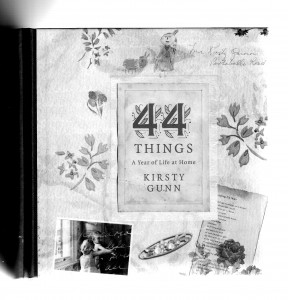
How hard it is to define one’s personal style, yet British author, Kirsty Gunn in her best-selling book 44 Things: A Year of Life at Home captures her step-mother, Irene so beautifully in the following vibrant extract.
“The woman who talks long into the nights and days, apartment and her flowers shining out around her, scarves and silvery earrings, hands that make their patterns in the air, her dancer’s gestures there, all elegance and light and grace, and everywhere she touches…Beauty.

Who’s some slim years beyond me and is who I need to see as proof that gorgeousness goes on and on and on…

….It’s you Irene. The gift, the smile, the word, the light, the tulip in the vase…’’

The author’s words too, are light and lively as she portrays Irene’s style further as “a woman stepped clear out of air and full of music, painting, and New York…’’

Published by Atlantic Books, London, 44 Things by Kirsty Gunn was first published in 2006 and celebrates the author’s home and family with a treasury of short stories, essays, poems and letters.

New Year’s Day 2011

New Year revelry

The new year begins with ham and eggs on hot, buttered muffins for breakfast at our Hindmarsh Island home before we take our friends on a tourist drive of Goolwa over the bridge from where we live.

Goolwa is a river port, the last town before the River Murray reaches the sea, and on New Year’s Day, the pretty riverside village is brimming with people.

However, the wharf is the tourist hub of Goolwa and we choose to take coffee there at Hector’s café. The large, modern cruiser, Spirit of the Coorong is moored alongside taking on supplies for its boatload of tourists, who will take the boat tour into the Coorong. The river today is choppy, the sky overcast, but

We walk along the wharf to watch the paddle steamer “Oscar W’’ steam towards us, hooting its imminent arrival.  It is the oldest steam-driven paddle steamer still in operation. They  slip on the gang plank and a stream of tourists disembark. Behind the building, a train engine chugs into the Goolwa Station to hitch onto the four old carriages of the Goolwa railway, which will take tourists to  Victor Harbour today.

We down our  drinks and drive along the shoreline to the barrage, which is news right now because it has opened its sleuth gates for the first time in eight years.

Two weeks ago we were on the water here yachting with friends from the Goolwa Regatta Yacht Club and as we approached the barrage, we could see through to the other side where a lone pelican floated by.

Today here are many more pelicans and sea wood ducks – all fishing for the schools of fish on the sea side of the barrage. Fishing is forbidden to humans for 150 metres allowing the birds to feed.

The wood ducks are feasting, disappearing momentarily under the surface of the churning waters while the pelicans simply dip their huge beaks into the sea, lift them up and the fish slides down.

We drive further along into the Coorong, a national park, where there is prolific birdlife.  Black swans outnumber the pelicans, whose numbers have diminished here because they have all flown north to Lake Eyre.  There is a lone white faced heron and seagulls galore swoop around in glee.

We drive past the sand dunes and stop the other side of the barrage to watch as the cruiser Spirit of Coorong, glides past us into the Coorong itself, a unique stretch of watery wilderness. It runs behind the Younghusband Peninsula, a sliver of land which separates it from the Southern Ocean. The whole region, the River Murray Mouth, the Lakes Albert and Alexandrina and the Coorong have been very stressed as a result of the 10 years of drought.

But today, the river flows straight through the barrage and it is a wonderful sight on this New Year’s Day as it too, brings renewal.