Mushrooming in Kuipo Forest

Sunday, March 27:
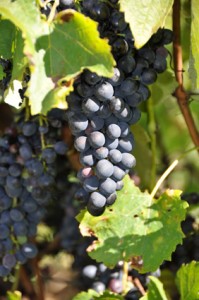
Another day of pure pleasure searching for the rare cepe mushrooms in Kuitpo Forest.

Cepe is a rare mushroom in Australia, but sells for up to 100 Euros a kilogram in France because its unique flavour is prized by the French..

Few Australians know of cepe unless they have seen the price tag in a French village marketplace.   In France, forests,where cepes grow are jealously guarded by locals.

Cepes grow in Fleurieu Peninsula pine forests, but Australians ignore these distinctive mushrooms because their yellow cap curls with age.

However, Olivier has a fetish for cepe and he finds a small  puffy mushroom on his morning  walk on Hindmarsh Island.  “Once the mushrooms pop up, we need to go to Kuitpo Forest,’’ he declares.

So, we take the Meadows Road from the Victor Harbor Road, another new route on the fascinating Fleurieu Peninsula.  Soon, we find the cellar door sign for Magpie Springs Winery Cellar Door and because I am behind the wheel, we deviate to taste its wine range.

Quelle Surprise! The vigneron here is renowned local artist, Roe Gartelmann, and her cellar door is also her gallery and art studio, with wonderful art displayed on its walls. She exhorts us to try Magpie Springs’ 2005 Pinot Noir, which she proudly says has been named equal top of the magazine Wine State’s prize list for cool region wines.
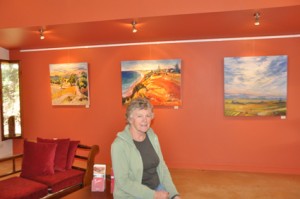
“Ours is the first winery in the Adelaide Hills Wine Region,’’ she tells us.

Wow! We live within cooee of five wine regions – Southern Fleurieu, McLaren Vale, Currency Creek, Langhorne Creek and only 20 minutes from home, is also the Adelaide Hills Wine region.

Roe Gartelman’s whole cellar door/ art gallery environment is as much an attraction as her prize-winning wine, not the least being the strange hobbit-like dwelling which acts as her cellar door/gallery/studio.

Her humble, utterly eclectic hand-built cellar door and galvanised iron studio has a veranda propped up by tree trunks and mud bricks hold together the whole eclectic gathering of recycled windows and doors.

We sample the prized Magpie Springs 2005 Pinot Noir and take our glasses into Roe’s garden and, (sheer joy) suddenly we come upon many mushrooms  as big as tea cups. They have popped up through mulch under the gumtrees and we ask to pick some.

“We don’t need to go to Kuitpo,’’ I say, hopefully. “Here they all are.’’

“They are not cepe,’’ is Monsieur’s retort.

We take our leave with a 2005 Pinot Noir,  the 2006 Merlot and three spice jars of exotic Australian native spices.
A few kilometres further on we strike Kuitpo Forest, but opposite, I spy an exotic garden surrounding the strangely-named Lazy Ballerina Winery cellar door.

Husband is not happy, to be so near his goal and diverted. But we discover this manicured garden has been restored phoenix-like following bushfire.

We take coffee to soak up the late afternoon autumn sun on the decking before departing with two bottles of Lazy Ballerina 2010 Viognier wine soruced from McLaren Vale wine region.

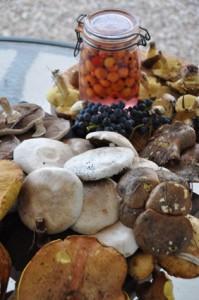
Its almost 5pm. Not surprisingly Olivier drives and his Gallic eye soon spots round yellow blobs of color from behind the wheel.  So we wend our way through the pine needles to gather two kilograms of cepe worth hundreds of dollars if sold in France.

Guess what we have for dinner?  Omelette aux cepes a la ventreche. (Recipe is on My French Kitchen blog.)

A fruitful way

There are myriad ways to bring pleasure into our lives and it helps to know that spontaneity is one element of longevity.
So, when husband Olivier suddenly suggested we take a different road home to Goolwa on the Fleurieu Peninsula, I turned right and took the unfamiliar Flagstaff Hill Road to Middleton for the first time.

This is despite the fact that we have driven past the turn-off countless times in the six months we have lived at Goolwa, always sticking to the same straight route to Goolwa from Mt Compass.

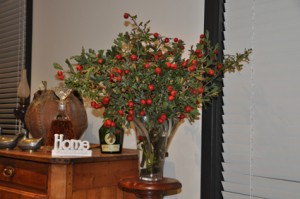
We did not know what discoveries were in store on this new road until we drove past an array of crab-apple trees on either side of the road, all laden with fruits.

The verge was a red sea of fallen berries and the thought of an innovative floral arrangement flashed into both our minds. We stopped, grabbed our clippers and like children who have discovered a forbidden apple tree, we clipped boughs of the petite red berries.

Then we strip other branches of their fruit, filling a plastic bag.

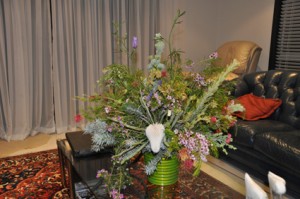
Once we were home, we indulged in pleasurable activities with our bounty.  Olivier made a vodka syrup and bottled the fruit, stewing left-overs some for dinner.  And I enjoyed arranging the boughs in my vase, setting it upon the pedestal.

Here is the floral arrangement for you to enjoy, too.

World Cancer Day

It’s World Cancer Day and there is really only one statistic to remember today:  11 million people worldwide are cancer survivors who will celebrate a birthday this year.
This good news does not negate the fact that cancer is a deadly disease, but medical technology has come up with many treatments which cure or keep it at bay. And we should celebrate this because medical research costs money and needs government funding and this is something we can actually do beyond the official message of today “Dear God, I pray for a cure for cancer’’.

Take a moment to reflect on how many people you know who have been diagnosed with a cancer. I have counted 19 relatives, friends and workmates in the last few years – and most have not passed over.

However, in the last four months,  my former husband, the father of my son,  has died of  a melanoma and I lost a male friend from pancreatic cancer. Both these cancers are deadly. Yet, of the nine  female cousins and friends who have had cancer in  the past 5 years, only one (my cousin) succumbed – to ovarian cancer – another killer cancer with a 50 per cent survival rate only.  So, cancer is a serious disease, but it is no longer the death sentence it once was.

Yesterday, we visited a girlfriend, who is having chemotherapy treatment for breast cancer and we listened as she told us how she lost her hair exactly 14 days after her first chemotherapy treatment.  Olivier told of his female hormone treatment, an implant in his stomach.

“I am having hot flushes,’’ he said flapping his hand in front of his face.

“And you never know, I might grow breasts!’’

It was a wonderful light moment and we all laughed heartily.  The irony was obvious because my girlfriend, of course, had had a mastectomy losing her right breast.

Then the date clicked.  Exactly two months ago – January 24 – husband Olivier was diagnosed with secondary spinal cancer and within days was on hormone treatment for advanced prostate cancer, the primary cancer.

The treatment is working well and we have many medical scientists to thank for years of research into an impressive array of drugs used by oncologists.  And, as Olivier’s oncologist told us, research is ongoing with a new generation of  drugs being tested in laboratories around the world.  This is the vital reason why we need World Cancer Day to make people aware of the high strike rate of cancer and highlight the need for a cure.

Beautiful native flower bowl

Did you know that the Greek goddess of flowers is Flora?  It was a recent question in SA Weekend’s Brainwaves test and I should have known it, or guessed the answer. I have been picking native flora from Hindmarsh Island to deck my house in bowls of flowers.

There is a spectacular grouping of mature shrubs which, I suspect, have been planted by Hindmarsh Island’s local community revegetation volunteers on a strip of land adjoining old post and rail cattle yards. This native garden, just down the main road, is where shrubs are flowering beautifully in March.
Splendid Banksia bushes, Native Hibiscus, Geraldton Wax and the spidery Grevillea are all in flower and soon I have an armful of cut shrubbery.  Albany woolly bush and light green new sproutings of another variety of Banksia no longer in flower provide foliage.

Voila!  Here are the two vases – one of  only Banksia in different stages of flower and the coffee table flower bower of beautiful native flowers.

I wish I could bottle the pleasure this simple act gives me – and it beautifies the home.

NOTE: Hindmarsh Island’s community planting program has been running for 10 years, the last five gathering momentum with a large band of 15-20 volunteers caring for 65,000 baby seedlings in the community nursery near the Hindmarsh Island information

“We are replanting the whole estuary in 70 locations…not just Hindmarsh Island, but Mundoo Channel too,’’ says Angela, who is dressed in green overalls.

They are propagating 70 different species, which are all natives to Hindmarsh Island.

Yesterday, Sunday, March 20, was a propagation day and 15 volunteers were busily placing seeds in tiny black plastic tubes and bundling more mature seedlings for planting.

Already the volunteers have been responsible for 250,000 native plantings.

“Environmental volunteers come from all over the world to held with plantings in the region,’’ says Angela proudly.

The Art of Living Fearlessly

Happenstance is an intangible thing. However, I find our mantra for living well with cancer in the most unlikely of places – The Cullen Hotel room where a colourful card had been left as a  welcome message.

Typically, on the outside is a signature sketch by Adam Cullen of his dog, Growler and inside is the simple message “The Art  of Living Fearlessly.’’

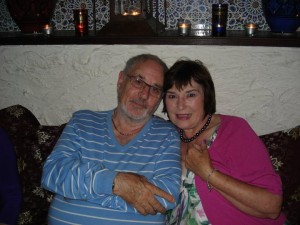
Enjoying ourselves at daughter Felicia's 40th birthday in Melbourne.

I grab the card and recognise it as the secret human element of enjoying life  as we  journey with cancer, now that husband Olivier has been diagnosed with advanced prostate cancer.

We have a handful of friends with cancer (two girlfriends currently on chemotherapy treatment and another who finished six weeks of radiotherapy last week) and so we aren’t the only ones on this somewhat uncomfortable path back to health. I think it must be something like walking with a small stone in your shoe and Gee, how you would love to take it out to make the walking more comfortable.  Cancer, however, as is the situation with Olivier, is embedded in  the souls of his shoes.

Those metastases  certainly are not, to borrow from the classic Paul Simon song, “diamonds in the soles of our shoes’’.

We find this secret message after visiting Olivier’s oncologist on Wednesday, February 15, a long 15 days after diagnosis. He is a youngish metrosexual, who wore a stylish pink striped shirt with smart, expensive cufflinks and fashion shoes. His waiting room was an extraordinary experience with big framed colourful children’s sketches and a take on one of Salvadore Dali’s well-known weird paintings.  “Doom doesn’t dwell in this room“ was the first thought as I sat down, my questions embedded in my brain.

Husband sat silently as a receptor,  but I was there  to do what I do best as a journalist, to get all the information about his future scenario. Pencil poised, I bravely asked the one question the other specialists did not answer – the survival rates for two years and five years.  (His lovely mature-aged woman GP had told us it was “unrealistic’’ to expect a cure for bone cancer.)    There was good news along with the bad.   Olivier’s “life-threatening’’ secondary stage cancer had frightened us so much, but, the skilled oncologist said he can live a lot of years if the treatment works and the cancer is kept at bay. “The survival rates for two years are excellent’’, he said. “It falls for the five year mark, but it is still around 50 per cent, perhaps more.’’

How far we have come since the despairing days of early February because this is good news to us compared with the dreadful scenarios I had conjured up in my mind.  We had time together.  Already the hormone treatment had triggered a fall in his blood levels, he had passed the first hurdle.

We visit the Cullen is in this new mood of hopefulness and we are going to adopt that art of living fearlessly.

“The best thing you can do right now,’’ the oncologist had said, “is exercise.’’

“It will do you so much good that I cannot stress it enough.’’

And I do swear, it was a much more erect, positive partner of mine who strode out of that office into our “vie quotidien’’, daily life.

HOUSE OF STICKS

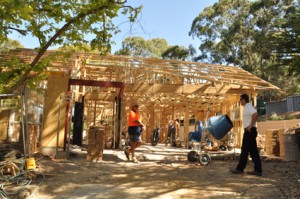
One of the great joys of life is to watch manifest all of the dreaming, planning and myriad decision-making as our new Belair home rises seemingly magically from its slab.
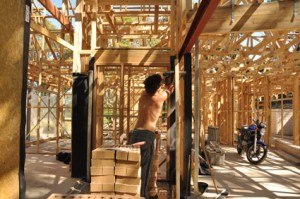
We live at Hindmarsh Island on Fleurieu Peninsula, and distance keeps us from the site, so when we come to Adelaide we dash to Belair and are thrilled at the sub-contractors’ speedy progress.

Today, instead of a grey slab, we have discovered a house of sticks at the end of our driveway with carpenters finishing off the 25 degree roofline.

Our rooms are now defined by timbers and we walk from room to room bursting with pleasure at the layout. Our house plan is the brain-child of building designer David Frazer and Olivier and I loved his initial plan the moment we saw it. Its stylish winged roofline was abandoned to bring the construction costs under budget, but we retained high ceilings and  bulkheads in the entrance hall, lounge and kitchen.

Most baby boomers, such as our neighbours on the River Murray banks opposite, are building McMansions, but our new  home is a relatively modest single storey, four-bedroom home with two bathrooms and two living areas. We each have a study and my friends need to take credit for the second bathroom, added after much pressure that a “housing product’’ of four-bedrooms needed two bathrooms.  As a former property editor (and a judge for a few years with the Master Builders Association) I should have known this, but I didn’t want to clean two bathrooms as an older woman and believed in one-bathroom, compact retirement housing.

 “It’s a dreadful planning mistake,’’ they would warn.

When I suggested we would never use the bathroom and the two-way big single bathroom was a brilliant idea, they would insist any future buyers would want two bathrooms for four bedrooms.

“Think of those teenage years,’’ they continued.

“You don’t need to use the main bathroom, but it’s there for guests and for socialising at home,’’ one would say. “I would want my own bathroom anyway when I’m 80,’’ another quipped.

So, David Frazer cleverly tucked in an en suite without increasing the roofline.

Today we can see, at last, that there is ample room for everything.

Our home offers 229sq m of living space and includes a double garage (Olivier’s old house had no garaging) and an outdoor living area all under the main roof.

For active retirees, it is going to be a wonderful living space – and it will be a “Smart House’’, wired for technology and home entertainment.

Most important,  with its high, white walls and subtle lighting for our art, it will become our unique retirement home, tailored to our lifestyle.