Omeo: A Gem of a place.
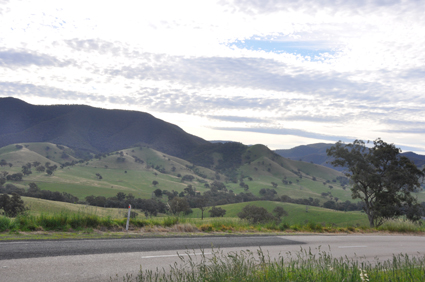
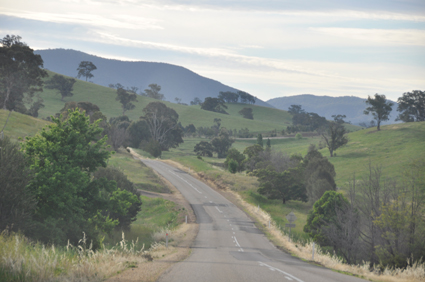
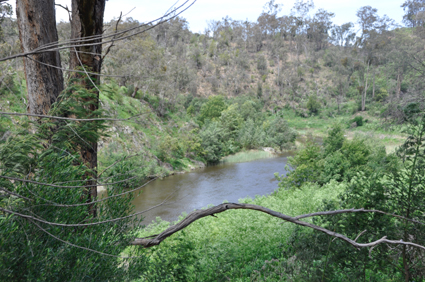
the Great alpine Road at Conner’s Lookout
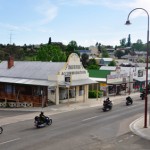
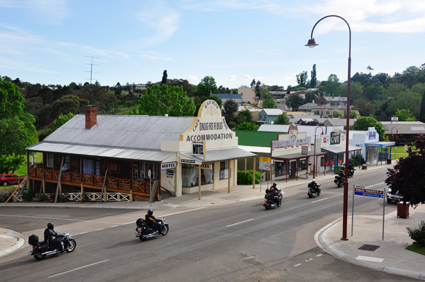
Omeo, with its grand goldrush-inspired buildings, is the idyllic mining town setting for the recent Australian film
Patrick Hughes’ Red Hill.  Not surprising.  It’s a gem of a place and  much of Omeo’s quaint 19th century hilly streetscape is an architectural timepiece, a legacy from when the town was the centre of Australia’s largest alluvial gold diggings. Its halcyon boom days, which saw the population swell to 9400 in the year 1900,  were over by the early 1920s. Luckily, those pioneering cattlemen kept a flicker of life in the town until tourism and the start of the timber industry in the 1960s turned around Omeo’s decline.

I strike up a conversation with another town character, Jim U’Ren, the volunteer manning the Country Colour and Visitor Information  Centre, who reckons Omeo isn’t quite sub-Alpine’’ at 600 metres above sea level.

It’s a very special country up  here in the mountains,’’ he says.  “We do a lot of bush walking and birdwatching.’’Jim reckons I must visit  the tourism jewel of Omeo – its Justice Precinct right across the road where the majestic red brick Court House, built in 1893 is an architectural masterpiece. It is one of five buildings, which makes up the most original and complete law and order precinct in Australia.  Alongside is the original log gaol built in 1859, which held its last prisoner in 1983 and the old Police House and horse stables (1883) as well as a large waterwheel set in the landscaped park.

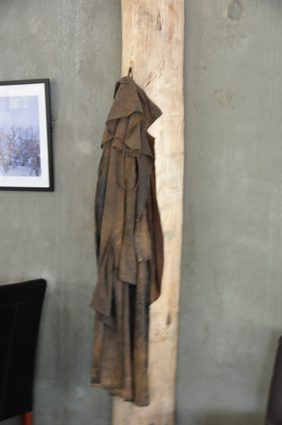
another magnificent iconic building is Omeo’s Art Deco Golden  Age Mote, rebuilt immediately following the disastrous 1939 Black Friday fire. From its wide irst floor timber balcony we regard the whole quaint streetscape. Breakfast beckons across the road at the Omeo Highplains Bakery and Café where an akubra hangs nonchalantly on a hook on the wall.  Could it have belonged to one of the  cattlemen, so much a part of the culture here, but banned from moving their cattle into the delicate Alpine region. One ponders what will become of Omeo.

Interestingly, it is probably the Great Alpine Road which will ensure Omeo remains on the tourist’s map. The last 10 kilometres of the road were sealed only in 1998 to make it the highest all-weather accessible road in Australia. Omeo is strategically placed on the route to the popular snow villages of Mt Hotham, Dinner Plain and Falls Creek. It has many interpretive signs and picturesque discovery walks for tourists’ enjoyment while Omeo’s new Oriental Claims Historic Area is a little up the road towards Cobunga where Jim lives.

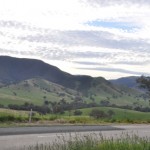
The air one breathes up here is crisp and clear with its distinct scent of pines wafting from the undulating pine-clad  hills. It’s the same undulating charm of Omeo’s streetscape. And so we turn around and take  the Great Alpine Road on an exhilarating drive to the  Gippsland Lakes region and Bairnsdale, the other end of this wonderful route. (even though we got stuck behind a convoy of horse floats). The velvety landscape is simply beautiful and changes from picturesque mountain scenery to postcard perfect gum country, grand homesteads and green, pastureland dotted with post and rail cattle yards.

We stop at the Albion Hotel in Swifts Creek for lunch because we have heard that husband and wife chefs Shannon and Tennilee Mee have won the best regional pub state winners in the I Love Food Awards 2009 following their take-over and renovation.  We tuck into their gourmet venison and red wine sausages with its light, creamy mash, accompanied by a local wine, Lightfoot & Sons Pinot Noir 2009.

Swift’s Creek boasts a daily baker, regional arts centre and a bookshop opposite the pub and we dally somewhat because Shannon reckons it’s a shame so many people drive straight through on their way to Omeo, 25 kilometres away. At Tambo Crossing, we begin to criss-cross the upper reaches of the Tambo River and it is so exciting about an hour later when we reach Swan Reach and take the Metung Road when we realise with the full, flowing Tambo alongside, that we have followed the length of the river from the mountains to Lake King in the Gippsland Lakes.

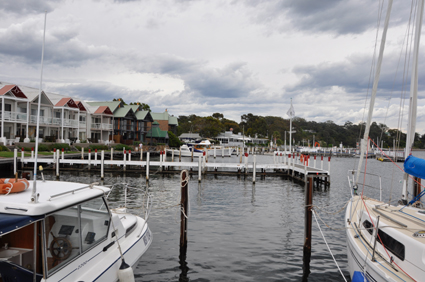
Metung is the jewel fishing village in arguably the biggest and most beautiful inland lake system in Australia. As we swing around a bend on Metung Road, the little township lies below us like a wonderful watery playground edged with a clutter of yachts and boats of all kinds on Lake King  “Oh, what a magic place!’’, I cry in delight. We board MV Corque winery/lunch cruise outside the historic Metung Hotel Bistro to experience a mere taste of the 400sqkm lakes and estuarine environment.

Skipper Geoff Mahlook takes us on a pleasurable 90-minute journey to Lakes Entrance. We are a captive audience and while we soak up the stunning waters and prolific birdlife, (sea eagles are protected here) he plies us with tastings of his Wyanga Park wines until we merrily alight for lunch at the winery itself. We glimpse the extraordinary setting of Lakes Entrance when the cruiser edges towards the estuary mouth and we could see the ocean through the break in the pencil thin peninsula.

And so, to end our extraordinary day, we return by road to Lakes Entrance and stroll along the Esplanade, past the carved
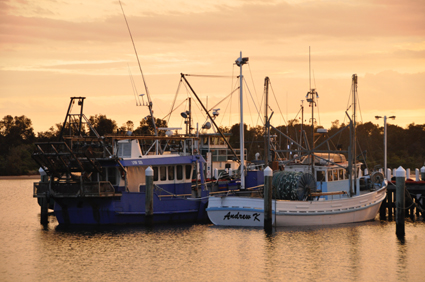
bollards depicting World War II heroes and past the moored fishing trawlers to Miriam’s restaurant where we eat a platter of fresh seafood.  Fittingly, we weary souls bed down at Chestnut Hill Country Retreat on a hillside overlooking the Tambo.

See inspiredbygippsland.com.au or www.omeoregion.co.au. Pick up a copy of 40 Inspiring Walks in Gippsland or telephone Omeo Region Visitor Information Centre 03 51591679.


Quack Quack about Le Petit Canard Restaurant in Paris

By SERENA WILLIAMS:

One of my “when I retire” fantasies is to have a native duck sanctuary cum farm.

The idea would be to create a healthy environment for native ducks and geese and any species that overpopulated the place would be for dinner.

Some people with whom I have shared this plan say: “Hypocrite! You’re only saving the species so you can eat it.”

To which I paraphrase Napoleon, who said that an army marches on its stomach. So too does an idea. Unless you can feed those who work towards it, there’s not much energy for work. And what better food is there than duck?

Duck in our family is the signature showoff dish. We eat it to celebrate, we eat it for the tryptophan and we eat it to celebrate the end of work every week. It is our special thing that is not so special that you can’t eat it regularly. When things are really special there is goose, but that is a different story.

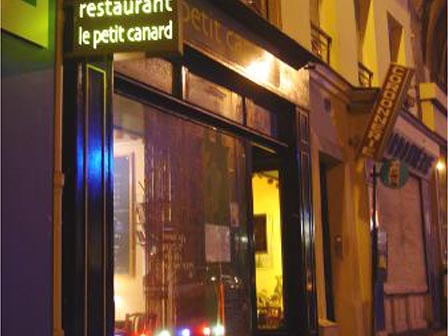
So we were collectively thrilled when I spotted Le Petit Canard, two doors down from our hotel in Pigale, Paris, on our recent farewell tour to France.

First, the restaurant uses only duck meat that the family has grown itself on its farm near the Swiss border.

A family that cares enough about eating duck to grow its own is my kind of family, even if it does speak a totally different language.

Also, in the window they have a variety of rubber ducks in different costumes, one of the best ways of keeping our three year old playing happily away while the adults got to relax.

They have kir royales, foie gras, and a plateful of different duck charcuterie. Unlike most Parisian restaurants, they have vegetables, and they’re crisp and well-cooked.

It is French farm style fare. There is no nouvelle cuisine, or nods to dieting. So don’t go with a dieting woman. Choose a friend who likes to tuck in.

Try the charcuterie plate, with six different kinds of smoked and preserved duck. Or the duck with mushrooms, which was simple but gutsy.

They don’t have a children’s menu but my nine year old was delighted to eat the pate. My seven year old ate the sausage, which was actually what we would call duck salami or mettwurst. He was grinning throughout the meal.

And for my fussy gussy three year old, who will usually not eat a dish until she’s seen it at least seven times on her mother’s plate, the chef prepared a sort of two-ingredient cassoulet – a little individual pie dish stuffed with potato and duck meat. She wolfed it down.

Pigalle is the red-light district of Paris and my dear stepfather Olivier is not overly fond of it, but for those of us who like their food, it is a solid area. Le Petit Canard has cemented in our mind that we don’t want to stay anywhere else. In fact, we’re going to do a Dame Nellie and go back there for another farewell.”


En Primeur at The Mill Middleton

Queen Rose releases her two French wines at the Fleurieu.

winemaker Rose Kentish

It could well have been in Provence, France on Sunda, May 22 at The Mill at Middleton when Ulithorne winemaker Rose Kentish presented the first tastings of two stunning new French wines she made while working at wineries in Corsica and Provence.

Rose, her artist husband Sam Harrison and their children recently returned after a nine month sojourn in France in 2010 and have  bought the historic The Mill at Middleton which doubles as an exotic cellar door and their own private home.

On Sunday,May 22 (despite dreadful weather) The Mill was filled with people  who attended the en primeur – an all-things French fun food, wine event.

However, amidst the frivolity was the serious business of the release of Rose’s two French wines – Corsus Vermentino 2010, the first vintage she made with French winemaker Jerome Girard at Vino Vecchio, recently named as one of the top Domains on Corsica. The other exciting wine – a limited release of the pale salmon-pink hued Epoch Rose 2010 was also the first vintage made by Rose and French winemaker Remy Devictor in 2010 at Domaine de la Sangliere, a second generation Domaine on the south coast of Provence, near Toulon.

Prior to her winemaking in France, Rose was McLaren Vale “Bushing Queen’ in 2008 and her Paternus 2006 was wine of the McLaren Vale Wine Show that year.

Meanwhile, Rose and Sam have returned and renovated The Mill and the event gave them an opportunity to open up the living quarters of their home, which doubled the capacity for visitors.

The white-washed walls of The Mill created a great gallery atmosphere for striking new paintings from Sam Harrison’s recent soiree in Provence while the space was scattered also with 1950s furniture and a new shipment of interesting hand selected French antiques.

Platters of French cheeses and local olives and vine grapes were placed on old French refectory tables and to add a wonderful French flavour, the family ran non-stop slide-shows of photographs of France on one of the white-washed walls.

For wine-lovers, tasting notes claim Vermentino 2010 has a “French pineapple and citrus nose’’. with big fleshy mouthfeel with a long, dry fresh acid finish.

Interestingly, the Epoch Rose 2010 (58 per cent Cinsault, 33 per cent Grenache and 9 per cent Mourvedre) was night harvested from 15-25 September 2010, de-stemmed, cooled and pressed.

Both wines sell for $34 a bottle and more information on www.ulithorne.com.au.

Staving Off Ageing:

 Yes, it’s a hellava way off, but by the year 2070 scientists expect to have found the key to slowing down the ageing process.

Scientists are slowly piecing together the ageing process at the genetic and molecular level – and it augurs well for the longevity of our grand-children.

Surprisingly many of the genes that regulate the ageing process have been found in yeast cells, fruit flies and worms.

And if that’snot mysterious enough, we  know that we are 98.5 per cent genetically similar to chimpanzees, so why do we live twice as long?  Are those the genes which lengthen our life span? Can they be manipulated?

After all, scientists have lengthened the life span of mice, rabbits, dogs, cats and monkeys and according to Dr Leonard Guarente, of MIT calorie restriction is the answer. If you feed dogs and cats, for instance, 30 per cent fewer calories, they live 30 per cent longer.

He has discovered the  gene SIR2, and says: “If the SIR2 gene is counter-acting ageing in yeast and in worms, it is doing that universally. And that would include in mammals, and that would include us.’’

two for the girls

Grey-power is Good:

71-year-old-veruschka-returns-to-modeling

Here’s a thought which is taking hold on the runways of the world. Since when have teenagers been known to buy haute couture? Well, why should teenagers with nubile bodies be used to sell high-end fashion to 40-somethings, 50-somethings and 60-somethings, the vast majority of whom have mature figures?

The penny seems to have dropped that older women are big spenders on fashion regardless of their size and grand dames may well be surpassing their younger sistuhs in becoming the fashion trendsetters of the 21st century.

A small item in Grey Matters raises this issue and provides evidence dating from last autumn’s top fashion shows when 47-year-old Elle Macpherson appeared on several catwalks, gaining world-wide media attention.

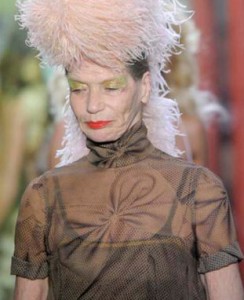
Then Juan Duyos gathered a cast of 60-somethings for his Madrid showings and evergreen supermodel Veruschka, now 71, strutted her style for Giles in London.

(I remember some time in my journalistic career seeing Veruschka on the runway and I was in awe of her ageless beauty (no surgery evident). It could only have been at the Australian Fashion Show in Melbourne many years ago because that’s the only one I ever conned my way into – not being a fashion writer, and known widely for my feminist writings.)

H&M also jumped on the wagon and included a white-haired grand dame in its video for Lanvin x H&M.

And any astute media watcher may have noticed the growing number of mature faces appearing as cover “girls’’ and our own much-admired celebrity cook Maggie Beer springs to mind.

Much more natural and endearing than the recent fashion magazine cover of Olivia Newton-John, who surely had had all her signs of age eliminated by surgery even before Photoshop.

In 50-Something magazine, I read about a Superstar of a different kind, revered foreign correspondent, Christiane Amanpour, who, at 53, showed the world how to nab the first American interview with Libyan leader Muammar Gaddafi since the country’s troubles.

The British-born Iranian has an iron-clad history covering the world’s major trouble spots including Afghanistan, Iran, Israel, the Palestinian territories and Rwanda.

Christiane reported on Twitter that Gaddafi “refused to acknowledge that any demonstrations took place in the streets of Tripoli,’’ and it was to Amanpour that he reckoned that “all my people love me. They would die to protect me’’.

 It was the second interview coup for Christiane during the Middle East uprisings because she was also the first to interview then-Egyptian president, Hosni Muburak.

And she has also interviewed the other controversial leaders including Iranian president Mahmoud Ahmadinejad and the late Palestian leader Yasser Arafat.
It begs the question Why do Australia’s media moguls place an age limit on women as interviewers for television news and current affairs programs?

 PS; I did get into trouble for attending those fashion showings, though. I was on holiday and not accredited. Nor was I dressed for the event and merely flashed my Advertiser nametag. On reflection, it was outrageous, but I scored front-row seats for my Sydney friend and myself which was not appreciated by some renowned fashion writers. I was reported and the editor dressed me down when I returned from holiday. The experience was worth it, though.

Celebs and Culture – May 2011

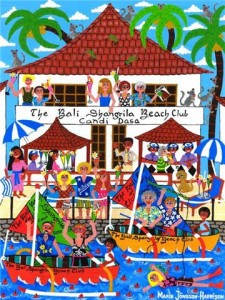
Congratulations to gifted Adelaide naive artist, Marie Jonsson-Harrison, whose work will be shown  at the prestigious 4th World Festival of Art Naif Katowice (Naive Art Exhibition) in Poland.

Marie and husband Bryan were invited to attend the prestigious event in the SZYB WILSON Gallery in the Katowice region of Poland on Friday, June 17,  but were unable to attend because of house renovations.

She has submitted three artworks – Snax Attack at Hungry Jack’s, a handmade ceramic and mosaic; Hide and Seek and La de da Shangrila,  both acrylic on board.

Artists must be invited to submit works and it has become the most important rendez-vous of all Niave artists in the world.

In all 2000sqm of space will be available in the SZYB Wilson Gallery and each artist has 2.5 metres of space. The exhibition will open on Friday, June 17 until Sunday August 14, 2011 and is organised by FIVAN, a French non-profit association and the SZYB Wilson Gallery. It is designed to promote naïve art and to sell paintings in a festive atmosphere.

Marie is an award-winning naïve artist, whose works feature regularly in Russell Starke’s Greenhill Galleries as well as selected regional galleries- and continuing to supply Japan and America. Her former home-town of Balaklava is decorated with her artworks at the entry to the town, outside the library and on park benches. 

….

Take a pew at popular Lucia’s Pizza and Restaurant in the western mall of the Adelaide Centre Market and Adelaide’s beautiful people are bound to pass or call in.

And on Tuesday, ever-gracious Lady Hardy, (once top model Joan McInnes) took a seat, ordered spaghetti (as one does) and sipped red wine while reading The Advertiser.

The stylish wife of  Sir James, wine icon and former Olympian returns from Sydney to live in Adelaide for some months each year and says she remains a South Australian soul.

I have interviewed Lady Hardy through the years – when she turned 50 when we talked about the pros and cons of HRT and again when she turned 60, she and Sir James were the cover story for the Looking Forward supplement.

This week at Lucia’s, she happily confides that she is now 65 (and looks 15 years younger) and in a catch-up conversation she says she does not bother with Facebook.

“I have many friends that I care about and I spend my energies on them. I don’t need Facebook to clutter my life,’’ she says.

Lady Hardy, who likes people she knows to call her Joan, should bottle her secret for how to age successfully. Not only has she remained glamorous, but she looks the picture of health and contentment, bubbling about her artistic project, which remains under wraps for the moment.  (Journalists must keep confidentialities.)

Another high profile South Australian, viticulturist Prue Henschke from the famous Barossa Valley Henschke’s wine label, has won the environment category at the InStyle and Audi Women of Style presentations in Sydney this week (May 11).

She has restored the landscape at her property and is working towards organic certification.

“Prue’s methods and dedication to creating a better environment make her a true ambassador of style,’’ said InStyle editor Kerrie McCallum.

It seems only yesterday that Prue invited me to be her guest at the 25th anniversary of Women in Wine. Along with other women winemakers, she hosted a table of 9 women and we shared a Henschke’s Hill of Grace red wine from the family’s museum collection.  I cannot remember the grape variety, but I remember thinking at the time it was the smoothest, most delightful red I had tasted.

On quite another bent, it’s hard to feel sympathy for former Royal Duchess of York, Sarah Ferguson who says she was hurt when she was snubbed for the recent Royal Wedding of Catherine Middleton and Prince William.

Of her list of misdemeanors over the years, the most embarrassing for the Royal Family happened only last year when  she offered an undercover reporter access to her ex-husband Andrew, Duke of York, for a $750,000 fee.

She told Oprah Winfrey on her US television chat show that “It was difficult’’ to cope with not being invited. But she added that Prince Andrew, who accompanied their daughters, Beatrice, 22, and Eugenie, 21 to the wedding, kept her linked by talking to her on the telephone that day.

“I wanted to be there with my girls and to be getting them dressed and to go as a family,’’ said the 51-year-old.

“And it was also hard because the last bride up that aisle was me.’’ (She married at the Abbey in 1986 and was in Thailand when the wedding took place.)

However, she also was philosophical and took responsibility when she said: “I felt that I ostracised myself by my behaviour, by the past, by living with all the regrets of my mistakes.’’