Spring breaks through winter of grief
My springtime garden is a picture of blooming flowers and the sun shines warmly to welcome an idyllic day.   I can appreciate such beauty now, but six months ago to this day, another Friday,  my beloved husband, Olivier Foubert slipped quietly from this life losing his 16-month battle with advanced prostate cancer.

His death plunged me into despair. I had lost my “lovely Frenchman’’, the hero of my memoir From France With Love,  and our wonderful married life, which was cut short cruelly after only four years.   Life became one black cloud of excruciating grief.

There we were cruising along a honey-laden highway of a later life of travel,  planning our new retirement home and enjoying a seachange at Hindmarsh Island.  But, it was the Beatles  who sang that “life is what happens when you’re busy making other plans’’ and in a moment, in January 2011, Olivier  was diagnosed with terminal cancer. We were heartbroken.   Our retirement dreams were crushed.  The foundations of our new home were still drying out.  Chemotherapy over the months helped and we moved into our new home and established our garden together.

All too soon I was alone for the first time in my life and consumed with sadness and uncontrollable weeping.  I hovered between the need for friends and family to support me and the need for solitude to grieve.  I did not eat and I could not face shopping  in supermarkets.  Bed was my refuge and the hardest thing was to get out of it each morning.

Depression sank its teeth into my heart but somehow I  groped along the grieving path until a new grand-daughter, Scarlett arrived to bring joy.   Recovery from grief is a work in progress and could take years to find that joie de vivre again.   One positive move was attending a 10-week grief support group and counsellor Faye,  helped us struggle together to face awesome feelings of fear, powerlessness and rage.

We received guidance to live with loss.  It isn’t only the loss of a loving partner, but also a lifestyle.    I felt deeply the loss of my identity as a wife and partner and I needed to re-construct a new self.

So I looked for new things to do and outward towards community.   I copied Olivier, an avid reader and began read in bed at nights, then mornings, too.  I began visiting the library, joined a book club and accepted every invitation. But the nights were long and lonely.

I began walking our puppy Oscar once more and on Saturdays when I ate breakfast at the local cafe  he would attract attention.   My children organised weekend family events and I followed Olivier’s footsteps into our garden planting and pottering, watering and weeding.   Friends brought plants to help.  I took over Olivier’s role selecting music, buying wine and taking photographs for my website www.nadinewilliams.com.au.

Ritual has healing power, too.  I still arrange flowers for the house;  I still learn French and I still write. Recently I resumed my charity work.  It is not such a struggle now to fend off sadness and I sense a new life is taking shape.


Pink heralds pretty Spring garden

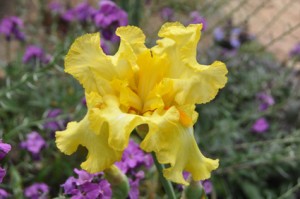
First new iris in the garden

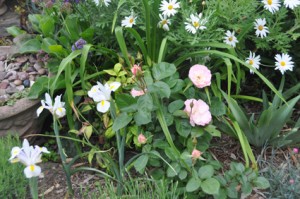
My new garden is a picture of pink blooms in its first Spring.  Pink roses flower prolifically, countless pink field carnations, chorus-like, nod in the wind and a border of pink daisies form a splash of colour against the pittosporum hedge.   I pinch myself each morning that somehow 12 months after this plot of land was a building site, today I see such a pretty scene. It reflects  why our home is named “Belle Vue”.

The new wisteria heralded the first stirrings of warm weather with its gorgeous display of racemes of pea flowers in lilac followed by sprays of lime-green leaves and colourful pansies – planted in the cold earth of winter have been bobbing their bright little faces around the perimeter of the lawn since.

Now  something new and exciting has happened to add to my joy.  The frilly irises are bursting into flower and this morning I pick the first – a frilly yellow iris, with two other exotics – an ice blue iris and a splendid orange specimen – about to flower tomorrow. These are the first of a dozen catalogue irises given by my friend Gwen. Back in the depths of winter when I planted them, I never imagined they would flower this season.  Watching them come into flower was a delight.

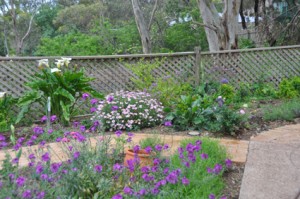
Beautiful borders of lavender await a few more warm days  and I have begun to focus on expanding the herb garden and experimenting with tomatoes dotted amongst the flowers. It seems I am metamorphosing into a serious gardener.

Of course, I am driven by the desire to create a memorial garden for my late husband Olivier, who had natural green thumbs and who loved his garden passionately.   Before he died, we established the “bones’’ of our garden – the pathways, paving, retaining walls, dripper system and steps.  The initial plantings were the landscape designer’s plan who left plenty of space for our selection of roses, irises and other favourite cottage garden plants.

However, my inspiration has been also driven by a new-found friend and prolific gardener Jan Whitford and our mutual friend, Jayne McLaren, who have both held my hand in case I fainted at the awesome prospect which lies ahead of me.  Both women have established beautiful gardens and have descended upon the garden with many tools, herbs and quick-growing ground-covers for a working bee.

“I can sense you have the makings of a gardener,’’ says Jan, with her arms full of baby spinach, rocket and salad leaves, oregano and sage.

It had me reflecting on my past, when I have indeed established a beautiful rose garden and landscaped grounds elsewhere in Belair  and after that I restored my mother’s garden in Broadview in Adelaide’s inner suburbs when I bought the family home in 2000.   However, those were the days of full-time paid work and competent hired gardeners did the hard yakka. In my new reality, there is me and my enthusiastic friends who are there to help.

Roses and irises in my garden

Unexpectedly, also, the Open Garden Scheme has become an inspiration as I visit the gardens open on the weekends in Adelaide. Elsewhere I will show photographs of these gardens, which include the water-efficient garden of Nancy, my neighbour across the road.

But first, here is my beautiful garden in Spring.

Powerful Message of Peace Within

It was eerie déjà vu and I could hardly believe the words my friend was uttering at the end of the telephone.

She was describing a painting she had bought many years ago of a magnificent horse standing on the top of a hill and underneath were the words “Be Still And Know That I Am God.’’

“I had been very ill in hospital and had been discharged when I bought the painting,’’ she recalled.

“But it is the words which are indelibly etched in my mind, more so than the image. They were the ideal words I needed at that time to cope,’’ she added.

And I gasped at her words because today is the second time in my life I have been told these words and I know they tell me how I must conduct my difficult life right now.

It is a text from the Bible and even after its profound impact on my wellbeing, I cannot quote the book, chapter and verse where it is written. However, now it triggers a powerful flashback and I can once more see myself sitting in a church pew with my adult children about eight months after my mother had died. It was about 15 years ago. Suddenly, the voice of the pastor faded and I heard my mother’s distinctive voice call to me “Nadine,’’ she said. “Why do you worry so much? You must remember God’s words – Be Still and Know That I Am God’’.

Only a mother, now in a spiritual state, would have had the wisdom those years ago to see that her daughter’s life was spinning out of control with busyness and stress. And that these words were the most apt to guide me back to a stable state of mind.  At that time, my daughter, who was sitting two seats up from me, sensed something had happened and leant forward in front of my son, looking at me strangely. It was a sudden move which broke the trance I seemed to be in. Then once more, in an instant, I was simply sitting on the wooden pew and my mother’s presence was gone. Nor has she ever returned to me.

Until today, when my friend Vanessa, unbeknown to her, brought the same message at a time when I am once more in a similar highly stressed state. Lost, bewildered, confused, fearful, vulnerable. All these words describe how I feel today grappling with emotional turmoil.  Of course, this wise guidance, once more, is from my mother, from beyond the grave, using another human being to impart her message.  “Be Still and Know That I Am God’’. Whyever did I forget it? Once more it is imprinted on my mind.


CREATIVITY CREATES SUCCESS AND MONEY AFTER RETIREMENT

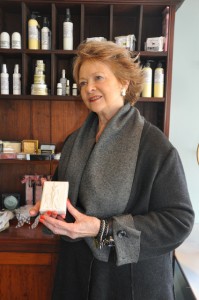
Kaye Quinn and her exotic soaps

They call him the stick dresser  and her a soap maker, but Doug Storton and Kaye Quinn reflect how a growing number of people find artistic success once they retire.  Doug’s shepherd crooks and Kaye’s hand-crafted soaps are among  an exciting gathering of works by South Australian designers and craftspeople at the new Studio D, which opened last month at Verdun.

Rams horns, deer antlers and selected timbers  are used by Doug  Storton to fashions his range of formal dress and country sticks.

“My grandfather was a Yorkshireman and when I was a child he used to make shepherds crooks because we needed them as a tool of work to capture the sheep,’’ says Mr Storton, 75, who came to Australia in 1976.

Doug was a stud groom in his working life in charge of breeding thoroughbred horses in the Barossa Valley.

About 22 years ago,, he picked up his childhood skill as a hobby and after he retired 10 years ago, it became his retirement passion. Demand quickly drove supply and he began numbering his unique crooks two years ago.

He says the Barossa Valley is a source of wonderful selected timbers such as olive, ash, almond and lillypilly. However, the handles are made from a variety of horns from rams, buffalo and cattle.

“I craft them from anything that is waste… olive tree branches,  for instance,  and I keep my eye open for anything that people don’t want,’’ he says.

What triggered him to pick up his skill?   “I got fed up with buying my grand-daughter cattle shell canes. They were $90 each and she broke three in the first week at the Royal Show.’’

One of his prestigious works was  the ceremonial mace for the Barons of the Barossa and one of his unique Shepherd crooks with a ram’s horn costs $350.00, which he says reflects the time it takes to mould the ram’s horn.

Kaye Quinn “I dream that I will become financial independent again through my art.

was a medical receptionist for a group of oncologists before she retired last year when she soon took a WEA course on making soaps.

“I am 71 and I still have ability and creativity, and I began to dream that I could become financially independent again through my art soaps, ’’ says Kaye.

Home-based, she jokes how her home has become a “veritable soap factory’’.

She relates how during her course in soap-making, she discovered that caustic soda was used and became alarmed when the students had to leave the because of the fumes.


“I decided that I wanted to make premium grade purest soap which is good for our skin.

“My biggest passion is to produce a product that doesn’t have any  nasty ingredients and there are

no sulphates in my products.’’

Kaye began a “protracted exercise’’ seeking  out the most exotic moulds from around the world.

“I have searched for two years for my hand-made range made from  what I think is the best premium grade ingredients.

“These soaps are works of art made from exclusive American moulds.’’

Her art soaps are made from vegetable bases and glycerine.  “I need to choose the colours and the perfumes and added ingredients such as essential oils. It may take me six efforts before I am happy with each design for the 3D soaps.’’

“People say to use these soaps are too good to use, but you need to pamper yourself;  it’s the little luxuries in life that can help create a sense of serenity.’’

“Now my home has become a veritable soap factory:  I dream that I will become financial independent again through my art.’’

Kaye’s soaps range from $9.00 made with olive oil, goats milk, honey through to the exotics and limited art soaps.

Studio D, on Onkaparinga Valley Road, Verdun, is open Wednesday to Sunday and features a changing range of professional designer homewares and objets d’art.

Tutti Kids “beautiful” performers

Tutti Kids at Novita


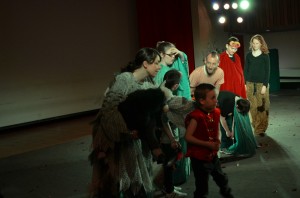
It was a charming event entitled “Beautiful Me, Beautiful Us Caberet when Tutti Kids, children with intellectual disabilities performed at Novita Theatre, Regency Park recently.

I had seen Hot Tutti perform a few times at public events and Olivier and I had heard them sing at a private Australia Day event back in January.   When my dear husband died in May, I had asked the artistic director, Pat Rix, if Hot Tutti could sing Edith Piaf’s Je Ne Regrette Rien at husband Olivier’s funeral. The girls only had four days to learn and rehearse the tune, but on that sad day in May, they sang so beautifully and every person in the huge congregation was surely touched.  I wanted to thankpersonally  the threee girls – Aimee Cratheren, Annika Hooper and Michelle Hall. (Caroline Hardy could not attend).

Beautiful Me, Beautiful Us began with a community tea in the foyer of the theatre – a large facility for physically disabled children, where I had worked for seven years of my life.  The foyer overflowed with family groups unpacking their food boxes and my friend Jenny and I sat and watched the unfolding cameraderie of a group of parents, who all had a child with an intellectual disability.  The children were like any Sunday School picnic as they played and made much noise with their siblings around their parents.  It was a joyful scenario and the only difference was that many of them had Downs Syndrome.

Soon we went into the theatre and Tutti Kids, which began in 2006, took to the stage performing in small and large groups of children under the watchful eye in centre front row  of their patron, local film-maker -Scott Hicks and members of the Tutti board, headed by John Scales. It was a charming, joyful, colourful performance of children aged from five years through to teenagers. My friend and I were enthralled and clapped as enthusiastically as the smiling, proud parents behind us.

Hot Tutti, the world’s first Alt-pop girls group of intellectually disabled singers,  also  performed and afterwards I thanked each young woman – as they are now all over 18 years of age – for so spontaneously agreeing to honour Olivier and how their performance touched everyone’s heart.

They are amazing artists who have emerged from the Tutti Choir and have been working together since March 2011. They co-write and arrange their songs and sing with passion. Importantly, they have been blessed with beautiful voices.

Since 2006, Tutti’s talented artisic director Pat Rix has expanded from three children to seven groups with a maximum capacity of 42 children. Each group meets once a week and thrives under the expert tutoring of four professional artist/teachers.

Apart from developing the children’s artistic and performing skills, the feedback from parents, particiants and teachers is so positive about the difference Tutti Kids makes to the children’s listesning and social skills, literacy levels and self-confidence.


s.  06re Much fun and dheiMy friend Jenny and I attended  =-

Prevention a Focus for New Cancer Centre

Prof Graeme Young

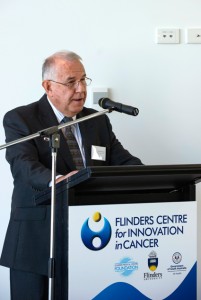
About half of all cancers are caused by lifestyle factors and behavioural change strategies could save lives,   says South Australia’s Minister for Health and Ageing, John Hill.

He was speaking at the opening of the new  $29 million Flinders Centre for Innovation in Cancer, based at Flinders University Campus, which will be dedicated to discovering how to save lives through cancer prevention in a bid to relieve the heavy burden of cancer on the community.

“Prevention is much better than cure and so many times with cancer, we don’t have the cure,’’ he said.

“There is reasonable amount of evidence that diet can play a preventative factor on colorectal cancer whereas other cancers the evidence isn’t as strong in the role of diet.’’

The new world-class centre would focus on preventative strategies, particularly for oesophageal, colorectal and prostate cancers as well as conducting clinical trials on cancer treatments..

Bowel cancer has the second-highest death rate.

For FCIC’s president of the governing council, Professor Graeme Young, the opening of the centre represented the 10-year-long dream of building a “flagship ‘’ prevention unit.

“The establishment of this unit secures cancer prevention as the key platform at the FCIC,’’ he said.

“Cancer doesn’t develop overnight; it usually develops slowly over a number of years which gives us a window of opportunity to cure it.’’

Prostate cancer expert, Professor Ross McKinnon has been appointed head of the FCIC and other important appointments include Professor Pam Wykes, Professor of Preventative Cancer Biology and Professor Carlene Wilson, Professor of Cancer Prevention through behavioural approaches.

Professor Young, a renowned gastroenterologist,  said the centre would bring together laboratory scientists, public health researchers to examine public screening strategies and behavioural scientists as well as clinical trial nurses to examine surgical oncology outcomes and treatment analysis.

The Australian Cancer Research Foundation Cancer Prevention Unit, which is made up of  Australia’s most famous scientists, provided substantial funding for the FCIC, while the Flinders Medical Centre Foundation and the State Government also provided funds. About $8 million was provided from private donations.

ACRF chair of the board, Mr Tom Dery said money raised by the foundation for “fundamental sciences in treatment and prevention programs’’ had already saved many lives.

“The five-year survival rates for cancer has risen from 47 per cent to 66 per cent in 20 years,’’ said Mr Dery.

“They are terrific statistics, but we still have a long way to go. We are only 66 per cent we need to be 100 per cent.”

The FCIC incorporates the ACRF Cancer Prevention Unit, the LIVESTRONG Cancer Research Centre and a cancer treatment centre. The stylish building

was designed by Woodhead Architects and built by Hindmarsh and project manager was Lyn Travar.