Kookaburra’s special song
Kookabura’s first visit

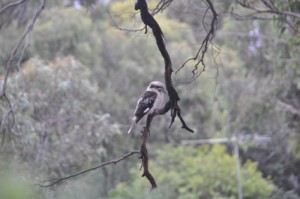
Remember the childhood song “Kookaburra sits on the Old Gum Tree…Merry, Merry King of the Bush is He….’’. The words flooded back this week when a kookaburra descended upon the gums surrounding the new garden and sat on a low-hanging dead branch. The interest in this snippet is that in the eight years I have stayed at Belair and the last five years when I have lived here, we have not seen a kookaburra close-up.

There are plenty so high in the trees it’s almost impossible to spot them and they laugh their merry heads off.  Their chorus is a part of the cabaret of birdsong in Belair.   Yet for the past three days, the kookaburra sat upon another branch of the same tree for some time before flying to the new garden fence, no more than three metres from the house. I snapped the beautiful bird so many times and took meat out to feed it, but it kept its distance.

It so happened, that the first time I saw this magnificent bird on the dead branch, former Adelaidean, Sue Mapp, who once ran the Variety Club in Adelaide when she was Sue Fraser, was attending the Wicked Women media members’ Christmas lunch here (see Life and Style by Nadine Williams).  Sue wasn’t at all surprised by the visit. “In my  Sydney home,  a kookaburra comes to my feet to eat the meat I drop there, but it won’t let me touch it,’’ she said.

What interests me now in reflection, is that this bird did not cackle or laugh at all, unlike the song which says …”Laugh Kookaburra, laugh Kookaburra, Gay your Life Must Be.’’  Instead, it sat silently for 10 minutes each time on its selected branch and this morning it rested for five minutes on the fence post.  It fascinated me and I share that photograph with you.
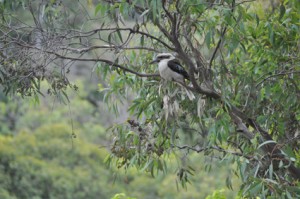
Kookaburra on the old gum tree

DAY FOUR:  Goodness! The kookaburra has returned this morning and this time only momentarily sitting on his favourite branch until it swooped towards the window where I sat and swept up over the roofline.  He returned a few minutes later, and this time, his cackling cry aroused me from my meditation to watch him laughing merrily.

My mind is filled with thoughts about that kookaburra’s visit – four days in a row – the foremost one being to remind me to laugh more and to be gay and that life is such a gift to enjoy such moments.

However, I also remember the special relationship Olivier had with “Eric’’, the frog-mouthed owl and here I take an excerpt from my memoir From France With Love.

I was writing about Olivier’s collection of beautiful and fascinating objects.

“He never had his own room in childhood but he has certainly made up for it since. An array of precious objects sit on the windowsill in his study. The room stays under the watchful eye of “Eric”” a stuffed tawny frogmouth owl that was once Olivier’s pet. He saved the bird as a chick and it happily cohabited at Belair well into its adulthood. “We think Eric simply died of a broken heart,’’  he told me later. “He was left alone in the house nd the children called in  to feed him each day on a roster system. Then one day he was dead. The children put him in the freezer and when I got home I had him stuffed. I loved Eric. He had lived his life on my shoulder.’’


Wark’s Wonderful World of Words


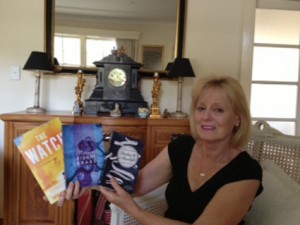
Marguerite Wark with her prize-winning books

Lyceum Club senior-vice-president, Marguerite Wark has won a special prize in the Writers’ Week competition and shares her delightful words with us.

“Writers’ Week – my favourite week in the year – when authors give insight into their raison d’etre , friends gather in the gardens to listen and  discuss ideas put forward by  highly articulate members of our community, a time for setting aside the daily lifestyle and immersing oneself into a world of words. Words not just written but spoken aloud amongst  treed lawns where birds chirp and flutter and the water of the River Torrens runs by not far away.

There is a strong sense that this is a continuing flow of the essential nature of people’s  lives in times past  – times when storytellers gathered to pass on their insights and wisdom in songs or poems around a campfire to an audience who  longed for their lives to be touched by their words.

Now is the waiting time – the time before the gathering together – when my thoughts turn to planning so that I can also be one with this community, who thrive in the prescence of language and the authors or storytellers.

I anticipate greedily the sensual delight of words written and spoken, thought about, discussed, savoured, reacted to: words that annoy, are argued with, played with, joked about. I wonder at that sensual fascination we have with the beautiful turn of phrase, the lyrical , the incantational , the rhythmic patterns, but most of all , I wonder at the enduring ability of words to define our thoughts and feelings and tell our stories.

Gathering together for all of this is the most important thing about Writers’ week to me.”

Marguerite won three books – The Watch by Joydeep Roy-Bhattacharya – who will appear in Writers’ Week 2013, Ossuaries   by Dionne Brand and Reading By Moonlight by Brenda Walker – both of whom appeared in writers’ week 2012.

The “old bugger” meets the new babies

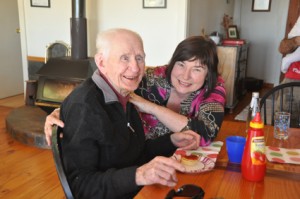
Father Frank and I on his 94th birthdayt

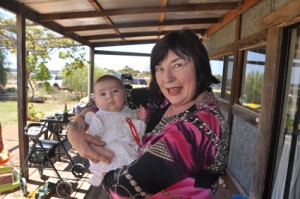
It is hard to determine who is the more fragile – my father Frank, who turned 94 a few weeks ago, or his new great-grand-daughter, Scarlett Rose Williams, who has been placed carefully into his frail arms.   He carries all the signs of a grand age -a face scrunched with wrinkles, balding grey hair and a body failing him and in contrast, the baby girl in his lap is lovely and new, with perfect complexion and the fuzz of new-born hair on her head.   Sixteen of us have come in a convoy of cars from Adelaide to celebrate his birthday at a renovated woolshed at Lyrup in the Riverland, a few kilometres from the residential care facility at Renmark where Frank is in high care. He is to meet the two new fourth generation babies to add his tally of great-grandchildren to six.

We hand Theo and Scarlett aged five months and three months respectively to the old man.  He gushes all the right platitudes, but he has not understood there are two, not just one.

“Tyson’s baby, I can’t believe it; how old are you now m’boy?’’ he says.  ‘We have little Theo, Jason’s little boy, here too,’’ we say, but the explanation is lost. “She is a beauty, isn’t she.  Just like your mother, Florrie,” he says of Theo, addressing no-one in particular. We don’t correct him, but let him slip into the familiar tale of how he met our mother when she was working in the Land Army at Renmark during the War.

We all know every word and it is as if his history is within a long tape-recorder in his brain and we will listen intently until he has said every single word of the story of their romance.

“Florrie was a real beauty,” he repeats and becomes emotional.

Dad is a living miracle for his age as he takes no medication other than pain-killers for his “dicky hip”, but my sister Anne and I can see that Frank, who lives in residential care at Renmark, has deteriorated in the past 12 months.

He had greeted us as he always does, bragging about his age. “I’m an old bugger,’’ he said. (He loves to repeat that phrase of former Prime Minister Bob Hawke minus the “silly’’).

“I’m 94 years old, you know, but I am still healthy and happy.’’ And he smiles up at us all from his deck chair. Dad has always been blessed with a happy disposition and although he is blind and cannot hear, he somehow recognises us all in his excitable modus operandi.

But his body is giving up and for the first time since he entered residential care three years ago, he now needs a walking frame. Always a wiry Englishman, no taller than five foot three inches in his youth, now he is as thin as a whippet and his tiny frame slumps into itself in the deck chair.

My heart skips a beat observing him and noticing the fact that after all these years with his nose in a newspaper, now he does not read anymore, even with his magnifying glass.

Scarlett and I at the woolshed

And despite all of the above, we sisters silently note that he is also illusionary at times and we suspect dad is beginning to suffer early stages of dementia.

Yet, there is no doubt there is longevity in our family. His aunt, my great-aunt Edith lived to 100 years and five months. And Frank’s only sister, Lilian turns 91 this month – and she is as bright as a button mentally, but also in a walking frame.

With these positive thoughts, we gather around the long refectory table for dad’s party, cocktail pies and pasties and a big cake I have cooked. Dad’s eyes. robbed of sight by glaucoma, light up like beacons as he pours tomato sauce over the top of a small pie.

It occurs to me that in his dotage, dad is still able to enjoy his place as head of his large extended family, four generations of children, 13 grand-children and six grand-children.


Oscar survives another misadventure

Oscar safe home again

Pretty puppy pooch, Oscar. has had another dramatic event which had him screaming  for his life.

My dear friend, Sheryl, dog-sits Oscar often because she has two doggies of her own – an old shi tsu terrier cross and a 14-month-old pomeronian – two months older than my little poodle/shi tsu cross. The two young dogs love each other and romp like lambs the whole time Sheryl cares for them.

This day she had said her daughter’s dog was  also staying, but he supposedly was a gentle giant of a dog and when I asked,she replied “ yes”, she could handle four dogs.

However, as Sheryl unlocked the screen door of her home one huge Rottweiler lunged at Oscar, who was contained on his lead, and the sequence of events thereafter are a terrifying blur. Sheryl  scooped up the screaming Oscar virtually  from the jaws of his predator and held him above her head.

“Give him to me!’’ I shout. And I am also losing my cool. I call out again. But Rottweiler jumps up on Sheryl’s chest and with his huge paw, scratches her arm trying to reach my terrified pet. Now Sheryl  is screaming to the vicious hound to get down and I grab Oscar from her hands  and run to the living room. Sheryl pushes Rottweiler to the floor, grabs him by his collar and brusquely takes him outside – locking the doggie door so the small dogs cannot get out.

Not that Oscar was going anywhere.  He was severely shocked. We sat him on a cushion on the couch and he did not move for half an hour.  Chloe, the sweet Pomeronian with her long black silky coat and perky brown face, kept licking Oscar to try and get him to revert to his usual playful mood.  But he, who usually spends his time trying to bonk Chloe, was having none of her persuasion. He sat mute.

Sheryl and I devoured a stiff drink to restore our equilibrium and after an hour of discussion relating events, surmising what might have been and recalling all the latest doggie-attack stories from the media, I had relaxed sufficiently. That dog, glaring at us through the glass double doors, would have devoured by darling doggie.

There was no option, but to  pick up my little bundle, still quivering in the way of his breed, and take Oscar home once more.

The message of this story is simple. This event reflects why dogs must be restrained on public beaches and at other places, too, because there was no warning this Rottweiler would turn vicious and it brought no comfort to surmise that he thought this tiny dog was a white rat.  It could have been someone’s child on a public beach – and Sheryl certainly warned her daughter that this dog cannot be taken into public places unless on a leash. Because it is the owner’s responsibility to keep the dog contained and the owner is responsible for any harm done by their pet..


Oz film industry created our own heroes – Jack Thompson

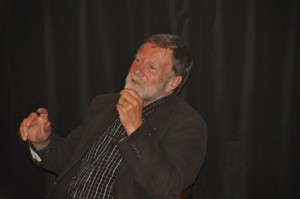
Veteran actor Jack Thompson at Mortlock Chamber

In 40 years, the Australian film industry has grown up from infancy and  “given us a voice on screen” by telling our own stories with Aussie actors portraying familiar characters says veteran actor Jack Thompson.

He was in Adelaide to celebrate the 40th anniversary of the South Australian
Film Corporation at a prestigious event “Jack Thompson in Conversation”” at the historic Mortlock Library.

“It is so easy to forget what the film industry was 40 years ago,” he recalls. “Australian stories were told very rarely and usually non-Australians came here to make our stories.’’

“All the heroes we had seen on the screenback then were either Americans or British.

“There was no sense that we might have our own heroes or heroines. We were suffering very much from this cultural cringe.’’

“It is important that we make films about who we are and what are our aspirations; that we see ourselves on the screen.’’

Organised by the StateLibrary of SA Foundation,  SA Film Corporation CEO Richard Harris interviewed Jack, who pointed out that Jack’s career had been on “the same trajectory’’ as the SA Film Corporation which was celebrating its 40th anniversary of film making.

So closely was his star hitched to the Film Corporation’s own stellar path that “the old Hendon Studios felt like the House that Jack built’’, said Richard Harris.

Ironically Jack told us he only ever thought acting would be a hobby.

“I never wanted to be a part of the film industry because there wasn’t one,’’ he said.
I never wanted to be an actor; It was my hobby from the age of six, but my hobby became my life,’’ he said.

“My first job in 1967-68 was on television and I decided to give myself 12 months when I would make enough money to put a roof over my head.’’

It was his father who first suggested a career; “My father said you wouldn’t want to be an actor would you Johnny?’’

“When I decided that I would have a shot at being an actor, the Australian film industry started to grow…this cresting wave.. it was fabulous.

He said his first film, Sunday Too Far Away was very much at the beginning of the flowering of a generation of film makers and what it has become. Until then we had no voice at all.

“It lay at the heart of the tale we wanted to tell which would be who we are as Australians.’’

He recalled his early recollections of films: “All the heroes we had seen on the screen were either Americans or British. There was no sense that we might have our own heroes or heroines. We were suffering very much from this cultural cringe.’’

“It is important that we make films about who we are and what are our aspirations.’’

In 1975 he read the script of Sunday Too Far Away. “I was so charmed by the accuracy; there was such an accurate recollection of a life I had known. It ws an absolute joy to be a part of it.’’

It was also his first real experience in SA.

Breaker Morant followed in 1980. “It not only broke me into the international film scene but the Australian film industry internationally, too.’’

He won the Best Supporting Actor at the Cannes Film Festival and recalled how he met his idol KirkDouglas.

“To me it was an award for the whole Australian film industry and Kirk Douglas was the president of the jury.’’

He did go to Hollywood, but related how he “seriously felt having received the award that I needed to return  and continue to be a part of the growth of the industry to tell who we are and what we have become, not about me in Hollywood.’’

He said the “Assassination of Richard Nixon’’ was an “extremely painful film’’ .

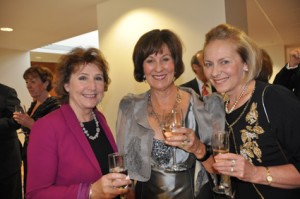
Leader of the Opposition, Isobel Redmond, Diane Colton and Di Bruce

Veteran film icon, Gil Brearley, who was in the audience asked questions, but also stated: “Jack, the breadth of your performance over the years is staggering.’’

Gil asked how he decided which role to accept.

“Largely, Gil, it is to do with whether or not I really want to bring life to this person. That is not a moral judgement because the nemesis can be as important as hero and it is important that they be good real life villians that they are painfully real’’.

“I choose from the material presented to me. Whether I choose a part is to do with the company I keep, the director and crews and cast. I see a script as an architectural drawing..this is what I will have to do , to bring to life.’’

When asked who he thought were the most important actors he said Sean Penn, Bryan Brown and Judy Davis.

“There is too big a list really. There are very few people that I have not enjoyed working with.’’

Some memorable moments included the fight scene in Wake In Fright. “That took 28 takes.’’

Despite his multiple roles, one was left with the impression that Breaker Morant was his favourite film.

“I was left with this feeling “You cannot charge men you have sent to war; you cannot charge them with murder. It’s an absurdity’’.

“It is so easy to forget what the film industry was 40 years ago. Australian stories were told very rarely and usually non-Australians came here to make our stories.’’

“It is important that we make films about who we are and what are our aspirations.’’


Scarlett’s Baptism Brings Family Joy

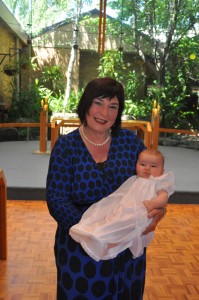
Scarlett Rose and I at her baptism

How strange that this morning I awake with a song in my head which is a popular wedding hymn.  Its words “This is the day which the Lord Hath made’’ run through my mind and it strikes me that this day – November 11 – triggers a strong mix of emotions quite apart from the historical fact that we remember our fallen soldiers at 11am.

My first thought is that this day has sadness written all over it because it is the six-month anniversary since my husband Olivier died.  It caps the worst year of my life, a long period of time, which has dripped in sadness.

Yet today is also the baptism of my new grand-daughter, Scarlett Rose Williams. And so the hymn words, which continue “We will rejoice and be glad in it”  had me springing out of bed in anticipation of happy moments.

So, here we gather as a large, extended family, all in our Sunday finery, wearing smiles and singing praises in the Concordia College chapel, which carries many memories. It is the same chapel where Olivier’s funeral was held. The same wonderful spiritual space where I married Olivier almost five years ago.  I sit in the pew now and smile remembering how sister Anne and I had arranged the flowers for my wedding day in the kitchen here and placed them on the altar and how the next day I had walked down the aisle between bowls of agapanthus on each step, dressed in a beautiful champagne lace wedding gown to marry Olivier. That was the happiest day of my life.

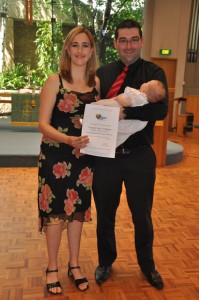
Now, where Olivier’s casket had sat on that saddest of days in May, my son, Tyson, his wife Vanessa – holding baby Scarlett in her arms, stand with the godparents and the pastor.  Scarlett is wearing her own mother Vanessa’s christening gown, a pretty white dress with its satin under skirt, lace edge and matching bib. The pastor sprinkles holy water over Scarlett’s head, which now has a gingery golden glow instead of the black hair of her birth. Baby does not cry, but I do, in joy at this wonderful occasion and the happiness that this little baby promises our family for many years to come.

The new parents at Scarlett’s baptism

Afterwards, we snap photographs, eat honey biscuits which Vanessa and I had made during the week, and our entourage of about 40 people,  depart to the Regency Tavern to eat, drink and be merry.

This glorious day finishes at the new parents’ home with a Christening cake, a big pavlova made by my sister Anne and trays of tasty slices made by Scarlett’s other grandmother Sandra.

A death, a birth and a baptism – c’est la vie.