Frankie is a champ at tennis


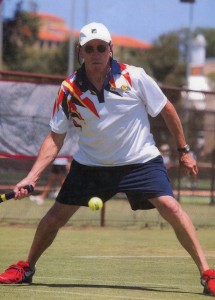
Frank plays champion tennis at 70 years of age.

Whatever happens to ageing rockers? Ask Frank Sebastyan, former sensational lead singer of Frankie and the In Sect rock band and he will tell you his sporting success story.

Forget about the microphone, Frankie now wields a tennis racket and played for South Australia in Perth at the Tennis Seniors Australia Championships in January.   He did let slip, though, that he was a member of the 70 – 79 age-group team.  And Frank, in his effervescent style, bragged of his wins and how chuffed he was to receive his South Australian State shirt. And he reckons it won’t be the last.

Here is Frankie in action – and note the colourful shoes – his trademark down through the years.


French women “wear the pants” at last


Paris chiefs have finally told women they can ‘wear the trousers’ after a 213-year-old ban on wearing such clothing was revoked as “incompatible’’ with contemporary French society.

Back in 1800 law-makers had originally issued the order forcing women to seek permission from police if they wanted to ‘dress like a man’.

Of course, this never stopped 19th century French author Georges Sand from dressing as a man, complete with lit cigar in her mouth, to foster her spectacular writing career, which she thought would benefit from her being seen as a male writer rather than female.

The order was later amended in 1892 and 1909 to allow women to wear trousers if they were ‘holding a bicycle handlebar or the reins of  orse’ but it officially remained a statute on the books.

Now French politician, women’s rights minister, Najat Vallaud-Belkacem, has decriminalised potentially thousands of Parisian women by saying that the law is incompatible with modern French values.

‘This order was aimed, first of all, at limiting the access of women to certain offices or occupations by preventing them from dressing in the manner of men,’’ she said in a prepared statement.

‘This order is incompatible with the principles of equality between women and men. From that incompatibility stems the implicit abrogation of the order.’

The order was originally issued following the French Revolution when Parisian women demanded the right to wear trousers in their attempt to win equality.

At the time, working-class revolutionaries were known as ‘sans-culottes’ for wearing trousers instead of the silk-knee breeches (culottes) favoured by the ruling classes.

The regime that took power after the monarchy was deposed is thought to have been afraid that true equality for women would undermine its power. It used orders like the banning of trousers as a way of keeping them in their place.

Meanwhile, in contemporary French politics, the manner of dress of French housing minister Cecile Duflot has provoked comment – and media coverage.

The 37-year-old Green housing minister was criticised last May for wearing jeans to the first cabinet meeting of Socialist President Francois Hollande’s new government. She was later subjected to jeers and wolf-whistles while wearing a floral summer dress in the National Assembly.

There was no question the law needed to be revoked when a number of other women also broke parliamentary protocol by wearing jeans during an extended debate recently over France’s planned legalisation of gay marriage.


Vive Les Mis et La Revolution!

Tom Hooper’s musical version of the Victor Hugo novel, Les Miserables,a classic tale of romance, morality and crushing poverty in revolutionary France, is spell-binding. This is due in no small measure to the astonishing performance of ex-convict Jean  Valjean by Aussie actor Hugh Jackman. Valjean, a credible thief, who does his hard time for 19 years before his redemption by a bishop. He rips ups his parole papers ushering in a life on the run relentlessly pursued by gendarme Javert played by Russell Crowe.  Surprisingly, Jackman has a strong, powerful voice as he sings his storyline, however a disappointing Russell Crowe fails to deliver as the ruthless Javert.  Although he has a history of excellent roles, he fails to deliver the terror Hugo clearly meant to capture in his novel.  Based on Claude-Michel Schonberg and Alain Boublil’s musical version of Les Mis, this well-made film is expected to collect a fistfull of Oscar awards thanks to its brave direction and the excellent cast, which sings live, outstanding costumes and make-up.

The storyline reflects tow strong tenets of 19th century French society – the ruthless pursuit of wrongdoers by the law and the French citizen’s psyche which continues in contemporary society, which prides itself on evading the law.  Years after breaking parole Valjean has made good owning a factory where Fantine (Anne Hathaway), a young, abandoned mother works, but whose life crumbles when she is fired due to an oversight by Valjean.  Her downward spiral towards destitution and prostitution is shocking.   Her beautiful song, I Dreamed a Dream, delivered in a heart-felt, desperate manner, stuns theatre-goers.  In this renowned French tale, Valjean takes over the care of her orphaned daughter, Cosette, against a tense backdrop where revolutionaries plan the stand-off at the Barricades. Such dramatic action is paled slightly when one learns the dramatic marching of the French Army, bayonets drawn was actually filmed in Greenwich, instead of Paris’s stsreets.  Les Mis captures the powerful revolutionary emotion of the French and the restorative power of love – packaged in an exhilarating musical.

Jackman, a nominee for an Oscar, well deserves to win because Les Mis not only does his excellent portrayal of Valjean anchor the film, the role displays his vast range of acting talent, with his wonderful voice an exciting discovery.


Oswald floods Queensland with cyclonic rain

So much for the idyllic Sunshine State! Brisbane seems to be drowning in a cyclonic drenching and 80km winds lash relentlessly around the Queenslander house built on stilts where my daughter lives, luckily high on a hill. However, the lower suburbs and restaurants along the banks of the Brisbane River are flooded and it is hard to believe that on Wednesday last week we strolled nonchalantly riverside along Southbank to the Science Museum.  Afterwards, we had coffee at trendy GroovyTrain at the City Cap dock.  Now the Bribane River is expected to peak at 11 metres higher than its normal tide sometime tonight leaving a swathe of flooding in its wake. The weather here is all-consuming and I sit daily on the balcony watching in awe as the sheets of pelting rain swish down the road like some giant broom is sweeping it along. This is unfolding under a low-hung heavy grey sky,  where nothing is visible beyond the two-storey block of flats opposite. I watch mesmerised as a ferocious wind howls around me, thrashing the palm trees in our garden and the street, Visibility is minimal, yet I can hear aircraft overhead and feel relatively safe under the wide eaves of this lovely timber-clad home.

On Friday we had a pleasant day at Ipswich taking the grand-children to the Rescue exhibition at the Art Gallery and despite the rain we could hardly envisage that three days of constant rain later, Ipswich is bracing itself for a high Bremer River tide of 15 metres, which has flooded many homes. Although two metres lower than the devastating 2011 floods to the Aussies, the hapless victims we meet on the nightly news, this flooding of their homes is just as devastating.

My heart goes out to them and find it hard to believe there have been so few fatalies – although the four confirmed so far is too much.

We know Australia is a land of weather contrasts, borne out by a Facebook posting from my son Tyson reporting on his role giving out Cancer Council sunscreen at theTour Down Under in Adelaide while we cannot venture outside in a city experiencing its fifth day of constant rain,  where the Premier advises everyone to stay indoors because of flooding creeks, power failure and uprooted trees. Cyclone Oswald has wrought damage right along the coast of Queensland including the Gold Coast and the Sunshine Coast. Hard to believe also that we went on a pleasant day-trip to Doonan, near Noosa on Tuesday – a mere week ago where the children swam in the pool of our friends Chris and Rob Nicholls… Now the Bruce Highway is cut and Gympie half an hour to the north is experiencing serious flooding. Airports on the Sunshine Coast and the Gold Coast are closed because of high winds reflected in coverage of one small aircraft flipped  over.


How strange also, that our nation has only just recovered from devastating bushfires in Tasmania, NSW and Victoria to now be struggling as a community to come to grips with the damage of Cyclone Oswald.  Now there is a new cry for  donations for Queenslanders who once more have lost so much two years after the 2011 floods.

It is quite a different feeling to be living in the community suffering this disaster rather than sitting safely in my armchair back in sunny Adelaide.


Diversity in Aged Care

The Federal Government’s national ageing and aged care policies move beyond mainstream to diversity.
The Federal Government has released its first national ageing and aged care strategy for Lesbian, Gay, Bisexual, Transgender and Intersex (LGBTI) people and for those from different ethnic backgrounds.

Initiatives include sensitivity training for the aged care workforce and a review of guidelines to promote access to advocacy for LGBTI people.

The strategy, recommended by LGBTI groups and the Productivity Commission, would also help to ensure all government-funded aged care providers develop policies and processes to address discrimination and prejudice, Ageing Minister Market Butler said.

Source: National Seniors newsletter.

More Water Saves Mighty Murray

It is a once-in-a-lifetime moment  at, arguably, Australia’s most controversial spot – the mouth of the mighty River Murray.

Today, the mouth is open and a mere sliver of blue waters run from the river to the sea, but until recently, dredging machines 24 hours a day were needed to stop it silting over.

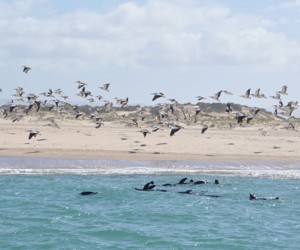
We are aboard the Spirit of the Coorong and from here I notice countless pelicans on the sandhills, flapping their wings for flight and seals splashing  their flippers in the river.  As the pelicans lift off I capture this wonderful wildlife to remind us that the river is habitat to myriad bird species, fish, emus, kangaroos and turtles.

It is the here that the deteriorating  river system has manifested so profoundly that built-up silt and sand closed over the river mouth  in 2002.

It threatened disaster for the river, the third largest navigable river in the world, and particularly, the delicate Coorong.  However, today floodwaters have naturally flushed open the river’s mouth and the dredging machines have been removed.

“There is 40 feet of water below us now at the Murray Mouth and that’s the way we must keep it if the river is to be healthy,’’ says Captain Bain Pedler, who has been taking tourists from Goolwa to the Coorong for 30 years.

This cruise was a highlight of our 12-month sea-change on Hindmarsh Island, a man-made riverside marina where we loved watching  the swans, herons, pelicans and plovers.

Australia’s longest river is beautiful, dotted with ancient river gums, national parks, river towns and magnificent limestone cliffs.   Its irrigation system provides the “food bowl of the nation’’ and vineyards, orchards and olive groves create a lush spectacle of fertility.  Its unique landscapes include the Murraylands,  the distinctive Mallee scrub and wetlands.
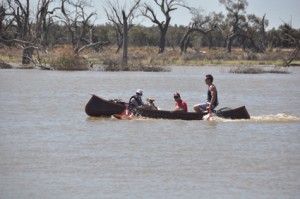
our adult children canoeing on the River


Riverside communities rely on river water for their livelihood and have watched alarmed at the decline in river health.

Over-irrigation upstream from SA and the effects of the 10-year-long  drought have stressed  the river causing deterioration of its banks, drying up of wetlands and closure of the mouth.

Political leaders have listened to the war of words about the river’s  critical state – and the first national plan to save Australia’s most important river system  has been signed into law. It guarantees 3200GL will be returned to the river by 2024 to restore its health. It reflects understanding that whatever happens along the Murray-Darling Basin impacts at the Murray Mouth 2520 km away.

The Advertiser must be congratulated for its community campaign “I Love the Murray’’ which has  helped achieve this legislation in Federal Parliament.