Family and a Frolic in City’s Mad March
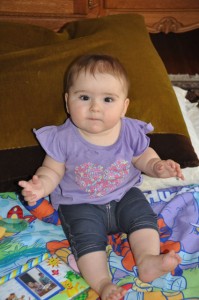
 

Scarlett under grandma’s care

Time slips by quietly and suddenly it is 10 months since husband Olivier died.  Some friends say “time enough’’ for grief and beseech me to “move on”.  And I wonder what do those words mean?  Am I to forget my great love? Yet I can’t erase him from my mind and I don’t want to. I am doing the sensible thing. Living each day as a blessing and still accepting all the invitations I receive.


Tonight’s gruesome episode of Midsommer Murders concluded with Barnaby saying “Grief is universal, but we must each express it in our own way.’’


Right now I am pouring my grieving into our garden, Olivier’s memorial garden and I do love to talk to him about the progress of our plants and the new ones. These include the roses, irises, flax plants, cannas and astromaelias which have been dotted throughout the “bald spots’’.


The garden is evolving in  a surprising manner, unlike anything we envisaged because plants now have been donated by kind friends who have dug up a proliferation of plantings for me. Everything goes in – even the humble seaside daisy. The most coddled plants, though are my tomatoes, scattered throughout the plantings – and one has borne 29 fruit!  Olivier must be smiling in his spiritual life at my metamorphosis.


This morning I began clipping the French lavender border plants. Soon, the agapanthas which line our long driveway will be dug up and divided for a long line along the eastern boundary.  The roses Amazing Grace and French Lace have flowered prolifically and here are some photographs of them.
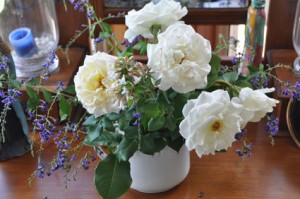
My vase of rises – Amazing Grace and French Lace


Meanwhile, on the plains Adelaide dances in Mad March with the whole city filled with tourists for the Adelaide Festival of Arts, Adelaide Fringe and my own glorious gem of a cultural event – Writers Week.  This unique literary indulgence began with the Booklovers Breakfast in the grounds of Government House, hosted by the Independent Arts Foundation, and then we women walked down the hill to Writers Week for the first of three days of listening, buying books, questioning, discussing authors and being inspired.  I sat under the canopies, strung between tall green trees in the Pioneer Women’s Memorial Garden to hear writers talk about their books. Read about it in my “culture’’ blog.
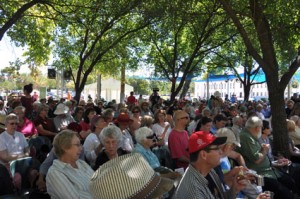
Crowds at Writers Week hear UK author Edward St Aubyn


The city has donned its party skirt for a non-stop frolic of fun, art, theatre and literature in Mad March.  What a spin we Adelaideans are in having to decide what to attend, where to spend one’s precious time.  Every nook and cranny, café or unused warehouse has been turned into a Fringe venue.  And whether we attended or not, the exciting Clipsal 500 with all that Vroom Vroom noise and jets zooming low over the suburbs,  adds the extra dimension that those thousands of high octane petrol heads bring to the city’s electric atmosphere.  One big reason for the sell-out 90,000 crowd this year was that Kiss performed after the big race.  And tomorrow there is a holiday for us to attend the Adelaide Cup.


And after all that delicious culture, Friday was a fabulous first for me – a joyful, but slightly unsettling event when I cared for grand-daughter Scarlett for the first time for four hours alone in my own home. Bliss!


Of course, beforehand I took her to my favourite shopping centre in her pusher and glowed as interested passers by stopped and ooed and aahed at her.


One old man pushing a trolley stopped me and told a story:  “My father was a toy-maker and when I was a young teenager, I would repair dolls,’’ he said.


“Japanese dolls were fashionable back in those years and they were beautiful celluloid dolls. I think that little baby looks just like one of them. She is beautiful!’’ A very special moment of sharing with a stranger.


Later, as I propped  her up on the child’s blanket I bought for zilch from a garage sale, scattered her toys around her and urged her to clap her hands (her latest development) I thought I would burst with joy.


Olivier would think I am doing quite well and I share every happy moment with him.


Women say Share The Work and Wealth:


Let us not indulge too much in platitudes this International Women’s Day because, although we can be smug about real progress over the past quarter century in achieving equality in law, the one big issue – violence – still impacts on women and girls.

We could examine newspaper clippings from the last few weeks alone to wipe that smug look right off our faces.

Women globally are likely to be beaten, raped, abused or mutilated in their lifetimes according to the head of the UN women’s watchdog. And by the men they know intimately or family members. It’s rarely strangers.


The UN Commission on the Status of Women in New York has demanded action to end the violence claiming it is  “the most pervasive violation of human rights and dignity’’.


“This pandemic strikes the lives of millions of women, fractures families and communities and impedes development, costing countries billions of dollars each year in healthcare costs and lost productivity,’’ says Michelle Bachelet of the commission’s plea.


She quotes data from the World Health Organisation which showed that an average of 40 per cent – and up to 70 per cent of women in some countries – face continuing violence in their lifetimes.


And, here in our so-called safe society, SAPOL domestic violence units, growing numbers of women’s shelters, burgeoning social welfare costs and continuing hospital admissions prove that nothing has stopped the local violence epidemic. This frightening behaviour not only injures women physically, it  crushes their spirit to achieve and diminishes their life chances.


There was news from Kathmandu in Nepal in January that hundreds of protesters gathered outside the Prime Minister’s residence for a 10th day to oppose violence against women there. They demanded that authorities do more to punish those involved in crimes against women and to do more to protect women.


And, who of us wasn’t emotionally distraught at the horrific rapes on a bus in India where an unfortunate young student, doing nothing but sitting there with her boyfriend, was repeatedly raped by a pack of men and then, naked, thrown from the bus. She later died of her injuries. It triggered rounds of protests by women in India and we can only hope for change and that the perpetrators will be found guilty and punished severely for what was not only rape, but murder.


And speaking of murder. In Russia, each year, 14,000 women are murdered, mostly by men they know. Shall I continue? Or change the subject to another long list of needs for women.


Such as endemic poverty in masses of women’s lives.  World-wide poverty in third world countries is beyond our understanding and the powerlessness of faceless, voiceless women in a male-dominated society in some Middle Eastern and African countries is unfathomable. This is because Australian women mostly have their own cars, build up their own careers, make choices, buy property and whether married or not, forge their own dreams into reality.


When we speak of women in power, we have Prime Minister Julia Gillard as No. 1 on The Australian newspaper’s list of the 50 most influential figures in politics, but there are fewer than one in five women in the other 49 spots. Tony Abbott’s formidable chief of staff, Peta Credlin, comes in at 21 and wields enormous powers in the Opposition camp.

At the other end of the spectrum, in suburbia, there is one role of women here in OZ which we must celebrate on International Women’s Day. Motherhood. These are the women who sacrifice so much in terms of personal financial gain, career opportunities and independent pursuits to make choices to leave work or work part-time to raise their families – and still in about 50 per cent of households – be partners. These women need to be honoured on IWD, too.  A woman’s work isn’t all about power and prestige, a lot of it is being a taxi-driver to and from school and children’s sporting pursuits. To these women who juggle both roles heroically, access to and the cost of child care are crucial to their life chances – and the ability to build up their own superannuation fund through paid work. Flexibility at work is still a dream for many women in low-paid jobs.  It should be mandatory for single mothers without a supportive partner.

Then there is sexual harassment, a difficult destabilising problem for many women in the paid workforce. (Read this week’s paper for validation)

And it seems a woman’s work is never done if one looks at the lives of the sandwich generation, to the Boomers, who find their adult children still bedding at home partaking of all the perks parents can offer. Sometimes, they even pay board and help around the house if mum works outside the home.

These middle-aged mums generally carry the caregiving role as their parents age and make that painful transition from independent living to residential care. They would be in charge of transporting frail parents to countless doctors and specialists appointments for parents.

As women age themselves, they care for their male partners, who will probably die before them at a rate of 2/1– and many will find themselves in poverty. Because their life choices have meant they have not built up their own superannuation nestegg. The average older woman will retire from the work force with about $32,000 in superannuation.  Most frail aged women will find themselves alone and on an age pension. And it is likely poverty will stalk their older lives.

One woman whom we deserve to listen to is Westpac chief executive Gail Kelly who is No. 46 on that list of influential women. She  addressed the Sydney IWD gathering about superannuation and companies with gender equality programs.
She leads by example claiming Westpac has increased the representation of women in its senior ranks – the top 4000 of its 37,000 staff – from 32 per cent in 2010 to 40 per cent by the end of 2012.

She announced the bank had a new goal of boosting this to 50 per cent by 2017. Even better news is that 62 per cent of Westpac’s workforce is on some kind of flexible working arrangement, including part-time, nine-day fortnights, job sharing or working from home one day a week. This is expected to grow to 82 per cent within a few years.  The results are clear in a 90 per cent return-to-work after parental leave.

Sex Discrimination Commissioner Elizabeth Broderick, says there should be no complacency that gender equity is finished business even with a head of state who is a woman and a female Prime Minister.

“There is this view that gender equality is finished business, but it absolutely is not. What we don’t have is a critical mass of women sitting under  this, and that’s what we need,’’ she says.

She reckons men need to shoulder their share of caring responsibilities and until they do, women will continue to be under-represented at the apex of business and politics.

And the big missing link to the whole chain is during those career building/child rearing years men must carry an equal share of household and child rearing responsibilities and that should include cleaning the bath, and the toilet, shopping and cooking and feeding offspring.

Then we can celebrate IWD together, men and women, because the opportunities, too, will be shared along with the childcare costs, to enable women to earn and build wealth during their productive lives.


Lung cancer overtakes breast cancer

A European study which looked at cancer rates in all 27 Europ0oean countries has released both good and bad news about women surrounding the diagnosis and death from cancer.

Britain has announced that deaths from lung cancer has overtaken deaths from breast cancer to make it the most lethal form of the diease among British women, research shows.  Sadly, we beat the Brits on that statistic because Lung cancer became the No. 1 killer of women ovetaking breast cancer about five years ago.  (I wrote that story while still working at The Advertiser).

This statistic – more than any other – surely links lifestyle choices to an untimely death.

The Europe-wide study shows that despite an overall decline in cancer deaths, mortality rates from lung cancer among women have continued to rise – up 7 per cent to around 82,000 since 2009.


In Britain, lung cancer now kills 16,000 women a year compared with 12,000 for breast cancer.


The present death rate is attributed to the numbers of young women who took up smoking in the late 1960s and 1970s.


Researchers predict that the later declines in the numbers of women smokers mean deaths from lung cancer will fall in coming years.


Meanwhile, the study published in the Annals of Oncology, announced the good news that there has been a steady reduction in breast cancer deaths across Europe in the past four years.

The death rates from all cancers in  the 27 countries of Europe in 2013 are likely to fall by 6 per cent among men and by 4 per cent among women compared with 2009. However, 1.31 million people will still die of cancer in Europe this year.

One of the study authors, Professor Carlo La Vecchia says the lower death rate reflects “an important and accumulating advances in thetreatment, as well as screening and early diagnosis of the disease”.


However, lung cancer is still the main cause of cancer death among men with almost 187,000 deaths predicted for 2013 giving a death rate of 37.2 per 100,000 men.

This compares with 21.2 women per 100,000 dying of lung cancer in the UK, the highest rate in Europe.


C’est catastrophique!


What is more French than savouring a steaming casserole of Coq au Vin, splashed down with a quality bottle of Sauvignon Blanc served at a classy restaurant which has honed l’art de la table .


The rest of the world could buy take-aways and fizzy drinks, but les Francaises like to think they are bred into gastronomic refinement by centuries of gourmet style.


But, what’s this snippet one reads in The Times of London about the French losing their “luxury appetite’’?  A new study has revealed that France has become a fast-food nation, which has guzzled more takeaways last year than sit-down meals in bistrots, brasseries and restaurants for the first time.


The startling news is a fresh blow to the nation’s reputation only days after Yannick Alleno – a three- Michelin star chef – had denounced the national cuisine as “no longer at the front of the stage’’. “It’s in the frying pan,’’ he added.


On the one hand, traditional restaurants are cutting prices in a desperate bid to win back customers and on the other, takeaways are enjoying a boom, says a report by Gira, food consultants.


Gira Conseil director Bernard Boutboul says the French fast food market has grown by 73.5 per cent since 2004 to E34 billion last year.


And in an historic shift, takeaway outlets accounted for 54 per cent of the total number of meals eaten outside the home in France.


The sweeping changes in French lifestyles mean the number of meals eaten in traditional restaurants fell by up to 4 per cent taking it under 50 per cent for the first time.


Quel un catastrophe!


Heat, Dust, Flies – and Fun

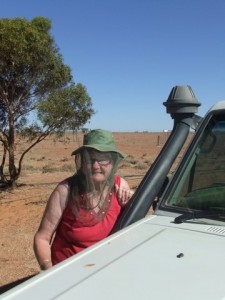
This is me at the top end of SA.

BY JEANETTE COOMBES


Certainly, this is not my best look! No Akubra for me, but the fly net is a must at Mt Barry working on a cattle station in the far north of South Australia in January.


The weather has been kinder today. Only 37 – not yesterday’s 47! The water in the taps is too hot to shower in until we run it for a while, but even then there is no such thing as a cold shower! I keep a bucket of water in the house that I can use to wet the dog down during the day. The water is far too hot for her!


Garry and I usually spend three-four weeks living and working on the station,  which is 100km north of Coober Pedy, the nearest township.  And Coober Pedy itself is another story.


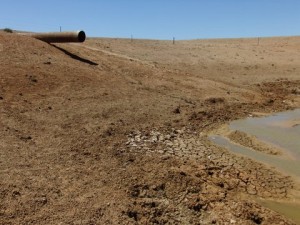
The landscape of Mt Barry is red, flat, crisscrossed sparsely with water courses which are usually bone dry. Here and there stark residual hills punctuate the otherwise flat landscape.  The watercourses are critical in the carrying of flood waters to the vast tracts of land grazed by the station cattle and the other animals. Dams are filled from rainfall carried in the creeks, but when there is no rain, as is the case this year, the dams dry out and the fish die and the cattle need to be moved so that they do not bog themselves in the mud. So cattle then drink from troughs filled from bores. Troughs need to be cleaned frequently to rid them of the algae which grow quickly in the warm water pumped from beneath the earth surface. The ground is covered in red stones seriously eroded by centuries of weathering. They give a rosy glow and shine in the sunlight and radiate such heat in the summer that they are too hot to pick up.

Mr Barry’s general landscape


One of Garry’s jobs is to keep the water pumps operating and the troughs clean. Sometimes that job takes five-six hours requiring him to drive over 100km on rough station tracks where the travel is only at 40 or so km per hour. While he is away from the station, we are in radio contact with me back in the homestead. That ensures his safety and my ability to support him with reassuring communication. Remember that in January, the temperatures are into the 50 degrees centigrade, so the work is strenuous and potentially dangerous. So it is important that safety measures are in place. Air conditioning in the Toyota traytop is a bonus! But the cold water in the esky is a lifesaver as is good food on his return!


Of course there are always flies….I have a very low tolerance to the pests, hence the fly net on my hat. I can’t stand them in my eyes, nose, ears, mouth and behind my glasses, so anything to keep them at bay is ok with me…too bad about the good look!


We love going to Mt Barry as we have over the last 13 years. We went there first as support teachers to a sick Mum who needed help with her student child whilst she was struggling with her illness. We have become close to the family and give them a holiday break down south in the harshest time of the year when regular cattle work is not carried out.


A major attraction for us, apart from the help we know we can give the family, is the huge contrast in life style that we experience because we live in such a ‘soft’ environment, close to the sea. We go from the cool sea breezes, the green country side, shops around the corner, neighbours a stone’s throw away, to the isolation, ruggedness, and challenges of a harsh work place. We realise how hard these people work to add to the economy of our country. We appreciate our home too!  We have 24 hour power, inexpensive compared to the diesel run generator that operates only about 12 hours a day.

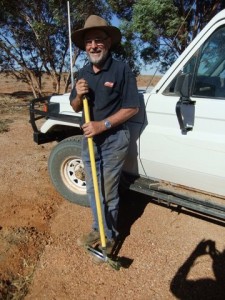
That husband Garry in 59 degree heat.


Another bonus Garry really enjoys is the opportunity to play with Big Boys Toys! He finds himself driving tractors and bulldozers and other heavy vehicles, tinkering with motor bikes and problem solving issues relating to anything from simple home maintenance to major breakdowns.

Dying Well – Prof Maddocks tells how

A belated but hearty congratulations to palliative care Godfather, Emeritus Professor  Ian Maddocks, who was named Senior Australian of the Year 2013. My heart jumped with joy at the news as I played a small part supporting his nomination by another South Australian, whose wife had recently been diagnosed with a terminal disease.

The media has told the  inspiring story of “Prof’’, who at 81 years of age is still administering medication for pain management to the dying well into the night.

However, for those of us whose lives have been touched by this Angel Gabriel, our stories are not just about the welcome pain relief, but also about how “prof’’ provides his patients with boundless care and compassion and helps them prepare to die with dignity.

We met Professor Maddocks in the most traumatic circumstances – at the end of a hospital bed only hours after my husband was told he was going to die.  Ignorance is not bliss facing such a life crisis as a death sentence from disease.   For the next 10 months,  Prof was only a telephone call away and he knocked on our door many times to give a prescription, adjust medication or administer a morphine injection.  It was priceless professional support at bulk bill Medicare rates.

Importantly, Professor Maddocks has played a pivotal role in enlightening the community  that the dying process  is a valued part of the life cycle. It is not to be shied away from and to this end he envelops the family in the task at hand.  He treats his patients with dignity and kindness  and respect until the moment of death.  He informs his patients and rather than dwelling in fear, his information gives them power. They know their fate is on the horizon and can face it as any other phase of life – fearlessly and in a comfortable state.

Dying is actually an ebbing of life, sometimes over a long period of time and for many, such as my beloved husband, severe cancer pain was a real fear.  Yet, with strong pain relief, he led a full life until the last two months when Professor Maddocks instructed a caring brigade of palliative nurses who called at home twice daily to administer timed doses of morphine intravenously.

Prof’s aim is to keep the patient comfortable to enable him/her to participate in life as much as practicable and this is all the more remarkable because he is an octagenarian.

The good professor has devoted the last 25 years of his “rather extended life’’ to developing  palliative care as a discipline.

In a recent interview he explained care of the dying. “It’s about how you can make terminal illness into something which is positive and which family can feel  happy with as they see the departure of the loved one going well,’’ he said.

“We were not doing dying well.  We were putting the dying away inside rooms; we were not thinking of the family. Hospitalised care is isolating and I thought we should be doing this better.’’

Professor Maddocks, who was made a member of the Order of Australia in 2003, was the first Foundation Professor of Palliative Care at Flinders University in 1988 and prior to that he was the Senior Medical Specialist at the Flinders Medical Centre.  He was the first president of the Australian and New Zealand Society  for Palliative Medicine.

He was awarded the Nobel Prize for Peace in 1983 as Chair of the Board of Directors of International Physicians for Prevention of Nuclear War.

Death was the last taboo, stuffed into the closet, but Professor Maddocks threw it open to allow the dying process to be aired as a stage of life which families should not fear, but face as a precious time for loving, laughing, for talking together and saying goodbye.

This is why Professor Maddocks’ award is such a joy because he has had the platform to talk about dying well; about creating a supportive environment of “love and courage and patience’’ so our loved ones can leave us peacefully and pain free.