“Suffer the little children”

My heart weeps for the victims of the Boston bombings. Particularly, I cannot throw off my sadness for the Richard parents of that little eight-year-old boy, Martin, who died and their daughter, Jane, whose leg was blown off.  Does their unspeakable grief break your heart, too? My sympathy pours out for Bill, the father as he grapples with losing his son and his desperate fear for his wife, Denise who is struggling to survive.  His despair as he grapples with the reality of his daughter’s terrible injuries must be profound.

There have been many bombings around the world and huge tolls in Middle Eastern countries such as Iraq, Afghanistan and Syria. And it is true that we may become blaze watching so much suffering and chaos after each and every bombing whether an exploding car bomb or aircraft bombings. Always there are dead children gathered up from the debris.

Nor must be forget the excrutiating pain of Krystie Campbell’s mother as she tried to speak to the media about the death of her daughter.

However, this little boy’s death brings home the  horror, because he carried  the same surname as my grandsons and was the same age.  My eldest daughter Serena and her husband Jon, have two beautiful boys – my grandsons Samuel Richards is 11 years old and his younger brother, Angus Richards is 9 years old.  They are so full of life and mischief and if Jon was a marathon runner, I know they would both be at the finish line fighting about which of them would hug their dad first. My grand-daughter, their youngest sister, Josephine would have been there too vying for dad’s attention. And right there in the midst of them would have been my own daughter, the wife and mother.

This deadly act has driven home my understanding that if we look over the past 10 years, thousands of children like Martin, have died through the American invasion of Iraq, the civil war in Syria and the conflict in Afghanistan.

Oh, what a mess the world is in today. Everywhere you look or whatever channel on television you watch, there is slaughter in the name of this or that political or religious “cause’’.  One little boy lost  symbolises the futility of terrorist acts, whether home-grown or operating for overseas-based groups.

However, do we stop the slaughter of children?  How do we bring peace to our suffering planet?   The present legislation to tighten gun laws in the United States could have been one small step towards a more peaceful place yet that government failed to protection its people through gun restrictions and police checks on people who buy firearms. How shameful is that in the aftermath of the Sandy Hook school tragedy?

Those little ones were all aged six – and my grand-daughter will turn six years old next month.

So, we should pray for comfort for the grieving parents as they try to comprehend what has happened to their lives.


How Does Your Garden Grow Dearest?

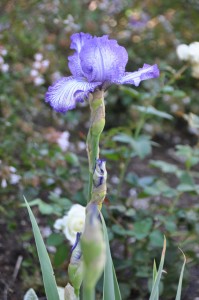
One of many named irises in the garden

To my darling Frenchman, Olivier,

If only you were still here dear to see how the garden is continuing to bloom and bring me pleasure. Remember the discussions we had about how we would choose irises and roses to colour the exotic plantings which the landscape designer chose for foliage?

Some of the roses have struggled to survive in our hot summer and as I have already written they were all chosen by name to reflect our life together. Therefore, I watched like a worried parent as “Dearest’’ languished throughout summer, a stunted specimen clinging to life with no growth.spurts.

Its very name meant it could not die. Slowly the roots of  “Dearest’’ seemed to take hold in the hard earth and the odd new leaf appeared, but it remained dwarfed against the spectacular growth of “Amazing Grace’’ and “”French Lace’’. These two bushes have provided a summertime of beautiful flowers for my floral arrangements.

Imagine my joy this morning when I noticed that “Dearest’’ had flowered – a delicate single pink rose which may not be perfectly formed. My heart jumped for joy and I cut it for the house.  One last white bloom from Amazing Grace keeps it company in a delicate vase.

The lavender border plants have been clipped into little balls and the lush green semi-circular hedge has had its honeysuckle flowers cut back. Daffodil, hyacinth and tulip bulbs have been scattered around the garden. All of this activity has had me feeling like mother earth herself. I sense that I am a gardener and I love tending your memorial garden.

There is much left to do before winter takes hold. The native grasses, which have flowered in fluffy purple fronds need to be cut back and the sour sobs, that scourge weed of the Hills are springing up like mushrooms through the mulch and must be poisoned.

Daughter-in-law Vanessa’s father , John, has had a circular support made for the wisteria which is now wound around the pole and nudging towards the ring. By Spring it should have hitched itself onto the ring to prepare for a splendid flowering in September.

Dwarf Nandinas form a spectacular red border in autumn, the named irises given by Gwen Alexandrou still flower and the salvias are still spread their floral lavender skirts.

You will be pleased to know that I have not moved the strelitzia from the pond’s edge as I threatened to do and I have added two more to the garden for dramatic effect.  The hillside garden is dotted now with carpet roses, cannas, seaside daisies, geraniums and the odd agapanthus. I am happy to report that the three red geraniums that you potted as your last gardening act, are surviving, but I cannot say thriving. It’s tough terrain up there on the hill. That said, I am happy to tell you that of all those 11 bougainvilleas that “died’;’ three resurrected themselves. The pretty pink and white species that we loved so much at Hindmarsh Island is beginning to fall over the rear wall.  I think of you every time I look at it.


French luxury label LV marries Aussie RM


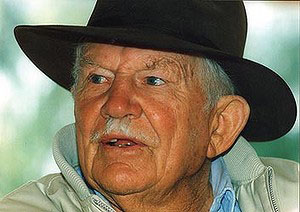
Iconic R>M> Williams, bushman who became millionnaire

Australian bush outfitter R.M. Williams has pulled off a dream deal. French fashion house Louis Vuitton has bought just under 50 per cent of its iconic designs tailored for stylish “colts and fillies”.
Rather than rue the French buy-up of a famous national label R.M. Williams chef    Ken Cowley says he hopes his new French partners will be able to help the high profile local label to increase its market share overseas, particularly Asia.

There is every chance this will happen when one considers the fortunes of luxury goods label LV.

Louis Vuitton, which accounts for half of luxury-goods conglomerate LVMH Moët Hennessy Louis Vuitton operating profit, generates €7.4 billion ($9.69 billion) in annual sales, estimates Bernstein Research. That is almost as much as Prada , Hermès International and Burberry Group combined.

Against such a remarkable luxury-brand giant, Australian bushman Reginald Murray Williams, was a humble home-grown hero who founded his famous clothing and footwear manufacturing company to capture Australia’s outback spirit. This was a far cry from the fashion labels under the LVMH label including Christian Dior, Tag heuer, Bulgari, Moet & Chandon and Hennessy. Its chairman and chief executive is none other than Europe’s richest man, Bernard Arnault.

Reg was born at Belalie North near Jamestown, in South Australia and rose from swagman, to a millionaire entrepeneur. Widely known as just ‘R.M.’, he was bred in a pioneering settler family working and training horses.  R.M. had many adventures in Australia’s rugged outback as a bushman. He became an outback icon for creating an Australian style of bushwear recognised world wide and left an enduring contribution to the Australian identity when he died in 2003. The company he founded enjoys annual sales of around $100 million.

On announcing the purchase of a 49.9 per cent share by an affiliate of global luxury goods brand Louis Vuitton Moet Hennessy (LVMH),  R.M. Williams chairman Ken Cowley, whose family owns the remaining 50.1 per cent controlling stake, says the new part-owner has agreed that the company will continue to manufacture its products.

The Cowley family – headed by the former News Ltd CEO – took over full ownership of the brand when Reginald (R.M.) Williams died in 2003. Cowley bought out fellow shareholder Kerry Stokes and privatised the company.

R.M. Williams already exports to 15 countries, has stores in London and New York and is carried by 900 retailers around the world, but Cowley says he hopes LVMH will help take the brand to the next level.

No Complacency About Cancer Screenings

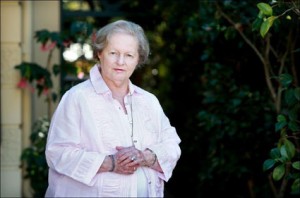
Dr Judith Roberts honoured for her cancer screening advocacy

Renowned healthcare advocate, Dr Judith Roberts, has warned that any Federal Government funding cuts to cancer screening programs would result in rising death rates from the dreaded disease.

Dr Roberts, a former president of Cancer Council Australia and chair of Cancer Council SA,  says the community needs to be reassured that life-saving screenings for breast cancer, cervical cancer and bowel cancer are not in the Government’s sites for cuts in the May budget.

“My big worry is that the Federal Government in a parlous state with their budget  that they will cut funding to the screening programs,’’ said Dr Roberts, who is the Community Patron of the Cancer Council of SA.

“Presently funding is shared between the Federal and State governments and if the Federal Government tries to handball its share, the states will be unable to take up the gap in funding.

“It will be a disaster for the screening programs, for cervical cancer, breast cancer and bowel cancer screening – and bowel cancer screening is under the greatest threat,’’ she added.

The Governor General, Her Excellency Quentin Bryce flew to Adelaide late last month to present Dr Roberts with the Cancer Council Australia’s prestigious Gold Medal for being “an icon of healthcare advocacy’’.

She was the first recipient of the award outside the field of clinical medicine.

Dr Roberts has devoted “decades of personal advocacy’’ as a volunteer to improved cancer outcomes , Her Excellency Quentin Bryce said on presenting the medal.

She was the driving force in the establishment and implementation of screening programs for breast and cervical cancer in South Australia, then nationally. The two women’s cancer screening programs  have prevented thousands of cancer deaths in Australia.

Dr Roberts chaired a Ministerial Task Force on cancer in women under former minister for health, Dr John Cornwall during the Bannon years and travelled to 10 countries afterwards to study the impact of breast screening programs.

Her report was accepted by the SA Government and she then chaired the Ministerial committee which set up the SA Mammography screening program.

“I was the mother of the breast screen program, but now I am the ‘grandmother’,’’ said Dr Roberts.

She also chaired the Ministerial Advisory Committee into cervical cancer screening and steered its implementation in SA and then nationally.

Following her ground-breaking recommendations  Dr Roberts worked for 40 years as a volunteer to improve community awareness of early detection through screenings,

“These screening programs have saved thousands of women’s lives,’’ she said. “They have reduced the death rate from breast cancer by a third.’’

But, Dr Roberts said there was no room for complacency, despite the high numbers of women over 50 who have regular mammograms.

“We have to keep the pressure up because Federal Government changes are always possible because of budgetry pressures,’’ she said.

“This is a fiscally desperate government;  who knows whether they will home in on the screening programs to save money.

“Funding is shared between State and Federal governments.’’

She said the bowel screening was not being taken up in large enough numbers by the community even though it was free and had the potential to save “countless lives’’.

Dr Roberts said more funding was needed for wider promotion of the free bowel  screening program to entice most Australian men and women aged over 50 to take up the free  program.

At the recent medal presentation, Cancer Council Australia CEO Professor Ian Olver said Dr Roberts had been president from 2004-07, when she built the capacity of the organisation to develop and promote evidence-based cancer control policy.


Under separate article : CANCER SCREENING FACTS:


Lucky Locky To Russia With Know-How


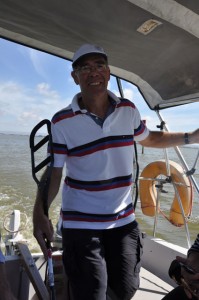
Lucky Locky at Goolwa last weekend

Some blokes have all the luck. Take popular yachtie vice-commodore of the Goolwa Regatta Yacht Club Locky McLaren  spend last Sunday motoring his yacht loaded with a bunch of female friends, including his wife,  my dear friend Jayne and my neighbour, dear friend Chris, three other girlfriends and myself on the River Murray from Goolwa to Clayton Bay.  As if an all-female crew of five beauties wasn’t enough of a thrill (their husbands were conveniently sailing in a second yacht) Locky left this morning  – a week later – for the exotic adventure of a lifetime.  To Siberia – and no, it’s not to the saltmines. His exciting adventure exposes how little we know about Russia, let alone Siberia. He flew to Dubai and then on to a Moscow, waiting for a local flight to Novosibirsk in Siberia where he has been contracted as a consultant to assist the locals with building up their beef industry.

His exciting adventure exposes how little we know about Russia, let alone Siberia.  Now that’s the first lesson for us all here in hot Oz. Siberia clearly is not covered with snow all year and Locky will be arriving in springtime when  one suspects the region is beginning to sprout summer grasses for cattle to graze.   Watch this space for more travel bulletins from what must be close to the coldest place in the Northern Hemisphere.  What an exhilarating life Locky is living right now.

A bit of background info about my experienced friend.  Locky was not chasing consultancy work and out of the blue he had a call from a former colleague and offered project work in Novosibirsk, Siberia, Russia.  Expo trade SA export to there and Siberia and has subcontracted “International Agriculture for Development” to develop technical advice and business plans for their Northern Hemisphere beef and dairy industries.  When Locky retired he said if he accepted any consultancy work he would want it to be with developing countries because he wanted to feel that his expertise was making a difference. Two previous consultancies has been in Australia with visiting senior Iraq and Egyptian professionals.

What an exhilarating life Locky is living right now.  Watch this space for more travel bulletins from what must be close to the coldest place in the Northern Hemisphere.


Hollande in hole of scandal, debt and despair

Ex-pat journalist Emma-Kate Symons sums up French president Francois Hollande’s bumbling performance in his first 12 months in office in two words – Quel catastrophe!

From her first-hand perch in the country, she reports that there is panic at the Elysee presidential palace as France, the second-biggest economy in Europe, fails to lift itself out of a morass. Unemployment has shot up from 10 per cent to 13 per cent,  a savage 75 per cent tax on the rich has triggered an exodus as its wealthy citizens and a ministerial tax evasion scandal by disgraced former budget minister Jerome Cahuzac has cut to any credibility Hollande’s government had.

But it is the everyday French citizen who is increasingly nervous as some economists suggest the country could be facing a “triple-dip recession’’ on the back of a sick economy. Where there is anxiety about the future, French people are spending less.

Hollande’s disapproval rate is a record 70 per cent and he has only been in office for less than a year. In The Financial Review Symons says Hollande’s election promises of stimuli for growth “are already dead’’: “They have been buried under Hollande’s absence of conviction, leadership and authority’’.

The problem Hollande refuses to face is the bloated public spending at 56 per cent of GDP and rising. Instead, having slugged the upper classes, he is biting the middle class with new taxes to plug incidental holes in the deficit. But, he has obstinately refused to cut into France’s bloated public service to fill a gaping abyss in the deficit.

While Hollande bumbles, “France faces its worst political and economic turmoil in decades’’ writes Symons.

Over the border in Germany, France is seen as a “huge drag’’ on the Eurozone because the socialist government has not moved fast enough on labour market reforms or deficit reduction.

Jean-Louis Dalbera, a banking sector expert has argued in Le Monde that although France has not fallen into full recession yet, it cannot rejoice.

The country’s first quarter growth of 0.1 per cent was only achieved because of a “significant rise in the public deficit’’, which accounts for 4.8 per cent of GDP.

He reckons belt-tightening will only aggravate the economic situation. “But at the same time we are heavily increasing taxes,’’ he writes. “We must finally take aim at public spending.’’