Masters Cricketer Man of Match in US


South Aussie cricketing Stalwart wins in US

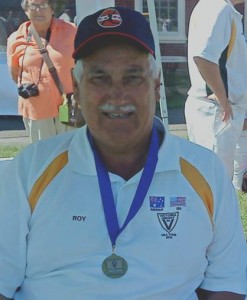
South Australian masters cricketer Roy Schulz proved a mean bowler in Australia’s national over 60s cricket team in its tour of the United States in May.

On the last day of the International Cricket Festival in Philadelphia at the Merion Cricket Club he was named Man of the Match. And no wonder!

Roy Schulz over 60 but not out… gave his sterling performance of 4 wickets in one match! THE TEAM PLAYED AGAINST FORMER TEST STARS AS Shaun Pollock (S Africa) and Chandapaul from India… They, too, may be grey but not down or out.

It was the first Australian national team to make the trip since 1932 and our seniors  played on some spiffy cricket pitches in Los Angeles,  New York and Philadelphia. Of note was the famous Merion Club and the Philadelphia cricket clubs. These private clubs are steeped in British traditions and standards of dress  and the fields surrounding the clubs showed touches of olde England. As an example of upholding the best of British cricketing tradition, that genteel of drinks, gin and tonic, was served to the ladies accompanying their husbands on the tour by the president of the cricket club himself.  The touring side played against such greats as Chandapaul (India) and Pollock (South Africa).

Roy was his usual modest self when quizzed about his performance, but his No. 1 fan, loyal wife Pamela praised him like any good Aussie cricket commentator. “Roy was indeed Man of the Match on two occasions because he bowled so accurately for a senior,’’ she reports.

“Despite our team often being twice the age of some of the teams they did remarkably well to keep the scores buzzing along.’’


Pentagon visit a coup for Pamela


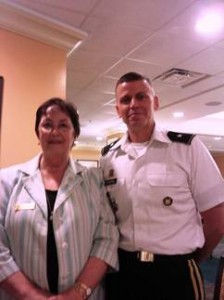
Dr Pamela Schulz in the Pentagon

High level military connections continue to serve up surprising treats for Dr Pamela Schulz, chair of the Defence Reserves Support Council of SA.

What could be more exciting than an informal visit to the Pentagon during her recent visit to the United States last month. And the invitation was from the chief of the National Guard Board (similar to our Reserves in Australia) Brigadier General William Stoppel himself.

They exchanged ideas and engagement activities for supporting Reservists with her host and colleague of General Stoppel,  Colonel Christine Stark, Dean of the National Defense University in Washington.

Naturally, this highlight required a reciprocal personal invitation to General Stoppel to attend a Defence Reserves Association Conference to held in Perth, Australia in August this year. Dr Schulz delivered the invitation on behalf of Major General Jim Barry, president to the Defence Reserves Association (DRA)  in Australia.


Oooh La La To Lovely Adelaide

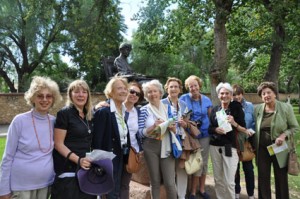
Our French visitors at Dame Roma Mitchell’s statue

For me, this has been an exhilarating week  of  girlie stuff: a strange French woman staying in my house, a glorious garden party with heaps of girlfriends, a girls’ night in delightful accommodation, a Friday lunch to celebrate a much younger female friend’s fiftieth and afternoon tea with my beloved sister.  There was the lunch-hour talk by former colleague Samela Harris on “Books in my Life”  where I snapped photographs and an evening pub meal with my dearest friend.

This smorgasbord of “sugar and spice and all things nice’’ began a week ago when I met the French woman I had agreed to billet, who was a stranger to me.

It did cross my mind as I stood at the balllustrade at the Adelaide airport awaiting the arrival of my house guest that my decision to billet a stranger could be disastrous – a weekend of an impenetrable wall of silence if her English was as bad as my French.  But within a noni-second of meeting Daniele, one of eight French women from the Lyceum clubs in France, I knew our three-day sojourn would be an enriching experience.

Instead I engaged with a delightful female of a certain age – like me – whose limited English bridged all the gaps in my schoolgirl French. She, who swooned when she discovered a koala in a street tree, hails from Brittany, an area where my late husband Olivier had also lived.

Danielle and her seven French colleagues are on their way to Perth for the tri-annual International Lyceum Clubs Congress – and I will join them next week in Perth.

On the Saturday,  Veronique, Jacqueline, Marie-France, Sabine, Danielle, Christiane and Muriel visited the Art Gallery of SA to see the Turner exhibition before my French teacher, Elsa and myself – and two other members of the Adelaide Lyceum Club – took our guests on a walking tour of our lovely city. Patrice, Sabine’s husband was the token male.

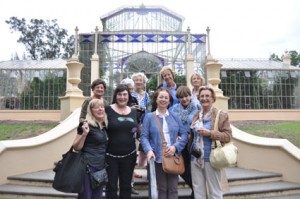
Our French friends at Palm House

Our tour had taken hours of planning and began walking along our cultural precinct, North Terrace, then onto the Adelaide Festival Centre, past the River Torrens to lunch at Regattas. Back onto North Terrace we all caught the free tram to the Adelaide Central Market for a 20 minute shop.  After gathering them all up like mother hen with her chicks, we caught the free bus to the East End, walking down Liberman Close to Rundle Street East to Fellinis for superb coffee. There we sat under umbrellas on the pavement against the quaint colonial Northern streetscape of Rundle Street.  We could have lingered, but walked briskly on to the Botanic Gardens.

We nipped into the Lily Pond pavilion in the nick of time before casually walking across the gardens to Palm House, the delicate Victorian glasshouse designed by Gustav Runge. Danielle is in the front row on the right.

Later that night, as Danielle and I dined at Windy Point Restaurant, with our gracious city twinkling mischievously below us, it occurred to me that we are blessed to live in such an accessible, visually beautiful place – Adelaide.  In one delightful  day, I can report that Danielle has fallen in love with the ambiance of our city and tomorrow we will visit Fleurieu Peninsula and our beaches to make her visit a memorable one.


I’m a cool, cute, cream-colored Citroen

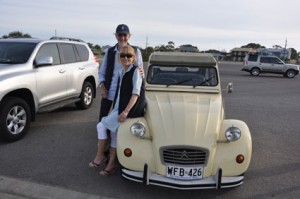
Graham and Ruth with their new “fun car”.

It’s a good thing these builders are sociable blokes.  Not only are they doing an excellent job restoring our ‘white room’ and building a French-style fireplace for us, but they have invited me to join them for their short lunch breaks because I work from home.  During one such break, we got talking about the popularity of all things French  (even though Rolf and Bill are of German heritage), and the conversation revealed that Bill owned a Citroen 2CV.


My wife Ruth has always had a soft spot for these iconic “people’s cars’’ so Bill made arrangements to drive the 2CV to our place on Ruth’s day off work.  It was a secret and she knew nothing in advance.  Her shriek of surprise when she saw it parked in the driveway that Tuesday morning was no surprise to me, but it amused Bill and Rolf.  Soon she was swooning on a drive around the back roads of Oakbank, and when she returned, she made Bill promise to give us first option if he ever decided to sell it. His classic car was beautifully restored – the result of a 12-year love affair during which Bill had lavished many hours on returning the car to its former glory.


Fast forward three months and guess what?  We are now the owners of that, cute, cream coloured, 600cc air-cooled engined ‘fun car’, an early retirement present. These iconic cars rarely come up for sale, and we knew if we wanted one it was now or never.


In the two months since we’ve owned it, Ruth hasn’t had time to master the unusual gears (the gear stick protrudes from the dashboard), so I’m the unofficial chauffeur, a role I relish. I had forgotten how much fun it used to be ‘going for a drive’. Unlike our other, boring, modern cars, when we take ‘Lily’ out for a run it’s a special occasion. People wave at us as we rattle past, enjoying the ride, floating over the bumps.


The car was originally designed in the 1930s to encourage French farmers to switch from horse transport to mechanised transport, and one of the design requirements was that it could be driven over a ploughed field with a basket of eggs in the back, without breaking any eggs! Consequently, the ride is delightfully ‘floaty’.


The car never made it into production before the war. The prototypes were destroyed or hidden so that the occupying Germans couldn’t discover and use the advanced technology (surprising but true. The design pioneered many automotive innovations later adopted by other manufacturers). Production got under way in 1948 and continued until 1990, by which time 8,830,679 2CVs and variants such as the Dyane has been built. And during all those years, the body style hardly changed – when you’re on a good thing stick with it.


There aren’t many of these little beauties in Australia, so if you see a cream one on the road, give it a wave and a beep – it’s probably us smiling away behind the flat windscreen!


Graham and Ruth Bettany, Oakbank


IRON LADY’S LEGACY LIVES ON :

Baroness Margaret Thatcher

In this laissez faire society of ours, it is hard to understand the hatred which spews forth in Britain upon the death of Britain’s first female Prime Minister Margaret Thatcher. The poor woman is dead, but the knives are out and none more vicious than from the mouth of former actress turned MP, Glenda Jackson.

The closest we have come to such bitterness would have been Gough Whitlam’s dismissal in 1972 when he famously said “Maintain the Rage’’, which of course, Australians didn’t do.  He has long been forgiven for his sins and in his dotage is admired by all for his good deeds, his mistakes and messes long forgotten.

Not so in Britain where Maggie’s death has divided the nation.

Yet, there is certainly more praise because Baroness Margaret Thatcher was probably the greatest female political leader of the 20th century. She transformed a nation and inspired a renewed sense of  greatness in a jaded people. She was an incredible, inspiring leader who, using Frank Sinatra’s catchcry,  did it her way, ploughing like a steamroller through her many opponents to achieve her goals.

Political commentators such as The Australian’s foreign editor Greg Sheridan heaped accolades on Thatcher stating that she had transformed a languishing British economy to lay the foundation for contemporary British society.

“She crushed inflation, balanced the books, sold off state-owned industries (involving 900,000 jobs) so that they would be more efficient and less prone to public sector union vandalism; she brought unions back under the control of the law…’’ he begins.

“She sold public housing (a million of them) to spread property owning economic independence from the state, and she greatly reduced income tax’’. This was an amazing feat with Sheridan reporting that the top tax rate came down from 83 per cent to 40 per cent’’.

It is interesting to note that she once said “feminism did nothing for me’’. This ruffled many female feathers because she was the epitome of what feminists strive to prove that women are as good as men at anything they turn their experienced hands to.

Hers were humble roots, the daughter of a Methodist shopkeeper, who was neither born with a silver spoon in her mouth, nor carrying  that upper-class born-to-rule mentality. Yet, she most certainly was not a working-class heroine either.  Yet, the doting wife of Dennis and mother of two held firm to kitchen table financial wisdom – You cannot spend money you haven’t got.

She had the political will to reform  industrial relations, but made a generation of enemies, who threw street parties when she died, 30 years after the miners’ strike of 1984-85 when feisty Arthur Scargill became leader of the miners.

Her other famous statement “This lady is not for turning’’ reflected her greatest triumph – revitalising the British economy and reforming a nation in its image of itself.

Anyone who has watched the film Iron Lady starring Meryl Streep may, like me, question whether Thatcher made the right decision to mount the Falklands War. Yet, according to Sheridan, “the whole operation, which Britain swiftly won, changed the understanding of Western military resolve”.

There is no doubt that Thatcher was a role model for my generation.  She had a fortitude which inspired Boomer women to adopt the same stoic resolve, to seek their own possibilities.

Former Prime Minister John Howard credits Baroness Thatcher as being one of the three forces , along with US president Ronald Reagan and Pope John Paul II, with the defeat of communism, the end of the Cold War with Russia and the fall of the Berlin Wall. What a joyous victory for the Western world.

So why all this hatred when her legacy nationally in Britain and internationally is so spectacular?

Well, she did do a lot of things which caused people enormous loss and emotional pain. She did shut 146 unprofitable coalmines catapulting 173,000 people out of work onto the dole queues. That’s a hellavu lot of personal misery and angst. Thatcher stopped propping up markets and deregulated them heralding more efficiency and accountability.   She rid the country of union “vandalism’’ dismantling the once all-powerful union system which often held the country to ransom  – and she went to war and won!

However, perhaps her most amazing achievement was to win over the working classes and introduce the capitalist mindset to millions of Brits. Thatcher shook British upstairs-downstairs society to its core. The would-bes if they could-bes were now becoming “affluent workers’’ able to acquire things their parents never even dreamt of. They became materialistic and they voted Margaret Thatcher into power from May 1979 until November 1990 when she resigned rather than be deposed from within her own party.

How interesting it was to have two all-powerful women –  Queen Elizabeth and Margaret Thatcher together – one on the anachronistic throne of England “reigning’’ the Commonwealth, the other ruling Brittania with an all-powerful iron fist. Rumour has it that the Queen did not like her, but in a break with tradition, she will attend Margaret Thatcher’s funeral. That’s the ultimate statement of respect.


When a grandchild is born

Scarlett Rose Williams

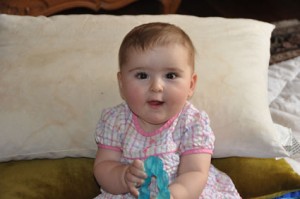
There is no point in wishing to be young again. I ponder this profound fact in the hairdresser today while having another colour to cover my rapidly increasing grey hairs.  I am impatient to finish because I am meeting my daughter-in-law Vanessa for lunch with my eight-month-old grand-daughter Scarlett . This is to be the highlight of my day.

It occurs to me that grand-children are the best part of growing “older’’  if you are blessed enough to have offspring who are busy breeding.  There is no doubt that these children of our children keep us young at heart with a spring in our step and a silly smile on our dial.

My dear mother had 13 grandchildren and I have four little darlings, although the two eldest, Samuel, 11 and Angus, 9, are known to have a feisty relationship at times.
Tomorrow Angus begins his AFL footy season for under nines and I know he will be a champion one day.  I am trying to convince him that Port Power should be his team of choice, but he is a faithful Bulldogs supporter.  Samuel is a genius at the computer and is my personal internet advisor.

Speaking of Angus, I grin remembering when I visited them in London on the occasion of Angus’s fifth birthday and he introduced me thus: “This is my grandma from Australia. I love her, but she can be tough sometimes.’’  Out of the mouths of babes!

When  my latest grandchild, Scarlett arrived I was given a delightful booklet Grandparents and Grandchildren subtitled , The delights of being a grandparent by Camille Liscinsky.

Every page holds a gem of wisdom on why being “older’’ is such a blessing – as long as your only son does not call you “elderly’’ as mine loves to do.

One of the many amazing things about grandparenting when you begin to collect multiple grand-children is to witness how they are so different, yet have the same parents.    So, it comes naturally to treat them differently, to note their idiosyncrasies, their capacity for humour,  and what reactions become familiar.  Or as one statement in Camille’s book so aptly states:

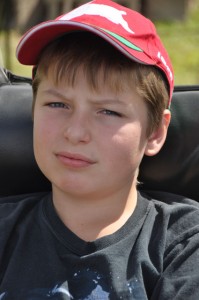
Dark-haired, dark-eyed grandson Angus Richards

“I think of our four young grandchildren as embryonic personalities emerging from tiny newborn strangers.’’

And then, if you are are blessed as I am, one little angel arrives who looks remarkably familiar – and to quote Thomas Hardy, who once said : “I am the family face’’. Scarlett, unlike her older cousin, Josephine,  bears the strong visual traits of the women in our family.

Another of Camille’s contributors offers:  “My granddaughter is so amazingly like me: I actually see myself as a child when I look at her. There I am, before my eyes, reincarnated.’’

Scarlett, like her great, great grandmother, has the deepest dark brown eyes like her father,  Serena and me and the three generations before me.

My mother had these blackish velvet eyes and when my father was wooing her he wrote “My darling, your eyes are like limpid pools of velvet darkness’’.  How could she resist such poetry?


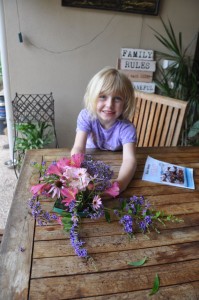
Josephine creates a floral centrepiece

And just in case you think this is a flight of fancy, grand-daughter number one – six-year-old Josephine whose blonde hair is like spun gold– tells me, her blue eyes sparkling like the sky:  “Well actually, grandma, Scarlett looks exactly like you .’’

Family likenesses give such joy and when they bear little resemblance, they hold our fascination for their difference. Josephine is enchanting for the simple reason that she is unlike any of my maternal forebears or me.

One grandparent captures this kind of pleasure:  “When I look at my grandson, I see my father’s same sparkling eyes, dotted with a brown fleck.’’

When a grandchild is born we have the wonderful chance of welcoming a new generation to love – and that is such bounty for living 50 or 60 or more years.

Because grandchildren are the link to our family’s past and a bridge to our family’s future.  And if you are like me you are having the time of your life with them.

I am sure you would like to meet my grandchildren – each one a glorious individual.