Flavoursome food, fine wine – and flowers
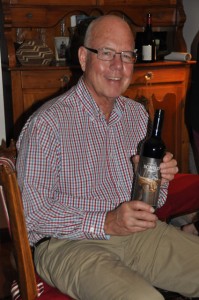
Celebrated wine identity Peter Dry

Celebrated wine identity Peter Dry

It was always going to be a spectacular dinner party.  There were eight guests and we had gathered to celebrate the fact that my neighbour and friend Peter Dry, has won the Maurice O’Shea Award 2014 for excellence in the wine industry over his successful 40 year career.    Peter and all of the three other male guests were wine connoisseurs. The women in our group loved wine and all guests were gourmands. My friend Jayne was responsible for dessert, so I needed only to prepare entrée and main course, yet the pressure for performing well had me changing menus until the day before.

Here is a photograph of the final menu, which my creative niece Chelsea designed to add a touch of class to L’art de la table.  My friends expect a certain Frenchness to shine through and I hope they were not disappointed. As a widow with only those one pair of hands, I had to be organised and I wanted to be relaxed.


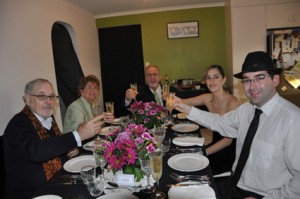
I dressed the table the night before our event and was happy with its simplicity and delighted with the central floral display from my own garden.
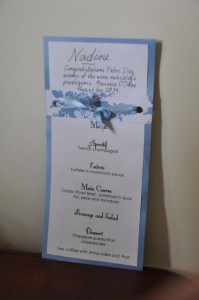
Chelsea's pretty dinner invitation

Chelsea’s pretty dinner invitation

The evening began with popping the cork of a Moet and Chandon champagne and as a light, summery accompaniment to such a classy French aperitif, I cut up big slices of watermelon into cubes sticking in tooth picks. To provide a contrasting taste, I quartered grapefruit, cutting into sections and drizzling with liquid honey and sticking again with tooth picks. This was a smart move because a friend had given me all of the grapefruit, making it  a low-cost, but attractive fruity duo  provided a refreshing, unique dish with colour and texture adding interest.

Once we all sat down, I presented the following menu:

Entrée – Farfelle in Mushroom Sauce – I must admit was chosen for its ease preparation, but also because it came from a favourite French cookbook. Voila! 

The recipe called for butterfly pasta and Characelle mushrooms, but when they were unavailable, I chose dried porcini, reconstituted, adding fresh, diced and cooked Swiss brown mushrooms.  A medley of finely chopped herbs were thrown into the sautéed mushrooms and the swollen porcini, drioed in kitchen paper was added to the mix, but not fried.. Lastly crème fraise was spooned into the hot mixture and I sat back and waited for the accolades.

After much agonising whether to have rolled turkey, I bravely decided on a large 1.8kg Scotch fillet to create the main course – Classic Roast Scotch Fillet.  Vegetables were gourmet potatoes, bought in a micro-waveproof plastic bag, peas and baked tomatoes topped with grated cheddar cheese. The butcher said the meat was so delicious it didn’t need to be marinated and simply needed to roats at 180 degrees for 1.5 hours. However at the exciting moment, after allowing the roast to sit for 15 minutes, the first cut clearly revealed a rare piece of meat.  What to do?  A male guest to the rescue. “Cut it in big slices and stick it back in the overn for 10 minutes,” he said.   All it took was another six minutes and the slices were further cut into juicy strips.  Another friend helped with the gravy, which was simply juice left after the pan was drained of fat, some of the pea water, a little beef stock and the master touch – A glass of one of the top wines sitting at the bar ready for consumption.  What could have been an agonising, undercooked failure, became the piece de resistance of the evening.
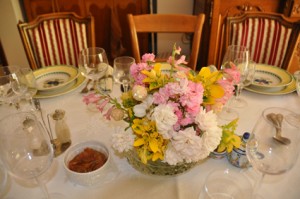
Flowers from my own garden are important for l'art de la table

Flowers from my own garden are important for l’art de la table


My friend’s Pineapple-Passoinfruit Cheesecake was lovely and light and delicious in its biscuit base.

However, such a magnificent meal really was the backdrop to the wines we consumed. Our guest of hnour brought one of his favourite reds, an Accerto Nebbiello d’Alba (even though Peter has been responsible for the education of a few generations of Australia’s current winemakers.  Another was Zucolo Fruiti Grave Pinot Grigio, an Italian wine delight in recognition that Peter was largely responsible for the introduction of many French, Italian and Spanish grape varieties to tge vineyards of Australia.

Austtralian wines were not forgotten with a REdman Coonawarra 2008 causing much discussion on which was best – French or Australian reds. French winemakers with vineyards in Australia also featured including Dominique Portet wines of the Yarra Valley because Peter had education Dominique’s son Ben, who is winemaker of the attractive range.  His signature wine Ten Men Shiraz 2012 from the Pyranees region was among Schild Estates Shiraz 2008 from the Barossa Valley, Mintaro Clare Valley Riesling 2012 and another 2008, The Islander’s Bark Hut Road, from French winemakrer Jacques Lurton’s vineyard at Pardana on Kangaroo Island.


Cricket bats and caps signal national grief


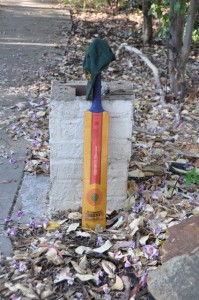
A neighbour pays his respects on the day of Phillip Hughes' funeral.

A neighbour pays his respects on the day of Phillip Hughes’ funeral.

Never have cricket bats been such a poignant symbol of culture.  Neighbours were among countless Adelaideans who placed cricket bats and caps on their properties as a sign of respect – and sadness – for the untimely and  tragic death of  Redbacks cricket star Phillip Hughes.  The nation’s overwhelming outpouring of grief  when Phillip died following a freak bouncer delivery by Sean Abbott, has become an amazing cultural phenomenon.  Some say the media has given us an overdose of coverage and expressed sympathy for Phillip’s parents for such an onslaught about the death of their beloved son.  However, on the day of his funeral, I snapped this cricket bat propped up against the letter box on my neighbours, three houses down in my street in the Adelaide Hills.  Driving to the hairdresser down on the plains, I passed a few others in leafy suburban streets.  Ordinary Australians far away from Macksville, wanted to show respect for Phillip as one of the young cricket stars of our nation. We didn’t have to visit anywhere. We could make a poignant gesture in our own front yards.

However, it is the television coverage of Phillip’s funeral which so united us. It was so sad that anyone watching would have been moved to tears.  We all needed to feel part of his farewell and every parent ached inside for Phillip’s mother weeping in the front pew of her son’s funeral, but especially, Phillip’s big, burly dad, weeping as he carried his son’s casket from the Catholic church.   Ironically,  his dad helped make it OK for men to cry  because he wept with great sadness in such a public place, which validates the fact that men need to be able to let grief manifest in tears. It is such a human response to profound human sadness and unspeakable loss.  This is why it’s OK for men to weep because it is part of our quiver-full of human emotions we are born with. Along with love comes loss.

Losing such a popular player at age 25 was certainly “unchartered waters” for our cricketing community and fans, but Australian captain Michael Clarke showed much-needed leadership which really was the stuff of 21st century Aussie sporting heroism, far more important at that moment than hitting a ball for 6 to clock up a century.  As former Australian cricket team captain, Rick Ponting stated in today’s The Weekend Australian, in a time of adversity, Clarke’s character and integrity shone through.

I believe why we were all engaged so completely with the tragedy was because, whether we are cricket fans or not, we are Australian and and we understood that Phillip was a country boy from a small regional town where many of us also have roots, even if a generation back in time. We agreed with his parents who declined a big funeral in a capital city and decided their boy would have a Catholic funeral in the same Catholic church where he was baptised, the same faith background of many millions of Catholic Australians. The spiritual environment of the country priest officiating and the informality of a Prime Minister sitting in row three seemed to resonate with who we are now as Australians – still an informal lot, mostly Christian and Catholic with a Prime Minister, who is a practicing Catholic.  The eulogies by Phillip’s siblings captured a wonderful young country fellow who had one foot back in Macksville with his cattle and the other at the pitch batting for South Australia when he achieved 63 not out against rival state NSW.   And where in the world would it have seemed so natural for everyone, from politicians, international and local cricketers and town dignitaries to follow the hearse with family and relatives walking down the main street of such a typical rural town – Macksville – now forever famous as the final resting place of Australian cricket star, Phillip Hughes.   That is my humble opinion on why we were all so moved by the whole process of  Phillip’s death. The media should be congratulated, not criticised for excellent coverage of what was a defining cultural moment in many ways.


Michael’s batting an innings into his 70s

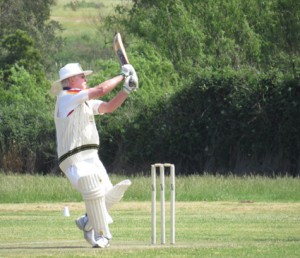
SA's cricket captain Michael Willlson displays one of his wonderful hooks at the cricket balll.

SA’s cricket captain Michael Willlson displays one of his wonderful hooks at the cricket balll.

On a much more joyful note, here is a photograph of quite a famous South Aussie Master of cricket – Michael Willson, who sent this snap of himself hooking the ball at the Australian Over 70s National Interstate Cricket Championships held in Melbourne recently. Michael is the SA Captain and also the Australian Vice Captain.  However SA missed out on the finals by one run.  Such nail-biting (although there doesn’t seem to be a crowd) is why cricket continues to enthral us and why we need our heroes, young and old.   Michael has been playing competitive cricket for more than 50 years of his life beginning as a young lad on his family’s farm on Kangaroo Island. Now he travels to England to represent his country in Masters cricket matches.

Peter leaves an Australia-wide wine legacy

Celebrated wine identity Peter Dry

Celebrated wine identity Peter Dry

Congratulations to renowned viticultural researcher and educator,  Peter Dry, who has won the 2014 Maurice O’Shea Award for his outstanding service to the Australian wine industry over 40 years.

He began his career in 1970 in the Riverland as a research officer with the South Australian Department of Agriculture in Loxton.  After five years, he moved to Roseworthy Agricultural College as a lecturer in viticulture, biology, plant pathology, microbiology and sensory evaluation.

Here he worked with Dr Richard Smart developing the first climatic classification for Australian viticultural regions. Together they encouraged greater diversity in the range of grape varieties being planted in Australia.

When Roseworthy merged with the University of Adelaide in 1990, Peter began to focus more on research. He is very proud of his research work with Dr Brian Loveys from CSIRO which led to the development of the revolutionary irrigation technique, partial rootzone drying.  It allowed the grapes to be grown using only half the water previously required.

In 2008, Peter retired from the University, but continues to work as a viticultural consultant with the Australian Wine Research Institute, lecturing at numerous seminars. He has authored 270-plus articles and has also edited some of the best-known books on viticulture in Australia. He has travelled extensively overseas as a viticultural consultant and eminent lecturer on Australian wines.

In 2012, he was inducted as only the sixth Fellow of the Australian Society of Viticulture and Oenology, which recognised his long career in teaching and research.   His other legacy is the generation of students training to enter the wine industry. He therefore has stamped today’s winemakers now working in vineyards and wineries across Australia.

In his absence overseas, Peter’s son Nick accepted the Maurice O’Shea Award, sponsored by McWilliams’ Wines, at a black-tie dinner in Adelaide on October 1, 2014.


Boomers’ unlikely to enjoy long Bucket List

If there is one thing which will keep ageing Baby Bpomers in the work force is the realisation that their long “bucket list’’ of activities for retirement will be unachievable.

According to new research released recently by Rest Superannuation Fund, of 1000 people surveyed, less than  one third believed they would  be able to fulfil  their retirement dreams – and one in six did not think they would be able to tick off any bucket list items.

This is because latest figures released by  the Association of Superannuation Funds of Australia showed that more than $57,000 a year would be needed for Boomers to enjoy a “comfortable ‘’ retirement together.

Multiply that by 10 years and the kitty would need to hold about  $600,000 – plus a freehold home.

For those seeking a lower standard of living in retirement, the association quoted a figure of $33,000 a year.

In tandem with their aspirations in retirement is the good news that the average age of life expectancy for men is about to pip 80 years, while women continue to live to 83 years of age. It means 50 per cent of the population will live beyond that age, many  well into their dotage.


My family wins table at Heston’s Fat Duck

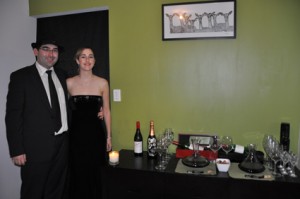
Tyson and Vanessa at the fabulous wines they offered us that evening.

Tyson and Vanessa at the fabulous wines they offered us that evening.


My children chose a Penfolds Grange Bin 30, 1990 to show their love for us.

My children chose a Penfolds Grange Bin 30, 1990 to show their love for us.

Pity it wasn’t one of those multi-million dollar lotteries, but from the exhilaration from my son Tyson’s household you would think they had won the jackpot.   However, in an exciting win, his wife, Vanessa’s name came up in the ballot results for  reservations at Heston Blumenthal’s Fat Duck restaurant at Melbourne’s Crown.

Thousands missed out. There was an unbelievable 89,000 entries meaning more than 267,000 people were vying for each one of 14,000 seats in the six-month period next year.

Why am I so intimately involved in this big win when I live in Adelaide?  Because the first telephone call to share the good news was to me, the grandmother of the two little children  Scarlett and Zachary, whom I shall be caring for when they take up their seat on August 11 next year.

They probably won’t remember, but it will be almost three years since that special night in August 2011 when this enterprising couple held an exceptional dinner party for their two sets of parents – Vanessa’s parents, Sandra and John, and my husband, Tyson’s step-father Olivier, who was terminally ill, and myself.

It was a big surprise and we were told to dress up with bling and we parents expected to be taken out to the theatre for the night. Instead, they had cooked a fabulous meal and even more special was the Penfolds Grange Bin 30, 1990, which  Tyson opened to share with the six of us. But the best part was not the exquisite wine – it was the heartfelt speech my son made about what wonderful parents we had been and how they appreciated our support.

Now that my husband has died, that evening, with the stunning l’art de la table, the attention to detail, an illustrated menu, and finally all the food so beautifully cooked and presented, was such an act of love.

It is no co-incidence that my daughter-in-law was the Dux of the Le Cordon Bleu Hotel and Resort Management Degree course some years ago.  Now the mother of my two grandchildren thoroughly deserves her great treat. And they are not coming home that night either, which is why I will be winging my way over to Melbourne to babysit.   Their dining companions, you see, are my daughter, Felicia and her soon-to-be-husband Justin.

That ballot ticket couldn’t have gone to a more deserving couple.