A Thumb Down on Sex

Anything British novelist Martin Amis writes is bound to be brilliant expression. And his comment on a new collection of British poet Philip Larkin’s letters is not only an excellent read in this weekend’s Australia Review, it reveals much about Larkin’s cryptic sex life in a rivetting manner.

In Philip Larkin: Letters to Monica, edited by Anthony Thwaite and published by Faber, Larkin wraps up his disillusionment with intercourse in just  one quote:

“I think…someone might do a little research on some of the inherent qualities of sex – its cruelty, its bullyingness, for instance.  It seems  to me that bending someone else to your will is the very stuff of sex, by force or neglect if you are male, by spitefulness or nagging or scenes if you are female.  And what’s more, both sides would sooner have it that way than not at all.  I wouldn’t.  And I suspect that means not that I can enjoy sex in my own quiet way but that I can’t enjoy it at all.  It’s like rugby football: either you like kicking and being kicked, or your soul cringes away from the whole affair.  There’s no way of quietly enjoying rugby football.”

Philip Larkin: Letters to Monica will be released in Australia in January through Allen & Unwin.

Hearing loss

An interesting  Lifestyle and Hearing Health Survey arrived on my desk this week from Dr Ross Walker, one of Australia’s leading preventative health specialist and because my father Frank, is deaf, I filled it in and read the small print, too.

Since a road accident in 1997, I have suffered constant tinnitus, a ringing or buzzing in both ears, so already my hearing is somewhat impaired.

Dr Walker says I am among one in six Australian adults (more than 3.5 million people) who have some form of hearing loss – and the figure rises to one in three over 60 years.

He says poor hearing impacts negatively on people’s quality of life creating feelings of extreme frustration, anger and increasing isolation from family and friends. The acid test here is if you need to ask people to repeat themselves as you didn’t quite catch every word or if you have difficulty understanding conversations in crowded restaurants, it may be time to check out your hearing.

What frustrates him is  that “large numbers  of people with hearing loss either don’t recognise their problem, or are in denial’’.

His message, via the survey is that medical research has proven that early diagnosis and treatment of hearing loss really helps people resume a normal life.

He suggests everyone over 60 years should have their hearing checked every couple of years. Anyone with the added problem of diabetes should check their hearing every 12 months.

The good news is that hearing aids are now virtually invisible and I remember receiving a neat stylish hearing aid in a slick container when I worked at The Advertiser.

Interestingly the survey which links our lifestyle and interests questions drives home firstly how enjoyment of life through leisure, hobbies and holidays  are dependent on hearing.

Wearing a sophisticated invisible hearing aid to enhance our quality of life seems a sensible step towards ageing well.

AudioClinic has also produced The Australian Guide to Hearing Services and offers a no-obligation FREE Hearing Test by calling 1800 057 220 (valued at $70).

A rose by the name of David Ruston

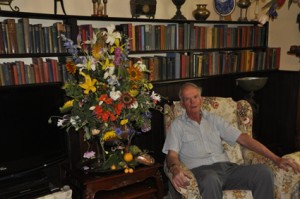
David Ruston with one of his period arrangements

It was a rare treat to join the acclaimed rose identity David Ruston on a tour of his world-renowned rose garden and his early 20th century home at Renmark, in South Australia’s Riverland.

David was the centre of attention at Renmark’s 16th Rose Festival this year because a sculpture was unveiled in the town in his honour and the extended David Ruston Visitor Centre was also a hive of activity.

The garden, ablaze with blooms of every colour and variety, is a testament to David who began extending his father’s rose plantings of 500 bushes when he was still a teenager. By 1968 there were 3000 bushes and he began a commercial cut flower business. Today there are more than 40,000 bushes of 3000 varieties covering 11 hectares.

We join many rose enthusiasts who follow David like children behind the Pied Piper, around the largest private collection of roses in the southern hemisphere.  He leads us past the display rose plantings released each year of the 21st century which edge the visitor centre, instructs us as he goes past  many pretty pink, red and yellow hybrids and magnificent blooming climbers.

We walk another few hundred metres past many ornaments and sculptures into his own personal cottage garden. Here 50-year-old roses form a flowering hedge for irises,  peonies,  poppies,  and carpet roses, each one neatly named.

However, the greatest treat was to open his home and to lead us into each room beautifully decorated with floral arrangements – glorious masterpieces which reflect his uniquely brilliant talent to create works of floral art reflecting the old Flemish, Dutch and French painters. His displays set in unique containers reflect the floral paintings by the old masters  which hang on all the walls of his home.

The delightful experience mirrors David’s impressive career as a floral artist who has created arrangements for a variety of celebrations and occasions throughout the world. Locally, he handled  the opening of Carrick Hill, and Chateau Barrosa in the Barossa Valley for Queen Elizabeth II, St Peter’s Cathedral and Ayers House. He has also presented floral displays for the Sandringham Flower Show attended by the late Queen Mother and Hex Castle in Belgium.

However, his grandest display on Australian soil was perhaps in the Great Hall

Sydney University for the Rose Convention in 1988.

David is a spritely 80 years old and still works each day in his personal garden although the rose garden itself has now passed to his niece, Anne Ruston and her husband Richard Fewster.

He is a former president of the World Heritage Rose Society and he received an Order of Australia Media for Services to Horticulture.

Media Bullying Judges

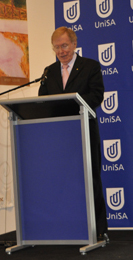
Retired High court judge Michael Kerby in Adelaide this week

Violent headlines and “angry language’’ by the media is bullying judges and having a negative impact on public opinion, according to retired High Court Judge, Justice Michael Kirby.

And he listed a string of  provocative headlines  including “This Justice is a Sick Joke’’, “Maintain the Rage’’ and “My Fury’’ over perceived inadequate sentences.

He said derogatory language such as “Overdue For A Dressing Down’’, “Who is judging the Judges?’’ and “Judges Must Know Their Place’’ undermined judges’  independence.

Justice Kirby  was launching an academic book Courts and Judges on Trial by communications expert and UNISA lecturer, Dr Pamela Schulz at UNISA in Adelaide yesterday which outlines a “discourse of disapproval’’ of judges in media language.

The book, a powerful research analysis of media reporting of justice,  also reveals how  the issue of law and order has been politicised and media reporting has fostered a culture of fear in the community.

Justice Kirby said the judiciary had suffered a loss of esteem through media coverage.

 “We get the angry language and the dumbing down of the courts and a bully-boy attitude towards the judiciary,’’ he said.

In the past, he said the Law of Contempt had upheld the respect for the Judiciary, but  was no longer used to restrain the media since the rise of the Human Rights Movement in the 1990s.  He said Dr Schulz had shown how negative media coverage of controversial cases and judgements had affected public confidence in the judiciary.

He admitted the judiciary had an image problem and was “struggling’’ with the problem of how to communicate through the media to the community.

He said it had responded with silence in the past and had not defended itself.

“Silence is no longer an option,’’ he said.

 “The judiciary does its good work on the quiet, but we haven’t been very good in the past to get this message over,’’ said Justice Kirby.

“The problem is that silence then becomes the story.’’

He said his brother David, also a judge,  presided over murder cases. “So judges are my world: They are very intelligent, extremely hard working, very devoted, if a little boring, and very focused,’’ he said.

  “But all the hard work, responsibilities and attention to detail (of judges) is gobbled up in very angry language,’’ he said.

He said Dr Schulz had collected hundreds of headlines, news stories and court data and used it to present her thesis.

“It is the discourse of disrespect that Pamela Schulz has identified. The judiciary has become a special target.’’

 He said the judiciary was struggling with how it could communicate the really important work that it does through the media to the citizens,’’ he said.

 www.nadinewilliams.com.au

Courts and Judges on trial by Media


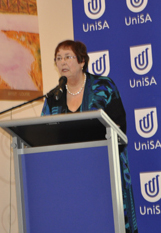
Adelaide communications lecturer Dr Pamela Schulz outlines her thesis at the launching of her book Courts and Judges on Trial.

Judges have been the victims of “rougher than usual media treatment’’ through “screaming headlines’’ and sensationalist television footage of controversial judgements, says award-winning Adelaide communications expert Dr Pamela Schulz.

The University of South Australia lecturer cites an ancient  quotation by

Cicero in 68BC “Alas my client is condemned by public opinion’’ to reflect .

her doctoral thesis that the media and the “politicisation’’ of the court processes and judgements have shaken public confidence in the judiciary.

She also claims in her provocative scholarly work that the independence of the judiciary may be at risk as politicians push the law and order issue to gain votes.

Her book Courts and Judges on Trial, was launched by former High Court judge, Justice Michael Kirby at the University of South Australia this week.

It is a powerful linguistic research analysis which critically analyses language and power surrounding media coverage and reporting of the courts and how it has had a negative impact on public opinion.

It reveals judges are subjected to a constant barrage of criticism through relentless “screaming headlines’’ and dramatic television footage, which casts doubt of the wisdom of judgements.

“I had started out on this long journey of scholarship to give judges a hard time because I believed judges were out of touch, but I discovered that I was wrong. If you constantly see headlines “Judges out of Touch’’,  that they are too lenient, after a while you believe it.,’’ says Dr Schulz, who interviewed 15 judges, court reporters and court administrators for her thesis.

However, judges are unable to defend themselves, says Dr Schulz, who was the first communications manager for the Court Authority of SA.

She is highly critical of the courts media liaison system as well as the media’s court  reporting and she calls for the re-enstatement of specialist court reporters.

“Tiny grabs from complex trials will be extracted to maximise shock, horror and outrage,’’ says Dr Schulz.

“It leads to increased distortion of news about the courts.’’

She lists provocative headlines such as “Outrage’’, “Premier orders DPP to Appeal’’ and “Only 8 Hours in Gaol’’.

 “Alarmist headlines are often false and misleading,’’ she says. Such headlines flame the public who are “paralysed by fear or crime’’ and politicians use the law and order issue as a political football.

“Yet, we live in a relatively safe society,’’ she adds.

She suggests a far broader courts communications system is needed and believes a “press judge’’ should be appointed to explain complex judgments.

“I have suggested judges put their sentencing remarks directly on line by appearing on camera so people can see the summing up in context,’’ she says.

What concerns Dr Schulz most is that this “discourse of disapproval’’ leads to a “discourse of direction’’ whereby the justice system is directed to carry out the will of politicians in power.

“This may lead to the destruction of independence of the justice system.’’

However, judges also need to understand the media’s requirements: “Judges do need to include pithy summaries in their judgement statements,’’ she says.

Dr Schulz’s book, which is for sale from Unibooks and www.amazon.co.uk, has received accolades from judges in Europe, New Zealand and the United States.

Dr Schulz has had an eclectic career moving from her former days as radio journalist to renowned public servant, to academic and now to published author.

Ex-model, Faye gives BC hope


Faye Hillmeyer with Frank Sebastyan at the Golden Years of Modelling reunion.

My journey down the path of breast cancer began with the discover of a cyst in my left breast in 2001.
This lump bothered me because I had been on hormone replacement theraphy for 11 years plus a stressful divorce so  I requested a repeat mammogram from my doctor even though I was
not due to have one for another year.  The mammogram was all clear and I quote “No distinct changes, no direct or
indirect sign of malignancy”   However the person who performed the mammogram noted I had very heavy tissue on both sides (I believe caused by the HRT) which could easily hide a lesion and suggested a ultra sound, followed by a needle biopsy. It detected cancer in my
right breast.   I firstly underwent a lumpectomy which is the removal of the
cancer plus surrounding tissue and was told I would have six weeks’ radio therapy. I was still in hospital when my surgeon came into the room and said there was “bad news” as suspicious tissue had been detected and he would need to do a mastectomy of my right breast.   When  I asked him about the left breast he replied that I could go for years without a problem, however he pointed out there was similar looking tissue on that side.  My immediate reaction was to remove the other breast because I never wanted to face this crisisall over again.  I wept in my room and after the surgeon left a nurse came in and when I told her why I was crying, she sat on the bed and told me her story of breast cancer at the age of 43,  five years earlier. It was a much more horrific story than mine.   We had a connection, discovered that we shared other similarities such as a keen sense of humour and we remain good friends.  I believe it is important to have someone with you at the doctors appointments as about a quarter of what he said registered because I was floating along in a daze thinking this happens to other women not to me.    You tend to dwell on thinking what caused you to develop this disease.  I wonder why it is happening to so many younger women.  Some women suffer the indignity of a partner or husband who rejects them physically because of the change in or loss of their breast and this must add enormously to the trauma.  Other women are fortunate enough to have the love and support of a special man who looks beyond the physical and sees beauty in their heart and soul.
There are also women who walk down this path alone.    For me personally having been a model it was devastating to lose my breasts which were the core of my
femininity.  I went through a stage of looking in the mirror, one minute thinking the implant reconstructed breasts were o.k. but the next minute thinking the reverse. In the midst of my anguish I sought counselling which helped put things into perspective.  I met women whose breast cancers were worse than mine.   Today, rather than look at my breasts in the mirror, I tell myself “you are a survivor of  breast cancer” and to hell with the physical changes.   Those few close women friends who were always there for me through the tears and bad days were vital and my way of coping was to talk about it because I discovered the more I talked it empowered me. Listening is also important, because I learned so much about other women’s experiences.
However some women cope by not being open about it and only wishing
their family and close friends to know.   Breast cancer has changed me
in that my tolerance level is much less now and I give you a quote from the film star Joan Collins who is a woman I have admired for her qualities of tenacity and determination and I had the pleasure of meeting her during the 20 years I lived in London with my ex husband the late Charles Billmyer Jr.  “There are
drains and there are heaters.  Some people drain you and some warm you.  If people become too much of a drain, I say “that’s it.  Time to say goodbye. I am not really ruthless but  I do cut people out. I have
recently got rid of quite a few.”     Other changes have been that I am attempting to
become somewhat selfish because we women are known to be the nurturers who care firstly for other people and our needs are often ignored.  I now attend yoga and belly dancing classes and have a massage once a month.  I also believe it helps you mentally if you have a passion in life which
fills you with pleasure and for me it’s cats both domestic and the larger variety
such as tigers.  I found maintaining a sense of humour is essential.  Breast cancer is not necessarily a death sentence today. 
There are many more survivors like me.        Faye Billmyer