Breast Cancer – A Beast of a Disease

Life can be such a bitch!  Over the past few weeks two close friends have been diagnosed with breast cancer and had operations to have breast lumps removed and diagnosed.

It means that today, fun-loving Anne will have a mastectomy. Her right breast must be removed because the lump taken out three weeks ago revealed third stage, aggressive cancer.

We heard the news yesterday at a joyful Christmas party at the home of mutual friends, and Anne, who has voluptuous breasts, was happy to show her scar. She has been always a cleavage girl, showing off her “assets’’ and now she pulls her lipstick from between her boobs, purses her lips and imitates painting it on her lips:

“I will have to find somewhere else to put my lipstick,’’ she says, shoving it right back  “because after this is all over, I am going to be a new woman.

“This is all going to go,’’ she says of her ample platform. “I am going to have this boob reduced,’’ she says, grabbing her left breast  “and the other one reconstructed with my tummy fat.’’

Anne is a funny, laugh-a-minute personality and now she laughs heartily as she grabs a roll of her “spare tyre”.

“But you know, I had the lump removed on November 25th and on November 27th, our first grandchild was born….so we went from the deepest low to the highest joy in two days!  To see this beautiful baby boy, gave us such much joy.’’

My friend from afar, Sydneysider Jane, underwent her second lumpectomy in six years last week. Her lump was in the other breast and this week, she telephoned to say it was another small primary cancer. “Thankfully, it’s low-grade,’’ she said.

In our lifetime one in eight women will experience the fear of finding breast cancer, but over the past 30 years, the survival rates have almost doubled. Mortality rates have dropped to about 23 per cent of all women diagnosed with breast cancer.

There are skeptics arising in our midst who question the cost versus effectiveness of Breast Screen to save lives.  But they need to heed the stories of Anne and Jane whose cancerous lumps were both discovered through the free breast X-ray service.

They both received that dreaded telephone call within a day or so and were called back for further tests.

Their new year heralds  the breast cancer journey of chemotherapy,  radiotherapy and life-saving medication – all part of the mix to save lives.

Women all say that treatment is a harrowing process, but I can now count on one hand, the number of friends, colleagues and acquaintances of a certain age, who have battled with breast cancer – and all have survived.

A moment with Margaret

In  the midst of the Christmas shopping frenzy I met an old woman in a wheelchair and she called out to me in barely legible words that she was selling a book for $2 a copy.

“It’s a book of my poetry,’’ she says as I momentarily stop.
Her left hand is wrapped in a sock and lies limp in her lap with two cigarette packets, one crumpled and empty, the other recently opened.

“I’ve had a stroke and lost the use of my left side,’’ she says, guessing my question.

But, I simply say “Merry Christmas’’ and walk onward to the chemist to pick up a prescription. But I stop in my tracks in the store and ask myself.  “What am I doing? I can surely spend $2 to make an old lady happy at Christmas’’.

So I turn round, walk out the store and stride back towards the wheelchair slowly moving down the main one-way street at Victor Harbour.

Catching up, I ask her “What’s your name?’’ .

“Margaret,’’ she replies and thrusts a booklet towards me.

“I’m selling my book for $2 and it’s all my own poetry.’’

And, sensing a sale, she rattles off in her croaky whisper “What’s all this about the Crows?

I just don’t understand.

There they are with pretty clothes

And biceps Oh! So grand.’’

Three verses long she recites before launching into yet another poem.

My head is full of questions: How old is she? “80 years old” Where do you live?

“In the Nursing Home over there.’’

Surely she is like a difficult teenager, slipping out when grounded.

“Do they know you are here out on the street selling your book?’’

“They can’t stop me,’’ she retorts.

Sensing my curiosity, she launches into another piece.

“Australia has been my land for years of that there is no doubt.

Their conversation is politics, football and cricket, too.

She’s proud of her koala, platypus and kangaroo…’’

But there’s one thing that fazes her –a team called “All Black’’.

“Wow! That’s great’’,  I say, and she smiles.

“I have been writing poetry since I was a little girl,’’ she says softly.

“They took my work and someone from head office got it all typed up.’’

And I cannot help myself as this retired journalist takes over.

“Do you have any children?’’ I enquire.

“No, I have never married,’’ she replies.

“I just love to write poetry, but I have been a secretary and a typist.’’

I think of my long gift list for my husband, my adult children, their spouses, the grand-children,  and they are the blessings of my full life. My heart goes out to Margaret – all alone on the street in Victor Harbour.  Her poetry, her expression of self is all she has left and she is so proud of  her gift.

“Well, I would love to have a copy.’’

So, we do business and I take the simple black and white booklet entitled “Always Bright’’ Recent poems by Margaret Mitchell.

It’s evening now and I am reading her poetry gems on quitting smoking, on cheating, about Horace, a wild wattle bird, and of a broken heart. Then, I catch my breath at the last ditty: It is named Tyson, my son’s name and its about her long gone dog.

So many chapters of her life are captured in her clever words, such as One is “Ten Small Steps’’ which she wrote rhythmically on October 14, 2004. “They said I’d never walk again, All I could do was pray.

“But Annaliese, Roger and Linda were there To help me on my way. I walked those steps, those precious steps, I walked ten steps today.’’

However, her poem Selling Books, reflects Margaret’s amazing zest for life as an 80-year-old out there plying her creative work.

“Selling books is quite a job,

In fact it bleeds me dry.

My intention is to rob

But never, never lie.

I have a book worth twice as much

As my asking price.

Its full of laughter, smiles and such

And makes you feel so nice.

O come and buy, come and buy, It’s really worth your while.

I’m out to make you happy,

I’m out to make you smile.’’

And I wonder at Margaret’s lyrical wit and her clever turn of phrase, which does make me laugh and smile and feel happy that I bothered to stop and buy “Always Bright’’.

Margaret, I suspect, will never feel old and my Christmas is richer for having spent a moment with her.

Elsa an inspirational French teacher

Never has learning French been so inspiring as this week’s lesson in the rose garden of Adelaide’s Botanic Gardens.

My French teacher is Argentinian-born and now new Australian citizen, Elsa Rozannes and we are sitting here on a bench under a flower bower, reciting French poetry.

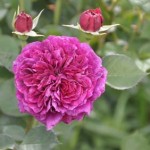
It is her idea to take this pleasant excursion into the National Rose Trial Garden, adjacent to the Conservatory and I notice above me hang clusters of  “China Doll’’.
Usually Elsa and I meet in the Intercontinental Hotel and sip potted tea sweetened with honey while I converse and try to grasp difficult grammar, such as the subjonctif tense.

But don’t start me on the frustrating idiosyncracies of the French language, because today’s lesson has been pure pleasure.

I am reciting  la Poesie Francaise, Correspondances  by Charles Baudelaire, about La nature est un temple ou de vivants piliers (In Nature’s temple living pillars rise) and sweet words such as “Vaste comme la nuit et comme la clarte, les parfums, les couleurs et les sons se respondent’’.

All of which, thanks to Elsa’s creative teaching style, I can read and pronounce more or less correctly and understand.

It has been a long, arduous task to learn French and it has taken much of this past decade to achieve through a variety of means including many terms at Alliance Francaise.

But Elsa’s dedication and our one-to-one instruction each week all year has been tipping point to my mastering the language.

“Maintenant, je peut dire que je peut parler assez bien the langue Francaise.’’

I can think in two languages that Elsa has taken me along meandering paths, past “vast pillars’’ of  “les arbres’’, glorious century old trees of myriad kinds, past a century-old Bunya Pine and a beautiful old Bottle tree even before we reach the Rose Garden.

The National Rose Trial Garden was established in 1996 as the first of it kind as a joint venture between the Botanic Gardens of Adelaide, the Rose Introducers of Australia (RIAUS) and the National Rose Society of Australia.

We have smelt many colourful roses even before I read about scent and colour.

However, the poem I must learn by heart now, because Elsa says it is a fundamental piece in French literature known by all French students is a sad little roses poem entitled “Consolation’’ and it was written in 1598 by Francois Malherbe. He wrote these heart-felt words for his lady love who had lost her five-year-old daughter, whose name was Rose.

“Mais elle etait du monde

Où les plus belle choses

Ont le pire destin.

Et Rose, elle a vecu

Ce que vivent les roses

L”Espace d’un matin.

Which means”: But she was of the world where the most beautiful things have the worst destiny.

And Rose, she has lived like the life of roses – in the space of a morning.’’

Such beautiful words transport me into a new phase of my journey into Frenchness – the study of French poetry and literature. And as we take coffee at the kiosk I cannot think of a more beautiful place for this transition to happen – alongside the Mediterranean Garden brimming with hedges and plants of myriad kinds with an inspirational teacher.

My Best Christmas:

It is a few days before Christmas in London and I am decking the halls of my daughter’s house with holly and tinsel. The year is 2006 and I have walked down her street – Bernard Gardens – with a pair of clippers helping myself to branches from holly hedges, all laden with beautiful red berries. They overhang the low fences bordering the triple-level 19th century Victorian houses.  I am humming the holly Christmas tune “Tis the season to be jolly’’ for the benefit of my two grandsons, Samuel and Angus, who trail along with me.
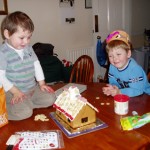
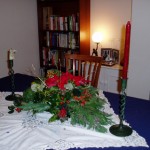
They are enthralled at how I snip here and snap off a twig there and stuff  a variety of foliage and flowers into my shopping bag. We are gathering greenery to make our own table centrepiece for Christmas Day and they have come along to buy the baubles at the village card shop.

Point-settias are a must and I buy them at the local florist  shop and eventually we traipse back home ready to put together our floral creation,

a table setting for our Christmas Day lunch, the first I have ever made.

It is bitterly cold here and London is shrouded in fog – a pea soup so thick that all flights, both local and from European airports are grounded. There is a melee of about 5000 people camped out at Heathrow, mothers with toddlers in prams, students with backpacks and business-suited blokes, elbow to elbow in the terminals, flowing over into makeshift tents.  Nightly we watch the growing mayhem caused by cancelled flights at  Christmas time.

Perhaps my joy at this simple act of arranging variagated foliage into a flower fashioner and carefully placing pine cones and fixing in bright baubles is misplaced.

After all, French partner, Olivier, flew to France earlier this week to visit his aged mother in St Remy de Provence and he is planning to bring back a bagful of French food goodies, particularly ice-packed fresh mussels and oysters from the Mediterranean Sea.
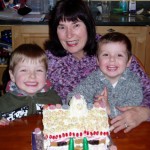
But right now,  unless the fog lifts, he won’t be able to fly back from Marseilles to London on Christmas Eve – tomorrow. Our Yuletide family celebrations could be thrown into dismay, but Christmas preparations must proceed. My daughter is pregnant  and there is much shopping, gift-wrapping, cooking, cleaning, cake baking and festive decorations to be done before December 25.

Son-in-law, Jon, wants stuffed goose, a traditional British dinner, which should be a synch. – After all, I stuff a turkey each year and have two favourite recipes.

But here in London, nothing is the same. Christmas goose must be stuffed with a chicken, I am told, and I stare in disbelief when he explains in a matter-of-fact tone, that the chicken needs to be stuffed with forcemeat first!

The peace and calm of making the floral centrepiece evaporates and anxiety sweeps into my mind.  Forget the flowers! We cannot eat flowers, the centrepiece of the feast will be the goose!

I need a diversion.  I have a special grandmotherly task this Christmas – to make a gingerbread house.  When I was a mother of three children, each year I planned to make a gingerbread house every year the same honey biscuit recipe that my mother always used.
Yet, it never happened down.  Life was too hectic with all that busyness of full-time work and each year slipped by without a gingerbread house.  This is despite the fact that the recipe was as close as my bookshelf because the front cover of the Time Life  cookbook series book for Germany featured a beautiful gingerbread house.

Now that I am a grandmother, daughter Serena has bought a packaged gingerbread house from the Wimbledon village. It has gingerbread walls with window cutouts, two steep roof pieces, a  chimney and door – all neatly packed in layers.  There is an icing pack and lollies galore to decorate. The grandchildren have been primed to expect this delightful Christmas task with grandma.  As daughter slips out the doors to enjoy her free afternoon shopping in peace for Christmas, she calls back:
“Enjoy, mother!’’.

Happiness is indeed piecing together this little house with Samuel and Angus, who has plonked himself on the table.  We work as a team, sticking together each piece with icing and whipping up more icing into peaks before plastering it on the roof. Samuel decorates the windows with “eyebrows’’ and we take turns to place countless lollies on the roof.  The boys wear party hats and lick their fingers and their eyes sparkle with delight when eventually our little house is finished.  It is such a joy to watch them as they chatter ceaselessly about the house we have made to eat on Christmas Day.

December 24:  The morning news brings good tidings.  The fog has lifted enough for flights to be allowed to land in London and  at around 3.30pm, Olivier walks through the door laden with boxes of oysters and mussels. I am overjoyed to see him and the grandsons hug him in delight.   Christmas is so much about the joy of family reunion.

And now it is Christmas. We gather around the Christmas tree, which has twinkled each night in the bay window, and here we exchange our gifts. My  son-in-law puts on a Christmas CD and daughter tells her sons why gift-giving is a true joy of Christmas. “The Bible tells us that the wise men from the East followed the bright Bethlehem Star until it led them to the infant Jesus where they presented him with precious gifts of Gold, Frankincense and Myrrh,’’ she says.
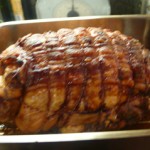
Church follows, but before we leave, I take the goose, stuffed, seasoned, trussed from the fridge and baste it with melted butter before carefully placing it into the hot oven.

Then the magic: The aroma of  the cooked goose wafts down the hallway as we rush in the door. Many hands make light work of setting the table.  Our floral centrepiece is placed on the lace table cloth between two tall candlesticks,  and then the best china is laid out with crystal glasses, silver cutlery and napkins.  The children’s eyes sparkle in anticipation.

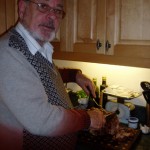
The greatest thrill, though, isn’t the French oysters, freshly shucked and doused in vinigraite, but the rich, golden roasted goose.  Olivier sharpens the knife, wields it for effect and we watch in anticipation as he slices right through the two birds and the stuffing.  It is a magnificent feast and absolutely the best Christmas I can remember.

Filled with family fun, sharing joy and gift-giving – and nibbling like mice on that beautiful gingerbread house.

Time

Annie Fox, one of my Facebook friends has a habit  of placing one word online for comment and possibly because another New Year is nigh, she threw in the word  “time’’.

Her move followed another conversation with a learned friend, Dr Pamela Schulz, who told me she is researching a “discourse of time” and its effects on public opinion.

This seemed to be a very curly topic and I prodded her for more information to be told her co-researcher is the eminent Dr Andrew Cannon, Deputy Chief Magistrate of SA.

“We will be looking at how time is being used as a yard-stick for what the courts do,’’ she replied adding their study will be published next year.

My thoughts on time are basic in comparison.

Time is a gift to be used to love ourselves, to love others, to create and to develop whatever unique skills we are blessed with.  The way we use time defines our life force and our qualities as human beings.

And Annie liked these sentiments.

Whatever we think and however we express it, time is precious. The older we get, time slips by as fast as sand through a timer. Watch it happen to get a valuable lesson on the fleeting nature of time.

Which is why, I know the answer of  on equestion in this week’s Brainwaves in the SA Weekend Magazine “What does the Latin expression “tempus fugit” mean?

“Time Flies’’, of course!

100 years of French cultural ties celebrated with haute cuisine.

Alliance Francaise d’Adelaide, affectionately dubbed “the frog pond’ celebrated its 100th anniversary in an unlikely venue – the elite Queen Adelaide Club on Monday night.

However, the French language and cultural institute’s ties to the upper crust women’s club stretch back to 1909 when French woman Madame Berthe Mouchette, founded the Alliance at the Queen Adelaide Club.

And to shoo any shadow of Britishness out of the famous James Place green door, Queen Adelaide Club’s resident chef, French-born chef, Alain Rousse, presented a delectable three-course haute cuisine fit for the French sun-king, Louis XIV.

Alliance stalwart and former St Peters College French teacher, Andrew McKenzie commended the Alliance’s community leaders and its directors for their fortitude to acquire the existing headquarters in Young Street, Wayville.

He praised the thousands of French students who, over the years, had breathed life into the building with their desire to learn the French language.

Mr McKenzie also highlighted the Alliance’s progress over the century including its popular Café Theatre and in the past 10 years, the popular cultural events the French Film Festival, the French Festival at Carrick Hill, its musical evenings and the staging of French theatre.

After praising present director, Philippe Marse for his energy and leadership, Mr McKenzie urged everyone to charge their glasses with Louis Bouillot Grand Reserve champagne to celebrate 100 years of French language education and cultural exchange in Adelaide.

Special guest at the event was Jean-Marc Lestabel, Air France representative, who flew in from Sydney to draw the winning ticket of Alliance’s  Centenary Lottery – and in a dream PR exercise the winner was Alliance student of the French language, Bruce Smith.

But when Mr Lestabel telephoned the winner to announce his prize before the clapping crowd,  Mrs Smith refused to believe him, thinking it was a hoax.

South Australia’s Honorary Consul for France, Dr Christine Rothauser and Alliance Francaise director, Philippe Marse and his wife, Colette, former Labor Minister, Jane Lomax-Smith and president of the French Australian Chamber of Commerce, Philippe Marse headed a long list of renowned Adelaideans with French connections either through birth or business.

One hundred years ago, the Adelaide branch of the Alliance Francaise was designed to continue its world-wide role of cultivating better relationships between British and French peoples.

The Advertiser on Friday, July 8, 1910 reported on page 8 that “the object of the club is to promote French conversation, the study of French literature and art and to show hospitality to visiting members of the Alliance.’’

“The rooms were decorated with flags and pictures and over the doorway were suspended the Australian and French flags, as well as several French rapiers. There was a large gathering of members and Lady Way, the president in declaring the club opne, trusted that it would long give benefit and enjoyment to all who were united in the common love of the French language and literature, and of French culture and social charm.’’

Such a prestigious event took place before the cream of Adelaide society including vice-presidents Lady Bonython, Lady Gordon and Mrs Reid Baird (delegate from Paris) and the French honorary secretary, Miss Doris Hawker

But,  100 years later in 2010, while the Alsace Gentil “Hugel’’ wine flowed and everyone tucked into Tournedos de Boeuf a la Bordelaise, there was one glaring omission – the French flag was nowhere to be seen.