Enter Giulia, Exit Loulou

The year in France had its moment of joy with the birth of Giulia Sarkozy, daughter of one-time supermodel  Carla Bruni-Sarkozy, 43, and the French president, Nicholas Sarkozy. (Hands up those who thought the marriage wouldn’t last).

Mr Sarkozy didn’t make the birth because of an urgent meeting in Frankfurt to try to stitch up a rescue package for the Eurozone crisis with German Chancellor Angela Merkel.  Afterwards, he spent a mere 50 minutes with the infant and her mum before rushing off to a waste disposal centre in western France, thus dismissing his paternity leave rights.

“We are fortunate enough to have a great joy,’’ Sarkozy told the assembly of workers.

“All the parents here can understand our very profound joy, a joy that is all the more profound for the fact that it is private.’’

They cheered the president and presented him with a bib for the new bub, an oak tree for the garden and Mince Alors, a book for Carla. Ironically, translated as “Thin Then’’, the book gives advice on losing weight, particularly after pregnancy and how not to become obsessed with dieting.

Ironically, Carla is making a very public appearance right now in cinemas around Australia with a bit part as a tour guide in Woody Allen’s latest film, Midnight in Paris.

French media reckons France’s First Lady is unpopular,  yet Italian-born Carla has proved to be a stylish, gracious and beautiful consort to the President.

Marriage matters in France and family is still the foundation of French society, and although opinion polls show that Mr Sarkozy is behind his socialist rival, Francois Holland, a baby in Elysees Palace could well be a trump card.

On a much sadder note, French fashion legend, Loulou de la Falaise, Saint Laurent’s colourful muse, died at her home in northwest France this year, aged 64.

Louise Vava Lucia Henriette Le Bailly de la Falaise acted as Yves Saint Laurent’s “creative partner, confidante and sentinal’’ for three decades from 1972 until 2002, according to the obituary published in The Times.

She had eccentric roots with a wild Irish beauty, Rhoda Lecky Pike as her grandmother and a mother who said she christened her newborn daughter with perfume instead of water in 1948. However, because of her mother’s many affairs, little Louise was placed in foster care.

At age 20, she was a junior editor of Queen magazine when she met Saint Laurent, who had established his fashion house six years beforehand upon the death of Christian Dior in 1958.

De la Falaise and Saint Laurent immediately took to each other. “Apart from her striking red-haired, wisp-thin beauty, he was attracted by her directness of manner and edgy sense of humour.  After a disastrous showing in 1971, she appreciated his gesture in sending her a box of high-cut emerald green fox fur coats,’’ The Times reported.

Within three years, Loulou was in Paris working with Saint Laurent, making jewellery for his fashion shows.

Loulou launched her own fashion label and eccentric accessories upon the retirement of Saint Laurent.

Once when asked what clothes she collected, she said: “I don’t collect clothes – I hand them down. They do sometimes turn into a pile of dust, but that’s tribute to a good life.’’


Meryl is magnificent as Margaret

There are a few good reasons to brace oneself for the reality of old age by viewing The Iron Lady, about the life of Margaret Thatcher, one of the greatest women leaders of the 20th century.
Firstly, the film is a toast to feminism as the headline from The Spectator in London says “Truth is, Thatcher led feminists out from behind the kitchen sink.’

It tells the true story of the metamorphosis of Margaret from poor grocer’s daughter to ultimate power as Prime Minister of Great Britain, but then there is the dramatic decline and disturbing images of Thatcher today, a frail, aged lonely woman in the first stages of dementia. Director Phyllida Lloyd leaves a lingering second message – that power is fleeting and that there is a high price to pay for political fame.

Her awesome political achievement is snapped in the photo session at the head of a huge all-male cabinet when elected Prime Minister.  In a warts and all portrayal, Lloyd does not flinch from showing Thatcher’s ruthless  11-year rule, and its social consequences for Britain, before her downfall at the hands of colleagues.

Hollywood actress, Meryl Streep is magnificent in her astute portrayal of Thatcher, particularly her ability to switch from the all-powerful political figure to the pathetic, frail aged Margaret in flashbacks.  Streep captures Thatcher’s ambition and ruthlessness to fix up the woes of a socialist Britain with brutal public policy and the social rebellion of the miners’ strike, the poll tax riots and the IRA bombings.  Thatcher’s personal life was pretty much one-dimensional and it is obvious that her family bore the brunt of her ambition, particularly long-suffering husband Denis, ably portrayed by Jim  Broadbent.

However, an actor can only work with the script provided in this case by Abi Morgan and Bruce Anderson in The  Spectator writes that the film’s depiction of the complex character of Denis Thatcher as a light-weight nincompoop was “the real weakness’’. Instead,  he  was “the most important figure in the real supporting cast’’, the only one who stood by her in the end.

Anderson criticises how the film depicted the young Denis  (played by Harry Lloyd) and young Margaret (played by Alexandra Roach) negotiating a political pre-nup as “inaccurate and unconvincing’’. And he writes his own scenario given Denis’s “upper-middle-class, British Club’’ background  and  subservient role of women in the 1950s.

“When I married the little woman, I knew she’d been interested in politics, but didn’t take that seriously. She’d never had any money and I’d sort that out. She could have a dressmaker and a decent hairdresser; sort of thing girls enjoy,’’ he writes.

“I’d put her in the club, so there’d be sprogs to bring up. In the long fullness, if she wanted to be chairman of the local Tory advisory women’s whatnot, no harm in that. But if someone had said to me: “Thatcher, forget local female thingummy – that little woman of yours is going to be prime minister of the United Kingdom of Great Britain and Northern Ireland’’, I might have scratched the fixture. I’m glad I didn’t.’’

Whatever.  History has it that Margaret married a brilliant young barrister who stood by her on her climb to the top and was there when she tumbled down again.  It’s an inspiring film for women of all ages and confronting in Streep’s portrayal of a frail, aged Thatcher.  For once, we are told the whole story and the reality of the last stages of life have not been edited out.


Rillettes De Porc

Method

Olivier’s claim to fame in the kitchen is home-made pork rillettes, which is easy to make, keeps well and can be made in big quantities for a crowd.

For 1 kg of boneless pork belly (with plenty of fat) you will need ½ kg of back pork fat.  Most butchers will remove the rind and bones for you and you will need to cut the pork belly into chunks as for a stew and the pork fat must also be cut in small pieces. Rub the meat well with salt first.

You will also need:

125 ml of  dry white wine

10 peppercorns crushed,  8 juniper berries, 3 bay leaves, a crushed clove of garlic, a dozen thyme sprigs made into a bouquet garnet

¼ tsp cinnamon.

The pork will shred well with two forks if you cut the pork into thick strips where the bones were taken out and then again into smaller, shorter strips of meat. Place everything except the wine into a covered oven dish, add a soup ladle of water and plunge the bouquet garnet into it. Bake in a slow oven, no more than 150C for four hours. Taste the pork and, add more salt and pepper if necessary. By this time the meat should be very soft and swimming in its own limpid fat.

Rillettes are bland if not seasoned well.  Sieve contents through a wire sieve into a big bowl, and well drained, use forks to pull the rillettes until they are finely shredded rather than a pate consistency.
Store in earthenware pots, preferably, and seal with melted pork fat and refrigerate. Remove before use to allow the rillettes to soften.

joyful xmas

What a wonderful, peaceful, joyful  Christmas we have shared with our two families in our new home.   Love flowed around our celebrations like sparkling rose and we have survived the mayhem of three generations together with good cheer and red wine.
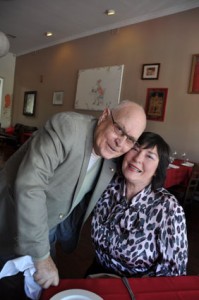
However, the “peace” of Christmas is yet to befall me because  I have cooked three ducks, a turkey with two stuffings, crusted a ham and a filleted Atlantic salmon for Christmas Eve, for Olivier’s traditional European celebration, Christmas Day lunch, the Aussie event and Boxing Day.  For the first time, I steamed a pudding, such is the allure of my new “French kitchen’’.

Olivier made his favourite French pate – pork rillette – with son-in-law Alain,  two of the sons – Tyson and Herve cooked prawns on the barbeque.  At the last minute, husband clipped small branches off the old, weeping Cyprus tree to make a simple table centrepiece with apple candles and red ribbon.  I forgot the bonbons until dessert – and one of  the ducks (cooked in the new oven) was not cooked when the barbecued “canard” was ready to serve.  There were thoughtful gifts galore with two chile plants (son Tyson and Vanessa) and a voucher for a Sunday breakfast at Stamps restaurant down the hill (Oli’s son Xavier and Patricia) being well-received.   Gift-giving is a delightful expression of Christmas and reflects the Christian meaning of the season, the birth of Jesus Christ.

However, the best thing about Christmas was the sheer pleasure of  sharing our gracious new retirement environment and beautiful instant garden with our adult children and grand-children. To bake cakes with grand-daughter, Josephine, to have all the bedrooms filled with adult children, to have to dodge remote-controlled toys in the hallway, to  be so filled with love on so many levels makes Christmas gatherings of families such joy.  The mayhem of many human beings thrust together in the one place to sit down and eat together and talk and laugh and joke.  The communal fetching and carrying to and fro to feed a crowd,  the all-hands approach of daughters and sons cleaning up after the feast while we retired to the lounge taking coffee and chocolates.  That camaraderie of Christmas is the sweetest gift. It builds family ties. It cannot be bought – it comes from the heart.

My most precious thing, though, is the card from my husband, so meaningful that I think I will frame it and hang it alongside his gift, yet to adorn our walls – “Feathers and Fins” a zany  acrylic on canvas by Cheryl Bridgart.


Sweet memories are made of this…

We have escaped to delightful Stanley Cottage for the weekend in Stanley Street North  Adelaide to celebrate the pivotal moment when Olivier first invited me to Belair for dinner eight years ago.  In my memoir From France with Love I described that night, the first Saturday in December, 2003. Olivier was a new widower, having lost his wife Colette in May of that year.
“As I drove up Olivier’s steep driveway, I could see him, through the open doors, sitting at his desk. As soon as I appeared, he rose and welcomed me with a kiss on each cheek.

“Come and see my garden before we eat,’’ he said. “But would you like an aperitif first?’’

And so I took my champagne as he guided me around his flowers and ferns and named each fuchsia that tumbled from his hanging baskets. He stopped suddenly at the fountain and we watched the miniature waterfall cascade into the pond.

“Your garden is an absolute work of art,’’ I gasped, overwhelmed by its beauty.

“Merci madame. It has kept me sane, cleaning it up again since I returned from France.’’

‘’You can call me Nadine, you know. Madame sounds so formal.’’

A faint smile broke the taut line of his mouth.

“I like the way you care about things so much,’’ I added, but there was no reply. Instead, he led me back to the house and said “A table’’.

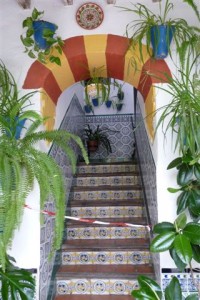
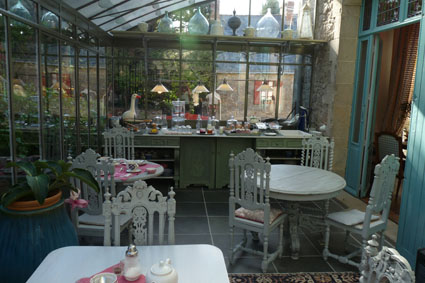
The antique French dining table was covered with a delicate lace tablecloth and set for two. His is a house filled with special things. A marble bust of the goddess Aphrodite sites on the 19th century French provincial sideboard, a grandfather clock stands in the corner, a large Louis Vuitton sea chest in another. I had never stopped in this room before, but had merely passed through on my way to see Colette. Now I saw it all, the exotic Indian silk rug hanging on one wall, the set of three superb sketches of Parisian bridges on another, the exquisite china plates mounted on a mock brick wall and the red Persian rug on the floor.  It was magnificent.

“Good heavens!’’ I exclaimed. “This is a real dinner party for two. Much nicer than snags on the barbie.’’ And I thought to myself, This is going to be fun!

“When you are French,’’ he said in a dignified voice, “you have a whole food culture to uphold.’’

And so the evening passed. We talked mainly of books, since it was obviously a common interest of ours.  His house is filled with books in English and French – they are even stacked up in the bedroom and the toilet.

…As we chatted I could feel his usual stiffness relax. I have always gabbled as if it is a crime to leave any airspace .empty. He is laconic and speaks in measured sentences, in which every word is carefully loaded with meaning- all delivered in his delicious accent. I clung onto every syllable, even when I had never heard of the French authors he was discussing. I hadn’t enjoyed such an intelligent conversation with a man in so intimate a setting for a very long time.’’

AND SO I FAST FORWARD TO TODAY – Saturday, December 3.

What would we do to celebrate our extraordinary eight years together.  (We married almost four years ago.) I had seen Woody Allen’s latest film Midnight in Paris with friends when Olivier was in hospital and I wanted to share the film with him.

It was such a delightful film and so poignant to our history as a couple, both through our love of art and literature, but also my love for the city of Paris.

What was more pleasurable was that he could sit in a cinema again, that this was the first cinema “date’’ we had enjoyed since his health plummeted in June this year.  By 8 o’clock we were back in Rundle Street East wondering where to eat.

“Let’s go to the Belgian Café for mussels and chips’’, I suggested.  We once celebrated Bastille Day here with French friends and the restaurant never disappoints with its traditional fare.  Sweet moments relived. The place was packed with people and we were lucky to find a window seat. Even the rain drizzling mercilessly outside could not dampen our happy mood. We ordered soup of the day and one meal of mussels which we shared. I thought how it symbolised how we have shared our lives together.

Afterwards we popped into Mary Martin bookshop for a browse and then returned to our little  love nest in leafy Stanley Street, one of the restored 19th century workmen’s row cottages.  Our hosts Rodney and Regina Twiss had left a complimentary bottle of Steeple Jack Chardonnay Pinot Noir from Ballast Stone on the Fleurieu Peninsula with truffles and gourmet biscuits. So there we sat in the comfortable leather settee like Darby and Joan, sipping wine, eating chocolates – and as is our habit – reading our two Saturday newspapers together.  Is this the love of the glossies?  No. But this reflects what Oli said to me so many years ago at lunch in the Ritz, “We love each other’’.

And the last words I wrote in From France with Love?  “They are still magic words, so laden with promise.’’

A Peep Behind Spanish Doors

Cathy Portas continues her writing about journeying in Spain.


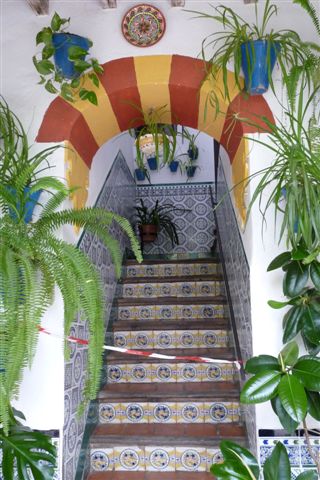
The timing of our visit to Cordoba, in Spain was pure luck as we arrived in the middle of the ‘Patio Festival’. It was an unexpected treat which gave us an exciting peep into people’s homely lives because residents in the Jewish Quarter opened up their private courtyard gardens to the public. All year round their high gates are closed and tourists can only guess of what lies behind them as one walks down the tiny streets of the old town.


The great weather bought out the crowds and foreign tourists mingled with many  Spanish families to create a terrific atmosphere. Sometimes, the lineup of people waiting to enter the courtyards snaked down the narrow streets. We loved it when many locals, while waiting, would try out their limited English with us – and helped us with our Spanish! We soon got used to sharing those little streets with the odd small car and lots of motorbikes- a horn tooting would mean people just moved to the edge, the drivers adept at weaving through.


Walking through the streets of the Juderia, we discovered the Royal Stables, and watched a spectacular Equestrian Show. The silent communication between horse and rider was a joy to see, at one point being joined by a spectacular Flamenco dancer.


Each day brought another unique treat. We had lunch in an impressive large square surrounded by colonnades, next to a big group of families celebrating their children’s First Communion. The pretty girls were dressed in long white gowns, and a little boy was beautiful, too, in a sailor suit! We snapped their picture and they loved it!  A stage was being erected nearby and when we enquired, they told us there would be a Flamenco Guitar performance that night at 10.00pm.

The biggest adjustment we needed to make was that people eat so late in Spain, and we immediately fell into the pattern of taking an afternoon rest, and then going out again later, to sample tapas at different bars and cafés.


After eating that night at Bar Rubio, our favourite bar, we made our way back to the square, to find hundreds of people, including families and children, in rows of chairs, watching an old man in the spotlight on the stage singing the beautiful Spanish songs that seem to be full of pain and longing, to the accompaniment of a young man playing flamenco guitar. We wandered happily back to our accommodation just before midnight, leaving earlier than everybody else. I found out later this was the Plaza de la Corredera, built in the 17th century, apparently Cordoba’s grandest square, and the location of executions at the time of the Inquisition!.