Mandy marries lesbian love
 Former Adelaide business leader, Mandy Keillor has been as straight as her black bob hair style all her life. Now at 47 years of age, she admits to having turned lesbian in her late 30s after being wooed by a gay woman who was her pilates instructor. “Natalia is a lesbian and left a female partner to be with me,’’ recounts Mandy.
Mandy, on the other hand, had always been with men, including a marriage when she was very young to the father of her two sons.
“I am a person who is open to love and that is what I told my children when we started a relationship…that it was about love,’’ says Mandy who was the president of executive women’s group, Women Chiefs of Enterprise.
“What is really amazing about my own union is when we started being together I didn’t think of the repercussions,’’ she adds. “ It felt so good and it felt so natural. The love came first.’’
Mandy was very much a home grown success story in Adelaide having been educated at Gepps Cross Girls’ High School and lobbying against entrenched gendered roles in society, particularly the building industry. Turning lesbian, however, has had its difficult issues particularly when she came out to her sons.
“They have obviously been through a lot in their life with me. I was a mother at 20, sole parent at 25, and I was the first female builder in South Australia.
“They just wanted me to be normal,’’ she recalls. “The last thing they wanted me to tell them is that I was about to be in a relationship with another woman.”
Her oldest son lashed out in harsh words…”His words were “everyone’s always thought you were a dyke builder and now you are going to be a dyke builder!@’.’’
“I told him, “ First of all, I am not a dyke. It’s not a very nice word. I have fallen in love with a woman and that is another person and it is about two people falling in love. They had this stereotypical idea of what it going to be like to be with a woman.
“They didn’t understand until they met her, when they could see that she was really an amazing human being and not at all stereotypical; quite different from what was in their head.’’
We are sitting in Urban Bistro, the trendy eatery opposite the Victoria Park racecourse, sipping a local wine and nibbling on marinated olives and the questions about how this metamorphosis happened tumble out.
Q: What triggered your coming out?
“Natalia was in love with me for 18 months before she told me. She will tell you she fell in love with me and tried not to feel that way because she loved her partner at the time and she admitted to her “Well, I am going to tell Mandy how I feel’.’’
“She invited me for a coffee and told me her feelings. I told her she was crazy.’’
It was the surprising beginning of an eight year relationship, which sees Mandy wear the diamond-encrusted wide wedding ring Natalia gave her on their wedding ceremony in Spain five years ago.
We discuss Australia’s Marriage Act and its definition of marriage being between a man and a woman, and how it is entrenched in the collective mind of the electorate as being unequivocal. This is despite a Private Member’s Bill seeking to amend the Act to include same sex couples.
Q: What are the main issues that the Australian public has to grapple with over gay marriage? 
“Somehow it is still seen as a novelty, especially for someone like myself who has been so straight most of my life.
“People don’t take it seriously as a life choice which is very important as to who you are as a person.
Q: From your own experience, what is it about gay marriage which people reject?
“I think it is fear of the unknown; they don’t understand. Australia is conservatively indoctrinated. We have had a very conservative government, the longest serving government which was very much in bed with the Americans.
“IN America, when gay marriage was approved in California, they overturned the amendment in California. It was passed and then revoked it.
“There are only 17 countries in the world where gay union is recognised.
“The reality is we can be of the same sex and fall in love with each other; it happens because for them it’s natural. You are born with those tendencies.’’
Mandy says she has grappled with feelings for other women in the past but never knew how to deal with them.
“I was a sole parent with two boys, running my own building company, the first female builder in South Australia. The last thing I could even think about was questioning my sexuality. Those feelings were such a surprise.’’
Mandy was married to her sons’ father the first time for six years and her second relationship, with another man, lasted 11 years. “ I have been in relationships with men all my life.’’
Q: What is the difference between being with a woman rather than a man?
“I cannot speak for other people, but for me, it’s the first time in my life I feel whole. It is weird for people to hear me say that.
“People put the emphasis on the sexuality rather than the fact that it is a relationship between two human beings.
“If you have two men together, two women together or a man and a woman together, we all go through the same chemical reaction, the (falling in love) brain chemistry, the same attraction, the same ups and downs of any relationship.
“It’s the commitment to being in a relationship with another person which makes it the same life choice.’’
“That whole notion of homosexual behaviour is still confronting to many peopleand I cannot tell you why, especially when I live in that (gay) community.’’
She talks of the world-wide gay community being inclusive.
“I feel very happy to be in it.’’
It was Mandy’s idea to go to Spain. She had visited Barcelona years beforehand and always vowed to return. She intended to live there and set up her building company. On the other hand, Natalia, a contemporary dancer was going to Germany to dance professionally.
However, as the date of parting drew nearer, Natalia decided to go to Spain with Mandy.
Q: What were you looking for in Spain?
“I wanted a new challenge, people do stop growing.
“ I had worked for 13 years as a interior designer/builder, but I wound down the business, Keillor Building Associates, and only told my trades a week before I left.’’
Mandy designed the first Cibo café and the immensely popular Chainti Classico restaurant.
However, at the first meeting with a building contact in Barcelona, she knew it wasn’t going to work in a new country.
“I was meeting with a well-known interior designer, Donna Kelly, whom I had corresponded with beforehand.
“She started talking to me about the building industry and my eyes glazed over and I decided I couldn’t do this anymore. I couldn’t find 30 blokes, train them in a different language and do the same things I had done in Australia.’’
Instead the two women capitalised on Natalia’s skill as a teacher of Pilates and Mandy’s business management acumen.
“We walked out of the meeting and I said to Natalie “we are going to start up a Pilates studio.’’
Their business, Studio Australia Barcelona, has grown at a rate of 25 per cent a year into a successful health and wellness centre.
“I teach body sculpting and body shaping because I have also been a body builder,’’ says Mandy, who certainly walks her talk with a slim body and blooming with health.
“We have more than 1000 clients or patients and we do a couple of hundred sessions a week.’’
She says living in Spain has left her feeling more European, but she is “actually proud to be Australian’’.
“The best thing about being Australian is we aren’t constrained by history. We break our own rules; we take the best that the world has to offer and we shape it to be ours. It stops us being inhibited.”
They are unusual thoughts coming from a lesbian who had to cross the world to marry.
More on Mandy on www.studioaustraliabarcelona.com.
Tags: gay, gay marriage, lesbian, Lesbian life, Marriage Act, marry, same sex marriage, straight, Studio Australia Barcelona
 womens lives | nadine 12/03/2012 |
  Comments (3)
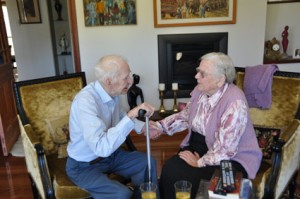 Auntie Lilian, my father Frank’s younger sister turned 90 and I threw an afternoon tea for relatives to celebrate . The old lady, who lives in a self-contained hostel unit, is the matriarch of our large extended famil. My 93-year-old dad and my other two surviving aunties, Yvonne and Betty, her widowed sisters-in-law were other elderly guests.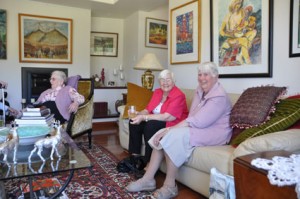
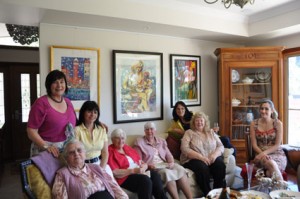 As the old aunties, full of thanks and praise, climb into Trudy’s car, it occurs to me that I feel uplifted by giving pleasure to others – and in retirement I have the time to enjoy.
 Meet the newest member of our household, a handsome, hybrid poodle/Maltese/Shi Tsu named Oscar. Our new puppy is an adorable bundle of fluff, champagne coloured with an angelic face which belies his wicked playfullness. He is the tiniest little soul and yet he is like a charged electric current of energy in our household. He wakes at about 6am, he whines to be let into our bedroom and he then bounces about our bed like the bunny in the battery TV ad. The four-legged dynamo does not stop racing through the house, chasing his own tail around the lawn, and already at 11 weeks of age, he has developed eccentricities. He loves shoes and shoe-laces and has a thing for smelly socks! His teeth have the strength of a lion already because he will drag husband Olivier’s big shoe – bigger than Oscar himself – down the hall to his lair. His new padded basket is where he deposits his precious things and he doesn’t mind being popped into a carry bag provided he can poke his head over the top.
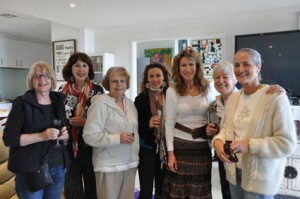 [left] Valli, Jenny, Suzie, Sarah, Host Marie, Ursula and Lynley