Lunch reveals lives of older boomers
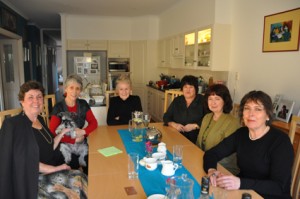
We are seven women of a certain age, who are lunching together at Kate’s place to celebrate my long-time friend  Sheryl’s birthday.   Sheryl is a baby boomer creeping further into her early 60s and we range in age from her sister, Diane, the youngest at 58 years of age to Margaret, who is 70 years of age.

As we munch on a delicious Moroccan banquet, it  is interesting to note that we  reflect the lives of  almost 25 per cent of Australia’s population according to the 2011 Census, released last week.

One in four Australians are in those two age brackets – from 55-64 (11 per cent) and from 65 years and over (13.3 per cent).

Our conversations reflects our lifestyles and concerns of our age. Frail, aged parents are a concern for Sheryl, Diane and myself with their mother almost 90 and my father a relatively fit 93.  Both parents are virtually blind and my father is deaf, too.   Margaret tells us that she is contemplating selling her home and buying into a retirement village.  I have just moved into a new home which my late husband and I built after razing his 50-year-old house and I won’t be moving any time soon.

Six of us have been married, but only one – Chris – is still married.  Diane has been in a long 35-year de facto relationship as Sheryl says “That’s longer than most marriages.’’ Four  are now divorced and living alone and I am recently widowed.

Our four divorcees reflect the life circumstance of 11.3 per cent of Australians according to the Census gathered last year – or 1.8 million Australians who are separated or divorced.

Sheryl and I have been friends for more than 30 years and over that time, we have grown into older women together. We are both dog-lovers and have our own homes on the typical quarter acre block.  Whilst we have both retired within 12 months of each other, Sheryl has returned to a part-time job.

We women represent other social facts as well.

As a new widow, I note that there are just under a million of us – 936,813 who have lost their partners to death – or 5.9 per cent of Australia’s population. Clearly I am not alone in my new status.

The numbers of separated or divorced Australians has increased by .5 per cent to 11.3 per cent from 10.8 per cent – a significant proportion of the population to show that “happy ever after’’ is a fading dream for many.

Each of us is a home owner, with our host, Kate, living in a single storey attached stylish dwelling with a single garage under the main roof.   Five of us live in lone households.  Interestingly, typical of baby boomers in midlife, all of us have made housing changes. Five have sold up their homes and moved elsewhere, not necessarily into smaller homes.  Sheryl has built a large, stylish extension onto her Edwardstown bungalow. “That has changed my life and I am certainly not moving anywhere else.’’

Margaret is the only one contemplating moving. She moved from a long-time home at Glandore into a unit at Fullarton three years ago, and tells us she is considering selling up to live in a high-rise retirement village.

“I don’t want to care for the garden anymore,’’ she says.

Although we voice concerns over this, we are all mindful  that different housing choices may need to be made sometime in the future if we suffer ill-health or when we become frail and aged.

We reflect our fertility years, too, with five or us having been mothers and now, too, so many years later, the facts and fortunes of our adult children and grandchildren form the crux of conversation.

The other unpalatable issue is that we all now know someone close who has died since we gathered together, the most recent being my own husband, Olivier, of prostate cancer.  But they knew women who had died of various cancers and this news was exchanged with sad reflection.

Then there was the moment when I took the attached photograph and said if they didn’t all smile I would call out “sex!’’ like I did when I worked in a newspaper office. Sheryl “what’s that?” and Kate came back with “who cares!”.   Someone else added “I pass!’’.  Their comments support other relationship research which revealed only one in three women over 60 still have sex lives.


In a recent article by Bernard Salt in The Australian, he commented on the Census defining the “five tribes’’ that shape our modern nation.  They are The inner-city elite: a fast-rising population living within a 5km radius of the centre of all capital cities.

The suburbanists – the largest single collection of Australians being 13 million residents.

The sea-changers – a relatively new phenomenon in Australia’s cultural landscape – where mid-lifers move to live in “lifestyle towns’’ dotted along the foreshores of the states.

The other two are the “rural heartlanders’’ which categorises 5.3 million residents of regional and rural Australia – up 11 per cent over the past decade. Lastly he identifies the “outbackistan’’  who live in the far-flung great Australian frontier.

However, I reckon Australians are still much more easily identified by their age and lifestyle demographics, regardless of where they live.

Our birthday lunch, sitting with six other women at the same stage of life and talking for three hours about our lifestyles, issues of concern to us and choices is a far more powerful tool to identify cohorts.

Our lives lived bear a striking resemblance to each other, even though we are absolutely different in professional background, political persuasion, career choices and personal life history.

Our lives are not characterised by where we live – because that is all over the Adelaide metropolitan area, but by our health status, whether or not we are still in paid work, the caring roles of our ageing parents and their various stages of disability, the needs of our adult children, our grand-children, decisions surrounding retirement and work choices.  And while it was only Margaret, who is beginning to think about downsizing, retirement housing and how to fund our retirement are issues at the forefront of our minds.


The bitch factor in French politics:


It comes as no surprise that former International Monetary Fund chief French politician Dominique Strauss-Kahn and his high profile wife Anne Sinclair have split.

The once-powerful French couple have parted after 20 years of marriage following yet another scandal involving Strauss-Kahn according to the French weekly magazine Closer.

The separation was on the cards even though Sinclair stood by her man during his sensational New York sex assault scandal with a New York chamber maid in May last year.

The scandal forced Strauss-KIahn to quit his IMF post and destroyed his hopes of running for French president in the recent election for the Socialist Party, which instead won power under Francois Hollande.

But it is believed that his alleged involvement with a prostitution ring has been the last straw for Sinclair, a wealthy heiress.

While Strauss-Kahn has grown depressed at his political demise, his wife has relaunched her media career as a news editor at the French edition of the US website The Huffington Post.

Sources close to the estranged couple confirmed that she threw him out of their home in central Paris about a month ago and the former IMF chief is now living in a separate residence in Paris.

The breakup contradicts an interview she did with Elle Magazine at the time of her appointment as editorial director.

When criticised that she should have ditched her philandering husband back in January 6, she retorted: “I am neither a saint, nor a victim,’’ she said.

“I am a free woman. No one knows what happens in the privacy of a couple and I refuse anyone the right to judge mine.’’

Valérie TRIERWEILLER

THEN THERE is the tangled web of romantic intrigue of France’s new president Francois Holland, whose love life belies his bland appearance.

Five years ago, his partner, French politician Segolene Royal was the most powerful woman in France as  leader of the Socialist Party in 2007 –  the first woman in France to be nominated by a major party to contest the 2007 French presidential election. However,  she lost to Nicolas Sarkozy.  Simultaneously, in June 2007 – on the night of the legislative election she asked her common law husband of 29 years – Francois Hollande to leave because she could no longer cope with his affair with a female journalist,Valerie Trierweiler.

The high profile couple had four children and the separation rocked France, even though Holland had never married her.

Five years on, at the next election in May this year, Holland – her former partner – won the election she so yearned for.

In 2008, the photogenic Segolene entered the leadership election of the Socialist Party to replace her former lover as president of the party, but as history shows, she lost.  Fast forward onto 2012 and Holland went on to win the French presidential election held on May 6.

And still the love tussle continues. Evidently there is no love lost between Segolene and Francois’s now entrenched lover.

Last month when the incumbent president  and the Socialist Party backed Segolene for a seat on the National Assembly,  his mistress launched a political assault on her in a bitchy move by tweeking her support for a Olivier Faloni and, horror of horrors for Segolene, Olivier was elected and Royal, the local candidate for Nantes, was defeated.  She was due to take the seat of Parliament de l’Assemblee Nationale.;,.  Again Segolene narrowly lost a seat on the National Assembly.

How heartbroken she must be as her political star fades and Francois shines like a lighthouse.  C’est la vie politique en France.


France’s fleshy fungi taste “Magnifique!”

Escoffier’s Estouffade a la Provencale

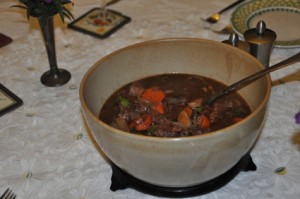
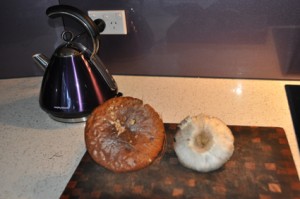
What to do with those two cepe mushrooms I found on the roadside? Well, a French recipe is a must because I first ate the fleshy fungi in France. I find a perfect recipe in  Auguste Escoffier’s book 2,000 Favourite French recipes, which is the only one of his works written for the home cook. He wrote it a few years before his death and I find a simple Provencial Stew recipe Estouffade a la Provencale.

INGREDIENTS:

500 grams diced chuck steak; flour, 200 grams streaky bacon, butter or oil, 3-4 onions, salt, pepper, 1 bottle red wine. 2 ½ cups of stock or water, bouquet garni of 2 sprigs parsley, 1 bay leaf, 2 sprigs thyme; 1 clove garlic  and 500 grams of mushrooms. (I added 2 carrots for colour).

METHOD:

Sprinkle diced steak with flour. Dice the bacon; brown in butter or oil for a few minutes and remove to a plate.

Put the meat, quartered onions and sliced carrots into remaining fat, add salt and pepper and sauté for a few minutes. Add the wine and cook until reduced by half. Add the boiling stock or water, the bouquet garni and crushed garlic. Cover and simmer for 2 ½ hours.

Pour through a sieve and put the pieces of meat back into the pan with the bacon and the quartered mushrooms, which have been  sautéed in butter.

Skim the liquid, return to the pan and simmer a further 15 minutes.

Escoffier suggests 2-3 tablespoons tomato puree and a few black olives may be added at this point.

Serve with mashed potatoes, macaroni, noodles or gnocchi.

(This is a flavoursome dish, heavy  with the flavour of red wine and I don’t think it needs tomato puree, although I added a few olives for decoration and served it with mashed “Nadine’’ potatoes.


Mushrooms and memories on hillside stroll

I am trying hard to nudge out grief from my mind by paying attention to the joy of life around me.

There is delight simply by walking down my street with Oscar on his lead sniffing at every blade of grass and piddling to claim his territory. It is strange to do it alone, but then we never did walk these uphill downhill streets once we returned from renting at Hindmarsh Island. You were too ill and I didn’t want to walk without you.  Now I begin again walking a new dog as our old Shi Tsu dog, Jackson, has been dead two years now.

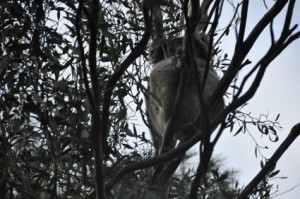
I notice the koala turds on the road and look up into the gum tree to see if it is still there.  And there he is. A fat specimen wedged in the fork of a tree. I run home and get a camera and snap him, who stares down at me.  A  medley of birdcalls pierce the still, wintry mist. If only you were here with me this crisp morning because the winter creek, which runs across our property and along the side of the road, is rushing with water.  Such a rare occurrence that I cannot remember if we ever saw it gush like this.  For 360 days of the year it is as dry as Oscar’s bone, but now it zips along flattening weeds and grasses on its journey down the hillside.  There are magpies, too, hopping around, flying overhead. And I notice it all on my hillside stroll.

However, around the corner in High Street, where we walked a hundred times in eight years, lies undiscovered, your joy of joys.  Under the tall pine tree, no more than 10 metres from the corner I find two cepes!   I almost shout our loud with joy and pick them both carefully. And we turn for home.  “Here comes breakfast!’’ I tell myself. “And a beef and mushroom casserole.’’

Before I met you, I had no idea that finding rare mushrooms could be so much fun. One is almost as big as a saucer and neither have been infested with grubs.  And as I walk briskly home, my mind floods with the memories of our mushroom adventures last May when we went into the Kuitpo Forest and found so many we didn’t have enough bags in the car to carry them.

Armed with this precious knowledge – and I remember how Yvette would never tell us her secret places in Adelaide environs where she would collect cepes each year –  we returned to pick more mushrooms to pickle.

We had stepped over the fence into the ploughed earth which bordered the forest to find cepes by the score popping up through the bare ground. But you insisted on going into the forest anyway  – a dark place, dangerous to walk with the broken branches and years of pine needles covering rocks.

“No, let’s just go home,’’ I had said when you beckoned for me to join you. “Look how many we have to pickle.’’

“I will hold your hand, darling,’’ you had replied.

“This is fun.  I will show you some magic mushrooms; they are bound to be here somewhere.’’

So I traipsed alongside you through a wonderworld of countless fungi and we picked our way over the fallen branches, rocks, and pine needles, treading carefully onward with the smell of pine cones all around us.

Into a clearing where tall trees had long been felled where mushrooms of a different kind now grew in gay abandon.

“Aha!” You cried out in joy. “Magic mushrooms. You eat them and you will get as high as on marijuana.’

Now I smile at the memories and yet am sad to think you missed finding the same cepes, which sell for $80 a kilo in French provincial markets, growing wild no more than 100 metres from our house.  Now I can only imagine the joy that would have brought you.

A Memorable Encounter with Music

Today, June 23, is Olivier’s birthday and a strange thing happened. Friends Ruth and Graham Bettany invited me to visit them at Oakbank in the Adelaide Hills to keep my mind off the significance of the first big “anniversaire” since his death six weeks ago.

Ruth took me to Avalon, a new purpose-built cafe in the pretty Hills village of Woodside and as we stepped into its exciting space, with its Francophilic homewares at one end at the cafe at the other – I could hear a familiar song. It was  Dance Me To The End of Love – the music by French chanteuse Madeleine Peyroux which I had chosen as background to the slide show at Olivier’s funeral.  Perhaps I am recovering somewhat from my grief, because I was filled with wonder at the “co-incidence”. Surely Madeleine is not a popular singer in Down Under music culture and yet this new cafe in such a small town was playing the tune I chose to reflect our life together.   I know people will sneer, but in my heart I know Olivier was with  me in spirit today. And my heart jumped with joy and I felt a familiar warm glow of memory, not the awesome sorrow of these past weeks.

When I think of the serendipity of my purchase of that CD a week before his death, the significance of today’s incident is heightened. I am not a music person. I have stepped into Blackwood Sound shop, probably four times in the eight years I have lived in Belair.  Yet that day I was driven to buy three CDs to bring my husband pleasure as his condition deteriorated.  On a whim, I chose Careless Love by former French street busker Madeleine Peyroux, a name I had never heard of and an inappropriate CD title for our purist love.   Yet, when I heard the first song, Dance Me To The End of Love, it so reflected our married life, how our time had been such a wonderful dance with life, that I slotted it away in my mind for when he would finally leave me.

To uplift me further, on the blackboard in the cafe was written “Reflect Upon Your Present Blessings….Of which everyone has many”.  And this is the thought I took back into the drizzly Hills day.


Marie’s Take on Hindley Street A Winner.

It’s known as Adelaide’s seedy strip, but renowned naïve artist Marie Jonsson-Harrison has captured Hindley Street in a whole new light – as a colourful, eccentric streetscape – and her images are to be taken to the world on a new range of contemporary bed linen.

The naïve artwork has been reproduced on the Art’N’Bed (Our Art, Your Bed) product label by Israeli entrepreneur, Mr Lior Rapaport, who bought the copyright for bedding and March will receive royalties per set sold.

He discovered her work while browsing the Museum of Modern Art on Facebook where he found one of her paintings someone had posted there.

“He really liked it and he went from there to my website to see “who is this artist?’,’’ recalls Ms Jonsson-Harrison.

Ms Jonsson-Harrison’s Hindley Street naïve art is one of three images in the range. It will be launched in New York on June 16/17, following its successful launching at Passover in Israel in April. The range will be launched in Japan and the United Kingdom later this year.

The exciting quilt features all the one-time familiar icons of Hindley Street –Jules Bar, Downtown Leisure Centre, Flash Coffee Gelateria and Jerusalem Restaurant in a splash of vibrant street life.  Crazy Horse nightclub is depicted alongside Goodwill Stores.  And the instantly recogniseable eclectic imagery is jammed with a multi-cultural crowd of people.

Swedish-born Marie Jonsson-Harrison, a former international model, said she wanted to capture the excitement and “naughtiness’’ of Hindley Street that she remembered from her youth.

“He wrote me an email and he said he was interested in featuring the Hindley Street artwork.

Her Hindley Street artworks were originally displayed at Greenhill Galleries.

Why Hindley Street?

“When I was a teenager we would “crack a Hindley’ where you would go in the car and cruise down looking at what was happening.  The whole scene was so much fun, with the tourists and the cruisers hanging out of cars.’’

Mr Rapoport has also commissioned Marie to capture the city of San Francisco for Art”N”Bed quilts and pillowcases.

Marie began painting in the naïve style 25 years ago when she had asked her brother, a sculptor, to decorate her newborn daughter’s nursery.

But when he was too busy with his sculptures, she decided to decorate the wall herself. “It was such fun, I continued painting,’’ she said.

Adelaide art dealer, Jim Elder “discovered’’ Marie soon afterwards and she has been painting professionally since.

However, Marie’s career has hit the international stage once she launched her website and offers to show her work flowed in.

A UK publishing company, wiuth 1200 outlets in the UK, has commissioned her to do a poster of the London Olympics to capture the city of London and its icons. These limited edition Giclee artworks will be available through some of the outlets during the Olympics.

The same company has also commissioned her to do an iconic artwork on Paris and has chosen five of her previous works for limited edition Giclee prints to be marketed around the world.

Marie has an established clientele in Japan through gallery exhibitions and from her website, she has made inroads into the European naïve art scene. IN May her works were written up in a French magazine, Artension Magazine France

She also was featured in January in Normandy France in the Henri Rousseau exhibition in L’abbaye de Montivilliers on the occasion of the 30th anniversary of his death.

This month her artwork will be also featured in the by invitation only Naive Festival, Katowice Poland.

Former president of the Hindley Street Traders’ Association and one-time owner of Downtown Leisure Centre Frank, Sebastyan, denies Hindley Street was ever the haunt of prostitutes and pimps.

“It never was a street of prostitutes,’’ said Mr Sebastyan, who scotches its notoriety. “There may be the occasional prostitute, but it is not a pickup street.”

He says Hindley Street has struggled with an unfair reputation for years.

“It has always been describe ed as the entertainment street of Adelaide… Today it is largely a street of entertainment, night clubs, bars and coffee shops.’’

For further information, contact Marie Jonsson-Harrison on n 0438 508 659 or 83873386.