A Year of Family Fun and friendship in France

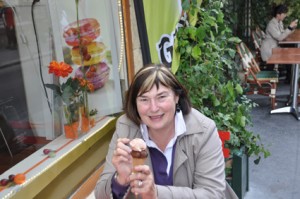
Icecream on the Left Bank in Paris

This is the second Christmas without Olivier and life in 2013 has been kinder. Life at Belair has been peppered with fun family events including my first holiday in Brisbane with daughter Serena, husband Jon and the grand-children, Samuel, Angus and Josephine.  They then travelled to Adelaide for a camping trip on the River Murray at Easter time with the Herbig crew (daughter-in-law Vanessa’s parents) which was tremendous fun.   There was much ado when  grand-daughter Scarlett turned one year old and we celebrated my father’s 95 birthday with lunches at his nursing home (see my articles in “My Journal”).  Niece Chelsea’s wedding was a highlight of the year and Qantas did very well out of the event because all my three adult children attended.  Daughter Felicia, who is Chelsea’s Godmother, came from Melbourne with partner Justin to make a full family table at the reception, including my sister, mother of the bride, Anne and husband Ken. It was a memorable night, even though I was struggling with a virus.

I joined the Lyceum Club leading to exciting activities locally and attended its international congress in Perth in May.  Afterwards, I joined the post-congress bus tour to Albany enjoying the Margaret River wineries and the Valley of the Giants (huge prehistoric trees) along the route.

It was time to revisit France three years after Olivier’s and my last trip in 2010. Sydney friend Jane and I had a fabulous time in Spain and France in September before I travelled on alone to Brittany staying with my new Lyceum friend, Daniele.  The amazing experience, though, was learning the French language at Alliance Francaise in Paris where I lived a lovely Parisian life with my host Catherine and her three dogs. One lovely Labrador was a geriatric, which made life interesting, and another was blind.

Olivier’s memorial garden has given me so much joy and his water lilies have flowered for the first time.  My life, too, is beginning to bloom again.


In the difficult world of fund-raising, Tutti Kids has embarked on an excellent idea.   Tutti has acquired the magnificent portrait of former Senior Australian of the Year and celebrity chef, Maggie Beer, painted by renowned South Australian artist Hugh Adamson.  At its recent Lady Galway Gallery launch, Maggie Beer officially opened the gallery, accompanied by Hugh Adamson.  Tutti has now released signed prints made of the painting, and will be offering them for sale before Christmas. 


Hugh Adamson was recently selected in the Waterhouse Exhibition and won the 2013 Acquisition Prize at the Adelaide Show.  He has been able to capture the mood and atmosphere in one of the special moments in Maggie Beer’s life – cooking in her kitchen!  Maggie graciously sat over a number of appointments for the work to be completed – usually standing, often nibbling, and always appreciative in her comments and conversation!

 Prints, which will cost $100 each, will be A2 size (about 60cm x 40cm) and will be signed by Maggie Beer and Hugh Adamson.


If you are interested in purchasing a signed print of the Hugh Adamson portrait of Maggie Beer, call Tutti on 8422 6511 and an order form will be promptly dispatched.


All proceeds from the sale of these prints will support our work of teaching, presenting and promoting the work and talent of disabled artists to the community and to the wider world.


Three talented artists from Tutti sange Je ne Regrette rien at husband Olivier’s funeral to showcase the excellent voice training these young peoplelreceive.


We Remember Their Sacrifice in France

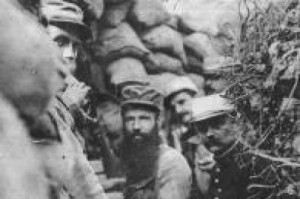
I write my tribute to our fallen Australian soldiers at 11am on the 11th day of the 11th month on Armistice Day when peace was finally signed after the four year Hell which was the Great War 1914-1918. We remember the catastrophic trench warfare in Belgium, Flanders and Northern France when the French people lost 80,000 men in the first few days.

Here in Adelaide three generations at least into the future, Naval, Military and Air Force Club member CAPT Mark Williams, of Adelaide, shares his poem with us for Remembrance Day. It was read on ABC radio at 9.20 am today. We will Remember Them and the French people certainly have never forgotten the whole-hearted war effort the young men of Australia played in their conflict on their soil.

Foreign Soil (The Field) by Mark Williams

Why cometh you to this yon hallowed grave? Laying flowers down against cold foreign soil.
Forgotten past now lost in time unseen, cocooned unscathed from fear and burdened toil.

You stop to ponder questions left unsaid, by those who died for they that now do live
Recalling all who speak of glory past, become confined to shadow – none to give.

They whisper meekly words through silent rush, as streams once red now turn a softer blue
Heroic deeds soon destined for the grave, unread – the grace of honour ripens dew.

Those lives once lost sleep ever softly still, against the mud where darkness soon doth peek
Their vigil felt – such burden bears the cost, into the ground their comfort soul to seek.

Both rich and poor lay buried side by side, no more divided rank and sapper rest
All comrades in this final place doth meet, war-memories withstand that fallowed test.

Their purpose bound diminished not by time, for still you visit, still you try to see
The need to know the past for future minds, such power through the grave seeks liberty.

But in this world the thirst for war goes on, across the land the children fight to die
Perhaps again in foreign fields you’ll stop, to honour graves of those whose stories lie.


Love endures for Frank and li’l sis Lilian


A special 95th birthday surprise, when Frank meets his sister Lilian again

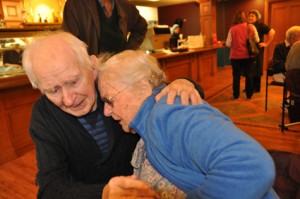
It was a touching moment when the two siblings – my 95-year-old father Frank and his 92-year-old sister Lilian – fell into each other’s arms and wept.   They had not seen each other for two years since my Auntie Lilian’s 90th birthday and the emotional reunion took place at father’s facility – the Glynde Lutheran nursing home.  Both have deteriorated since then as they are now in walking frames, but they both have a certain alertness and they shower each other with affection. And sheer delight at the occasion.


Since then Frank has moved from Renmark to an Adelaide aged care facility and Auntie Lilian has moved from independent living into a nursing home at Elizabeth on the outer edges of Adelaide suburbia following a number of falls.

My father Frank had no idea of the surprise I had in store for his 95th birthday.   Lilian is his only sister and the only surviving sibling – their four brothers are all deceased.


At their age, such a reunion holds it challenges – negotiating with nursing staff at both ends – and ensuring that Auntie Lilian will be comfortable leaving her facility and driving into the inner suburbs. It will be the first time she has left the nursing home since being admitted in April. She had suffered another serious fall which left her unable to care for herself.


My father is almost blind through glaucoma he can make out hazy shadows and while poor of hearing he can recognise through voice. And the moment Auntie Lilian opens her mouth with an emotion “Frank!’’’, he cries out in delight. “Lilian, my little sister’’.  And so the tears of joy flow and we, who watch on, are caught in the emotion, too.  Together, they have clocked up 187 years of living in each other ‘s lives.

Dad wont let go of Lilian’s hand

My grandmother was pregnant with Lilian when she and grandpa brought their two little boys (Frank the oldest was two years six months old) by boat to South Australia. My English great aunts told me that grandma was sick every day on board and wrote back home telling them it was a “hellish voyage”.   Auntie Lilian was born one month after “Frankie’’ turned three years old in 1921, the year they arrived here.


It is an hour-long drive to Elizabeth, but as soon as I saw her sitting in the lounge patiently waiting, I knew this will be a special day.  One of the carers pulls me aside.  “She has changed her clothes about five times wanting to look nice for today,’’ she says.


The walking frame is a recent addition, she tells me.  Behind her conversation is the same bright, kind auntie I have known all my life.  At 92 years of age,  her stage of ageing illuminates that father Frank has deteriorated markedly over the past three years when he was 92.


The moment she is satisfactorily settled in the car, she fires off the questions about all the children and the grand-children (remembering their names) the marriages and the births.  She wants to know how I am coping as a widow and tells me her own story after my uncle died. And, we haven’t left Elizabeth yet! It’s as if she has stored up all the questions and wants to get them off the agenda first.

I tell her she looks lovely today, but she comments: “I am not happy with my hair.” And she pulls a few loose strands back behind each ear. ” Does that look better?” she asks. All her life, she has worn her long, fine hair in a bun at the nape of her neck –  the same style as her mother, my grandma.

She wants me to take her to a chemist because she needs tweezers and a shaver “For myself’’, she adds.  “I must be well-groomed mustn’t I?’’ And I  marvel at her care and attention.


“When I left my unit to go to hospital, they cleaned everything out and no-one can find my gopher! I am sure it was nicked,’’ she says.


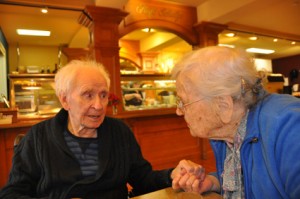
It may well be the last time the siblings see each other and they know they are blessed to have both lived such a long, relatively healthy life.  Which is why my father strokes his sister’s soft face and won’t let go of her hand.  And they chatter on as if they were once more children sitting on the verandah of their Dudley Park home.


Frail Frank soldiers on at 95 years.

My frail father, Frank, turns 95 today and my sister Anne and I are with him as he shuffles on his walking frame to Kafe Schulz, the restaurant in his nursing home where we will buy him a chocolate drink and cake.

Frank has always been a chatty fellow and talks as he walks. He is almost blind and has very little hearing, struggling to decipher the snippets of conversation he can pick up.   Dad has always been a stick thin small man, no taller than five foot three inches. Now his legs are failing him and he huddles over his walking frame until we reach the security doors, where Anne keys in the code.

It’s hard to have a father in a locked ward,  but he has some dementia, although to listen to him and his timely comments in context, it is hard to believe.

As we walk, we tell him that on Sunday we will have the family birthday party for him in the covered barbecue areahere  where the fruit trees are in springtime blossom. Frank shoots back his first question; he wants to know who of his large three generations of offspring are going to be there.

“Who has the baby?” he asks and we inform him there are two babies, the first children of his grandsons  Tyson and Jason, my own son and Anne’s second son respectively.

“I looked after Tyson when he was a little tacker,” he says. His grandfatherly duty when I returned to work 30-odd years ago ensures that he remembers Tyson better than some of the other 12 grand-children.

“And last week I looked after Scarlett, Tyson’s daughter,” I answer.  “She looks exactly the same as Tyson, only she is a little girl.”

“Well, that’s life love.” he adds and it warms my heart to hear his term of endearment.

Each meeting with dad involves a recollection – almost word for word – of his life work as a “sparkie” and he tells us for the umpteenth time how he handled some “pretty big jobs in my time” as an electrical contractor.

Frank appears as fragile as glass, yet he is a freak for his age. He remains remarkably healthy. He takes no medication and does not appear to be in any pain.  He has always had a cheerful personality and although he is one of the newcomers to the nursing home, he has quickly become a popular character.

He is a celebrity today, too, as all the residents in his section of the home have enjoyed a slice of his birthday cake. As we wander down the corridor, residents come and congratulate him.

He tells anyone who listens that we are his two daughters and he has the two best daughters in the world.

When we first admitted dad to the nursing home we were warned that he had dementia and would need to be moved to the high care dementia ward.

Because he had come from a Renmark aged care facility to Adelaide after a very long wait for a bed, we asked nursing staff to give him a chance to settle in before moving him again into high dependency.

However, dad has blossomed under the care of the staff and there is no more talk of dad moving anywhere within  the Glynde Nursing Home. His sparkling personality and quick wit has ensured he stays put, where he watches the television much of the day and sleeps the rest of the time.  He has a routine and his first activity is to read The Advertiser with his magnifying glass, a task which takes him all morning.

I suspect he recognises us by the sound of our voices rather than his sight which has deteriorated through glaucoma.

Last Saturday I called in to see him, but he was sound asleep. The races were on the television, so I turned it off. When he awoke, he chastised me. “Why did you switch off the races?” he asked.

“I was watching them. It’s a big race in Melbourne y’know. I like to watch the horses.”

Dad has never been interested in horse racing and herein lies the lesson. He is still broadening his interests even in the confines of his room.

As he slept I noticed his bottom jaw was slack and thought his bottom false teeth must have fallen out. When he awoke I didn’t like to point this out to him in case his jaw could no longer support his 60-year-old teeth.  But after about half an hour, of his sloppy speaking, he felt them down the side of his body.

“Ah, look what I have found?” he says laughing in his jovial manner of a lifetime.

“My teeth!” and he proceeds to show them to me and then insert them into his mouth.

I shudder because the thought is always there that in 24 years, it may be me sitting in the comfortable armchair of a residential care facility.

As we reach the café and my sister goes to order chocolate, I reflect on his life as our father. Dad was a workaholic for most of his working life, running his electrical business and there is no denying he was what we would call today an “absent father”.  Typical of the times, he did not see child-rearing as anything he should be involved in. He was the breadwinner and our mother, Florrie, raised the five children.  Perhaps this is why he has been granted such a long life to allow us to engage with him on a much deeper level than seemed possible when he was a hard-working father.

In  his dotage, he has kept his peculiar habit of winding his stick-thin legs around themselves as if they were indeed growing around a stake.

I smile to myself and remember when I was a skinny teenager he once told me that I had “legs like matchsticks with the wood scraped off”.    Now he tells me I am too big and buxom and should try and lose some weight.  He is still the parent and around him I return to my core self.  No point in displaying airs and graces for my dad. After all, this is the man who was there when I was born; who knows me; who loves me unconditionally.

Dad was born in England and came to Australia when he was two and a half years old.  Despite that tender age and despite lashings of our own Australian culture, he has always had a very British sense of humour.

One of my early boyfriends was a Chinese student, who had the usual Chinese accent. Whenever he telephoned, to my embarrassment, dad would call down the hallway saying “Who Flung Dung is on the dog-and-bone”.

When I would rebuke him in teenage hysteria, he would say “I’m a pommy, the telephone is always the dog-and-bone” ignoring the racist slight.

His chocolate drink arrives too hot to drink and in glee he clasps his palms together and raises them skywards. This is enough of a precursor to disaster that the ever watchful waitress returns with a big mug and some cold milk. “I think things will be safer if we cool down his chocolate drink,” she says,  pouring the tea cup’s contents into the mug.

“You will do the MC thing on Sunday, won’t you love?” he asks.

“Of course dad,” I respond.

“I want to live to 100 so I can get a letter from the Queen, y’know. I’ve got a lot of time for the Queen. Her mum lived to 103 y’know.”

“I reckon I could make 103.”

Goodness, Frank is almost 100 years old anyway and his continuing engagement with life is a joy to behold. He may indeed make 100 years old as his English Aunt Edith lived to 100 years five months.
Paris Pockets Packed with History

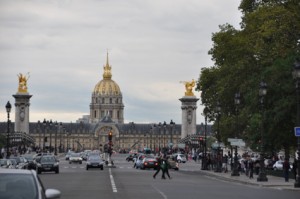
Les Invalides in Paris

In his grand tome entitled Paris, Edward Rutherfurd describes the site on the Left Bank where the Romans established their town, named Lutetia, as “a low, flat hillock, like a table overlooking the water”.  Here on this gentle rise of land, they  had laid out their town, building a large forum and “the main temple covering the top of the table.”   Even back then, its colloquial name was the city of the Parisii, after its original people.

I know none of this as my travelling companion and I traipse up the last 100 metres of the so-called gentle hillock dragging our cases to our hotel, L’hotel Sainte-Genevieve.  Things are not going well for the start of our six day holiday in Paris. The road is blocked for the annual Patrimione Day and the taxi has had to leave us half way up the hill because it seems the schools in the Latin Quarter have open days. We find the number 17 on Rue Descartes, but there is no hotel sign, simply the large numbers alongside a pair of those huge ornate timber doors, which so characterise Paris.   Voila! There is an entry button and when I press it, one of the doors swings slowly open and we proceed into a courtyard.  Our accommodation is indeed a discreet hotel for French army personnel and their families. So in this unassuming place, we begin an exciting week of living like the locals on the Left Bank in Paris – coming and going through those huge carved doors which once opened to horses and carriages in the 19th century.

Even though this quaint curved rue is named after the great French philosopher Descartes, it is highly likely that Roman chariots took this route as they charge up the hill to the old Roman hilltop town 2000 years ago. More significant is that Saint Genevieve herself, the patron saint of Paris, would walk daily up the same road we are on now to the Abbey Sainte-Genevieve , which was named in her honour. The route, too, where the taxi stopped is named in her honor  as Rue de la Montagne-Sainte Genevieve. At Place Larue it becomes Rue Descartes.

so do the streets.  The abbey, built in 502 by King Clovis I was ravaged by the Normans in 857 and when it was rebuilt in the 11th century it became a monastic empire.  It is a thrilling find that the first saint of Paris was a devote woman, who walked this same way every day to pray.

This is my first holiday in Paris since my husband Olivier passed away 16 months ago and I thought I knew everything important about the City of Lovers. It is also my first overseas holiday with a girlfriend.  Jane has never been to Paris and I hope she will be as gobsmacked by its beauty as I was nine years ago. Without a Frenchman to drive me around this glorious city,  we do what other tourists do, buy a two-day pass on the REd Bus with its open top upper deck.  This is the most economical way to get your bearings on the enormity of Paris  from one’s high perch.

The slow bus drawls around the quays and boulevards stopping intermittently for tourists to alight or board at any of the wondrous iconic buildings of Paris, the Eiffel Tower, Notre Dame, Le Louvre, La Madeleine, Les Invalides, Conciergerie, the magnificent Alexander III bridge over the River Seine, the Opera House and the Arc de Triomphe .  It is a leisurely, pleasurable way to soak up the history of this ancient city indelibly written on the buildings we pass.  The Champs Elysees is Paris’s prime high end shopping precinct and there is always a river of people on either  side.  On the one side Guerlain is being renovated, clothed behind a “wall” of printed partitions and on the other side, that temple of luxury, Louis Vuitton spreadeagles around one whole corner.  Our English recording of Paris’s history (there are nine different languages) adds to the beauty before our eyes and ignites our curiosity.

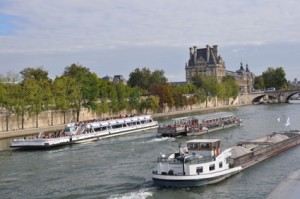
Musee du Louvre on the banks of the Seine


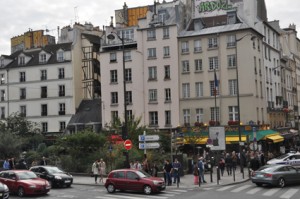
The Left Bank (Rive Gauche) offers quite a different side of Paris to the Right Bank, (Rive Droite).   On Day 3 when we turn the corner from our hotel in search of La Poste we find the awesome Pantheon on one side of the street – and just as impressive,  the ancient L’Eglise Sainte Genevieve on the other.  Our hotel, as is the church, is named after Paris’s first heroine, the woman who inspired the citizens in the early city of Paris in the 6th century to rise up and defeat Attilla the Hun.  We walk on a little further, and there it is, the hub of the student quarter – the Sorbonne – the University of Paris.  No wonder students pour like gushing wine from the Metro in the morning and now they are lined up outside almost every doorway we pass awaiting entry for classes.

Under our very noses, we have discovered the other Paris, the antithesis of the rich two-mile stretch of the Champs Elysses, the student quarter.   No wonder the street where we traipse each evening towards our hotel is named Rue des Ecoles (street of the schools) because it seems there is an ecole or lycee (high school) at every corner.   We are walking very famous streets because Rue St Jacques, which heads straight down to the River Seine, was once the Pilgrims’ Way to the Compostale in Spain.

There is a trick to travelling with a trusted friend, mostly learnt through trial and error..  To know and love Paris as I do is his lovely legacy.

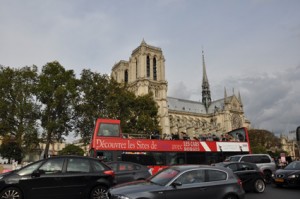
The red tourist bus by Notre Dame

To ensure peace and harmony, here are a few tips which helped us enjoy Paris without impinging on each other’s sense of adventure, n0t forgetting fashion shopping, which is tedious for the onlooker.

1. Begin your holiday by taking a trip on the tourist bus and follow your course with a quality map of the city. The bus operator provides one, but I bought a plastic-covered one from The Map Shop on Unley Road.

2. Write all details of your hotel, address, telephone number  and the route to it from a landmark (ours was Café Panis) into your diary or travel notebook. Keep it on you at all times. Take mobile number of your travelling companion.

3. Synchronise times on your watches and if making a meeting point, mark it on each map with a big red circle. Always be on time to avoid panic attacks.

Shakespeare and Company bookshop on Quay Montabello opposite Notre Dame

4. Visit Shakespeare and Company – the bookshop in Paris filled with English language books on Quai Montebello.

5.  Check out the Metro if you wish to use it and it is the cheapest and most efficient way of moving around Paris. Personally I prefer taxis in such a beautiful city as I never tire of studying the buildings, which reflect centuries of architecture.

6. If in Paris for the first time, book a river cruise to learn the intriguing history of the bridges which cross the River Seine. A meal on board is wonderful.

7. Check out the tours offered through your hotel – use up the specials offered through the open deck tourist buses.

8. To get your bearings on the left and right banks of the city, take a taxi trip from the Latin Quarter on the Left Bank to the posh Right Bank. Pick one up on the corner of Boulevard Saint Michel on the quai and ask to be taken along Rue de Rivoli to the Marius (Place des Vosges has dramatic Parisian buildings) and then return along Rivoli to the Place de la Concorde turning right into Rue Royale with the magnificent La Madeleine in front of you  and get off at Rue Faubourg St Honore for an hour’s “promenade” on this famous shopping precinct of Paris. To your left is the high end of Paris fashion and to your right don’t miss Place Vendome (look for  the central column) for exquisite jewellery stores and the Ritz Hotel, but continue along St Honore (stopping for coffee at Place Du Palais Royale) towards Rue du Pont Neuf  where you will find one of the many “villages” which make up Paris. This was the part of Paris I described in my book From France With Love.

9.  Other special pockets of Paris are St. Germain des Pres to see the oldest church in Paris and also the two famous cafes of French existential writers Simone de Beauvoir and Jean-Paul Sartre – Café de Flore and Les Deux Magots on Boulevard St Germain and wander down Rue Bonaparte for an interesting mix of shopping experiences;  and at Montmartre are its two distinct – but very different attractions – Moulin
Rouge and the magnificent white L’Eglise, Sacre Coeur. Take a walk from the Butte to discover its fascinating web of streets, stairs and squares rather than the funicular.

10.  Lastly,  my musts list includes Jardin du Luxembourg for the statues of the queens of France, the exquisite Sainte-Chappelle on Ile de Cite,  and Musee  du Louvre, but remember it is closed on Tuesdays and across the river, Musee d’Orsay is closed on a Monday.