Birthing, Bonding & Back-to-work for mums
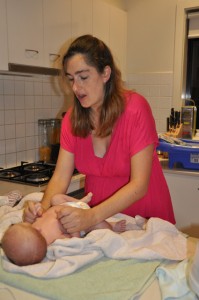
Grandson Zachary is cared for by his mother Vanessa.

Grandson Zachary is cared for by his mother Vanessa.

One thing that fascinates me about the current feisty debate around  Prime Minister Tony Abbott’s “signature” Paid Parental Leave proposed policy is that women, themselves, are not hailing this initiative as the best thing since sliced bread.  The hoo haa from men was always expected, because the vast majority simply continue to go off to work each day once children arrive.  Their superannuation upon retirement is big and fat after a long working life.  But it is the mothers who suffer the financial deprivation if they drop out of the paid workforce for any length of time.  And it is mothers who need to manage the domestic scenario in order to return to paid work. Which means arrangements for paid child care and weighing up the costs.

Where are the losers here if this policy passes the Senate?   Women, particularly low paid women in menial jobs, will be big-time winners.  They will be paid for six months at their usual salary – as a work entitlement – and surely this will give these women integrity as valued workers – and fortify their sense of independence and equality. Importantly, it also validates their important role as mothers-to-be bearing, birthing and raising children.  We have created a two-income society and in doing that, this country can no longer afford to provide middle-class welfare for women to stay at home indefinitely.

The Federal Government is on the right path to insist that once the last child is at school and reaches the age of 6, that it’s time for women to return to paid work.  Former  Prime Minister John Howard’s mantra that women needed choice, has run its course and because of the enormous debt the country finds itself in, tough decisions need to be made and implemented. It is madness to think that social policy does not yet fully underscore women to maintain their role in paid work as well as have children – the next generation.

This isn’t only about fiscal repair.  One of the saddest states of being for a woman is to find herself in her 60s, often alone and with very little superannuation of her own.  When freed of her family responsibilities and able to enjoy retirement, she is reliant on the age pension which provides little more than basic living standards for many older Australian women.

Paid Parental Leave for women who earn up to $100,000 will lay the foundation to build an uninterrupted working life as well as raising a family.  Disposable income drives our economy and also provides the funds to ensure the nation’s children enjoy their fair share of activities such as sporting activities, artistic endeavours and school outings.

This policy which delivers six months full pay, allows women time to bond with their newborn babies and enjoy mothering for the crucial first half year. It endorses women’s place as part of the fabric of the nation’s working life and builds an expectation that they will returning to their existing jobs. Figures support this with 69 per cent of women now in the paid workforce.  The sound idea is to ensure there are no gaps or obstacles  in women’s smooth transition from paid work, maternity leave and then returning to work. Which means government also needs to closely examine the issue of paid child care. Accessibility is still a problem and now, added to this is the much higher costs of childcare. Costs have risen 44 per cent over five years.

The Federal Government should also examine subsidising child care fees on a sliding scale of need. Availability of child care is still a stumbling block for many women along with its cost, especially for women with two children under five. These women are the ones who need to be encouraged to retain their links with work while establishing their two-child domestic world.  Having money in the bank at the end of paying child care fees is a great incentive to take on the juggling act of working and child-rearing.  The more low-paid a woman is, the more she is sensitive to childcare costs when deciding whether to return to paid work.

So let’s help them.  National Centre for Social and Economic Modelling figures shows only 43 per cent of childcare subsidies are paid to families in the bottom 60 per cent by income.  The current dual system – a means tested benefit and a universal rebate – needs to change to provide one payment which is means tested. This will ensure a higher percentage rebate goes to lower income workers.

One thing which would help households justify the woman’s return to work would be for husband and wife to share the cost of paid childcare so mothers can pocket more of the money they earn and fathers can have half the cost of childcare skimmed off their usually larger take-home pay packet.  Why should it be considered only the mother’s expense. Daddy should also bear the financial load fairly.

The long-term benefits for women of staying in the work force through their 20s, 30s, 40s, and 50s manifest in their 60s, 70s and, hopefully 80s and 90s, when their little nest eggs of superannuation can ensure a quality of life for them, either with their partners or alone.


Exhilarating journey of an eclectic life

A happy snap at my 70th birthday with family and friends.

A happy snap at my 70th birthday with family and friends.

This is the week that I reach the formidable milestone of turning 70.  I never thought it would happen, but time moves right along and here I am enjoying myself with a week of activities whereby I have managed to involve my family and most of my friends.

In  seven decades I have jammed in much change and adventure and no-one could accuse me of being lily-livered. So let me highlight a few points I have made at the three major celebrations this week.

I have had three husbands, three children and three major careers. I have built four houses from scratch and I have five gorgeous grand-children.

The sun has shone on my life, but it has caused some very long, sad shadows, too. Mistakes? There are more than a few but I have learnt the hardest lessons through them.  I have had a fair share of bad mother days, but a pile of career successes to compensate.

With a large intimate family of 11 and a larger extended family of 25 persons, I am so rich in human relationships and kinship. When I look at my family, I see my past, present and future. And over this past week as I welcomed my close friends and reunited friends – I also see my past, present and future.

My children – raising them from infancy to adulthood  – with all the mixed blessings that entails, have been my greatest purpose in life. In reflection, I loved my mothering years and I am so proud of how they are living their adult lives, the choices they have made and what they are becoming – because life is a long continuum. They are beautiful human beings.

In reflection, my most precious birthday gift in my whole life was, without any doubt, my 16th birthday when my mother, Florrie gave birth to my only sister, Anne, who followed three brothers’ births. I am the eldest and Anne, is not only “sis” but a beloved friend. What a wonderful gift and as she said this week, she loved pretending I was her mother when I took her shopping – and vice versa of course. I pretended I was a very young mother of little Anne Victoria.

Recently, I was talking to my 95-year-old father and asked him if he could remember when I was born and he threw his hands to his face and said “Florrie said, Oh, it’s a girl! We wanted a boy.”

I then asked him if he loved me regardless. His whole face broke into a smile and he said with feeling “Oh yes, you were our little missy.’’

Frank picks me up in his Mercedes

Frank picks me up in his Mercedes

It was such a precious memory for him and so wonderful to witness in his dotage, how much he loved me as a little girl.

Chris, Pat, Sally, Jill, Cheryl, Barb and Lesia celebrate with me.

Chris, Pat, Sally, Jill, Cheryl, Barb and Lesia celebrate with me.

Turning 70 cannot be fobbed off as being the new 60, because the body has aged and even though I still snap at my son if he dares to say I am elderly, “little missy” is now an older woman.

The selfie I took this week reveals jowls just like my mother. Behind me on the whole, etching those wrinkles the sunlight blatantly exposes, is a blessed life.

My marriage breakdown in my 20s shattered not only my dreams of happy ever afters, but also my health and happiness for years.

I found myself where I never expected to be – as a single mother.

Another marriage, and another divorce 14 years later ushering in a long 20 years of singledom until I married my third husband, Olivier, in 2008.  The saddest chapter was losing him to cancer and caring for him in his deterioration until death.  I could hardly bear the profound grief which consumed me.  The loss of happiness was excruciating. Now I find myself where I never expected to be – a widow, and alone for the first time in my life.

On the career front I have been a shop assistant in my father’s electrical shop, a secretary, a high school teacher, a professional fund-raiser, quest organiser, public relations consultant, and lastly, a journalist, columnist and editor  during a 20 year career.

My career  at the Advertiser was an exhilarating journey of growth and change and amongst countless different roles and writing assignments, two stand out – drawing up an agenda of women’s news for the male editors of the day to shape into editorial policy and establishing the women’s issues round to write stories which reflected women’s lives.  The other major achievement, the story which had the biggest impact, was breaking the State Bank story; that our bank was driving South Australia to bankruptcy.

At the other end of the news spectrum I enjoyed a few years as celebrity columnist writing up the gossip surround the stars and juxtaposing this with serious columns on social change. Whilst cultural issues writer, I met my future husband Olivier.

Maria Kenda who designed my birthday present to me - a pearl pendant.

Maria Kenda who designed my birthday present to me – a pearl pendant.

One quantum leap into the unknown was writing my memoir of our first trip to France where I fell deliciously in love with Olivier – and I combined this risky enterprise with working full-time at the Advertiser in a new role as editor of the supplement Looking Forward – the highlight of my long career. My book, From France With Love, published by Penguin, became a best-seller and we sold the film option, an exciting dream for a few years.

The news of the moment is that despite two rejections from publishers over the past six years – I am again writing a manuscript which I hope will be published. It will be the story of returning to France last year with my dear friend Jane, who lives in Sydney and our various experiences and misadventures as I tried to throw off the mantel of grief which had all but snuffed out my joie de vivre.

Therefore I am not afraid of failure and, as with my website, www.nadinewilliams.com.au, I am willing to take risks.  My name, Nadine, means “hope”, yet I am bracing myself for another rejection.  But beginning to write again after closing down through grief is a success in itself. When I complete the manuscript of 100,000 words, whether a publisher wants my story or not, that huge project can never be considered a failure, but a growth phase in my older life.

So, I felt proud sharing these chapters of my life with my friends this week.  It has been a fruitful life for a “lassy” (another name my dad called me in my teens) who was frightened of her own shadow at 20. Dad didn’t believe in educating me, so I educated myself  completing year 11 history and shorthand before achieving matriculation English in my late 20s. It took eight long years in my late 30s and early 40s to achieve my Bachelor of Arts in Journalism, but this was my entrée to a career in journalism which has metamorphised my life.

At 70, I am healthy and content. Grief rides in tandem with happiness as only the grieved will understand. Balancing this all up, I do feel a fulfilled woman.


Nancy Inspired by Widowed Refugee Mum.


Nancy Nguyen, a Perth based Business Advisor for Woodside Energy, has been selected by The University of Sydney Business School and the Australian National Committee for UN Women, as the inaugural recipient of their MBA scholarship.

The scholarship and new 2014 partnership between the Australian National Committee for UN Women and The University of Sydney Business School were celebrated at a lunch attended by the Chancellor of The University of Sydney, Ms Belinda Hutchinson AM, on 1 July which was attended by 40 industry leaders, students and alumni.

Nancy says as a child she gained strength from her mother who became a widow due to the Vietnam War. She saw her single mum with two children, in spite of her vulnerabilities, find the resilience to fight for her family’s freedom and future.

“Coming from a refugee family from Vietnam, I am grateful for the opportunities that I have been able to pursue. I am part of a first generation of women in my family to be able to have a tertiary education in Australia.”

The Scholarship is open to all women from Australia and overseas.

French chanteusse brings taste of The Lido

Caroline Nin sings a Hymn to Piaf in Paris last year.

Caroline Nin sings a Hymn to Piaf in Paris last year.

French songstress Caroline Nin served up a exciting slice of  songs from the Lido, the world-famous cabaret venue on Paris’s Champs Elysees at the Adelaide Cabaret Festival in June.

Nin presented as a quintessentially French performer with her sexy personal style and glorious sensual voice intoxicating the full house at The Space.   She had selected a repertoire of songs from the five years she spent performing at The Lido in Paris, which easily transported us into the City of Lovers.

She told the audience she had not performed in Adelaide since 2007 when she treated audiences to a rousing tribute to Marlene Dietrich during the Cabaret Festival.

My French-born husband Olivier and I had front row seats for that riveting performance. Last year, when I was in Paris,  I attended a special performance in a cosy, if somewhat claustrophobic 13th century cellar to hear Nin commemorate Edith Piaf on the 50th anniversary of her death in October.  Henceforth, I declare that I am a devoted fan.

Her appearance in Adelaide could not be missed, but my friends and I had to be satisfied with Table 23 this time at the Matinee – both Friday and Saturday evening performances booked out early.

We were not disappointed, and like the whole audience, we were enthralled as this Chanteuse presented a variety of songs from the biggest cabaret venue in the world, the famous The Lido on the Champs Elysees.  However, for an encore, Nin presented Je ne Regrette rien  Piaf’s most famous song and the audience loved it.

“I am so thrilled to be back in Adelaide because this city really celebrates the true cabaret artist,” she said after the show.


Child-bearing, birthing, bonding & back-to-work.

One thing that fascinates me about the current feisty debate around  Prime Minister Tony Abbott’s “signature” Paid Parental Leave proposed policy is that women, themselves, are not hailing this initiative as the best thing since sliced bread.  The hoo haa from men was always expected, because the vast majority simply continue to go off to work each day once children arrive.  Their superannuation upon retirement is big and fat after a long working life.  But it is the mothers who suffer the financial deprivation if they drop out of the paid workforce for any length of time.  And it is mothers who need to manage the domestic scenario in order to return to paid work. Which means arrangements for paid child care and weighing up the costs.

From my experience of following this issue for many years as a women’s news writer and editor, I see no losers here if this policy passes the Senate.   And women, particularly low paid women in menial jobs, will be big-time winners.  They will be paid for six months at their usual salary – as a work entitlement – and I say Hoorah  to that.  It gives these women integrity as valued workers – and fortifies their sense of independence and equality. Importantly, it also validates their important role as mothers-to-be bearing, birthing and raising children.  We have created a two-income society and in doing that, this country can no longer afford to provide middle-class welfare for women to stay at home.

Fierce American feminist Betty Friedan interviewed French feminist Simone de Beauvoir, author of The Second Sex during the Women’s Lliberation Movement about giving women choice – to either work or stay home to raise children. Bearing in mind that de Beauvoir chose not to have children, she still said that women should not have a choice because they would invariably choose the easier option. (Her words).  However, the Federal Government is on the right path to insist that once the last child is at school and reaches the age of 6, that it’s time for women to return to paid work.  Fomrer  Prime Miniister’s mantra that women needed choice, has run its course and because of the enormous debt the country finds itself in, tough decisions need to be made and implemented. It is madness to think that social policy does not yet fully underscore women to maintain their role in paid work as well as have children – the next generation.

One of the saddest states of being for a woman is to find herself in her 60s, often alone and with very little superannuation of her own.  When freed of her family responsibilities and able to enjoy retirement, she is reliant on the age pension, which leaves no fat for simple fun let alone a fancy lifestyle.   It delivers poverty for many older Australian women, who never worked or if they did, they did so sporadically.

There is no need for this scenario for women of child-bearing years in paid work today, and it does require a long working life where regular contributions are made to a woman’s own superannuation.  Paid Parental Leave will make it easier for women to build an uninterrupted career life as well as raising a family.  Disposable income drives our economy and also provides the funds to ensure the nation’s children enjoy their fair share of activities such as sporting activities, artistic endeavours and school outings.

This policy is designed to encourage women to return to paid work after six months maternity leave, which allows them time to bond with their newborn babies and enjoy mothering for the crucial first half year. It endorses women’s place as part of the fabric of the nation’s working life and builds an expectation that they will returning to their existing jobs. Figures support this with 69 per cent of women now in the paid workforce. Of course there can be no gaps or obstacles  in women’s smooth transition from paid work, maternity leave and then returning to work. Which means government also needs to closely examine the issue of paid child care. Accessibility is still a problem and now, added to this is the much higher costs of childcare than when I was writing about it as a critical issue in women’s lives.

Imagine any other aspect of our life styles where costs rose by 44 per cent over a five year period.

However, I would also argue that subsidising child care fees on a sliding scale of need would be an equally important move by the Federal Government. Availability of child care was also a vital women’s issue along with the quality of child care and importantly, its cost, especially for women with two children under five. These women are the ones who need to be encouraged to retain their links with work while establishing their two-child domestic world.  Having money in the bank at the end of paying child care fees is a great incentive to take on those 3, 4 or 5 day working days. Jessica Irvine in her opinion piece in The Advertiser says low-income women are “much more price sensitive to childcare costs when deciding whether to return to work”.

So let’s help them. Irvine states National Centre for Social and Economic Modelling figures which show only 43 per cent of childcare subsidies got to families in the bottom 60 per cent by income. I agree that the current dual system – a means tested benefit and a universal rebate – needs to change to provide one payment which is means tested. This will ensure a higher percentage rebate goes to lower income workers.

One thing which would help households justify the woman’s return to work would be for husband and wife to share the cost of paid childcare so mothers can pocket more of the money they earn and fathers can have half the cost of childcare skimmed off their usually larger take-home pay packet.  Why should it be considered only the mother’s expense. Daddy should also bear the financial load fairly.

The long-term benefits for women of staying in the work force through their 20s, 30s, 40s, and 50s manifest in their 60s, 70s and, hopefully 80s and 90s, when their little nest eggs of superannuation can ensure a quality of life for them, either with their partners or alone.


Footy culture flavours family life

Angus at footy practice

Angus at footy practice

AFL football has gained new-found interest in my life since my team – Port Power – reached top of the AFL championship ladder and this elation has been a great conversation booster over the past few months. Allegiance to a footy team adds colour to family life, too and I notice on my grandson Zachary’s baptism invitation that this bare-chested  little fellow  – at two and a half months old – is wearing only his Port Power beanie!  It seems my son Tyson has won the right for his son to wear his footy team’s colors, because Zachary’s mum, Vanessa, is a staunch Crows supporter.

Meanwhile, grandsons Samuel and Angus, who live in Brisbane are supporters of the Western Bulldogs and were joined up by their dad, Jon, within weeks of being born.  Which is interesting because now they live in Brisbane and Angus is shining as a potential star in his  junior footy team, Cooperoo, which is  sponsored by the Brisbane Lions. The lions provides top coaches, prizes and incentives.  Angus is only 10 years old, but was best “man” of the match last week.  My grandson, who wears Brisbane Lions’ logo on his footy top, is still wearing his red mouth guard after winning a match.