Quel Horreur! Cry French Chefs

Quel Horreur! France’s most distinguished chefs  are trembling at the prospect that disgruntled diners can describe dining fiascos in the world’s most influential restaurant guide.

The august Michelin Guide – the bible of gastronomy – has catapaulted into the social media with a new website that has opened to public comment.

The move has “les grands cruisiniers choking over their casseroles amid warnings that Frnace’s whole gastronomic edific coul;d crumble”.

They are horrified at the notion that ordinary diners could say what they thought about the Filets de sole sur mousse or Supremes de poulet la Valliere.

An article in The Times quotes Alexandre Cammas, a respected food critic and founder of an alternative guide Le Fooding, as saying the row showed Michelin’s dominance as an arbiter of haute cuisine.

“The business of chefs like Alain Ducasse and Joel Robuchon is totally based on Michelin,” he said.

“The top chefs will never admit that they are afraid of having the public comment about their restaurants but the truth is they re not at all sure of themselves and they don’t want this.”

Ducasse, a multi-Michelin-starred icon, reportedly told managers of the guide: “If you leave the comment section open, there will be uproar in the profession.”


Hope for Breast Cancer Cure

A new study holds hope that breast cancer treatment could be far more tailored in future with the discovery that tumours can be classified into 10 specific types.

Researchers analysed 2000 tumour samples from women which they say will lead to more tailored breast cancer treatments.

Cancer is one of the main causes of death in Australia, the most common types being skin, (melanoma) prostate, breast, bowel and lung. An article in The Advertiser’s Education Now lift-out states that current methods of fighting many cancers are “somewhat inadequate in identifying the first symptoms of cancer”.

A key to unravelling the unknown causes of cancer is to understand the cells in which cancer begins. This can then lead to early diagnosis, effective treatment of the disease, and most important prevention.

Although the exact origin of cancer is unknown, researchers believe cancer stem cells are involved in triggering the disease. These cancer stem cells may originate from mutated normal stem cells or from more mature cells that regress to a stem-like state.

Recently, much research has been devoted to defining the exact cell of origin for specific cancers. This will be the first step towards many cancer cures, the experts believe. However, so much work is still required and much money still needs to be raised to enable researchers to continue their valuable work, which has saved so many lives to date.  To prove this point, there are 11 million cancer survivors around the world.


su

Where the “girls” are.

Still glamorous Chris Nicholls, once a founding partner of Rave Model Agency flew into Adelaide for the weekend with husband Rob for grandparents’ Day at Immanuel College where grand-daughter Chloe goes.  They visited us at Belair on Sunday bringing news of former David Jones model, Jeanette Zealand, who now lives close to Chris at Cooroy Queensland.  Here Jeanette runs her fashion shop, Wildflower, which, despite the tiny size of the town, does very well indeed.

Also on the fashion front. Leonie Milburn who ran Chelsea Fashion either side of the entrance of Chelsea Cinema is still in limbo over her role in the cinema’s future since she vacated the controversial premises.  She has transferred all that stocto at her 2nd shop, Swish at Erindale, which must be busting at the seams.

Husband Olivier is delighted to have discovered former French model Sophie Mehaffey works at The Currant Shed restaurant at McLaren Flat in the wonderful McLaren Vale wine region of South Australia. Sophie has the cutest blue hatchback Renault which is eons old, but remains her pure joy.


Hello faithful friends,


Another four months have slipped by since I wrote you a note, but our life is a little like a ship rolling in high seas  – one is on the verge of seasickness all the time and it’s a daily problem to stay steady on one’s feet.  Ours is now a home hospice and I write of this challenge in My Journal. Yet, life also continues to present lovely surprises like the lemon cakes and eight dozen biscuits best friend Jenny has made for the conveyor belt of friends, family, nurses, doctors and carers, passing through our home. That French connection is a wonderful bonus, too, when two of our friends –a former French restaurateur and a head cook for one of Adelaide’s prestigious girls’ schools – brought delicious dinners for us to enjoy – on the same day within an hour of each other. It lightens my life as a carer.

My  Absolutely French blog on www.nadinewilliams.com.au has my reviews from the French Film Festival and a snippet on the French presidential elections. There are recipes too on My French Kitchen and some hilarity about our petit chien, Oscar. He certainly is the symbol of the art of living fearlessly in the shadow of life-limiting cancer.


This month, my good friend and former Advertiser colleague, Samela Harris has kindly allowed us, courtesy of The Advertiser, to share an article she wrote on Professor Ian Maddocks, who has indeed been “a living angel’’ in our life as Olivier’s palliative care expert.   There are also a few snippets in Celeb s and Culture and some positive health news for women in women’s lives.

Once more I ask anyone with an interesting story, particularly travel yarns to tell, I would love to publish them (edited perhaps) and thus keep the web relevant when I have so little time.

In Life and Style by Nadine Williams you will enjoy superb photographs of our weekend in Clare and how glad we are that we travelled there for vintage.


Kind regards, Nadine.


Family life, death and les femmes de nuit

C’est la vie en France:

French cinema always offers that element of surprise and this year’s offering at the French Film Festival was no exception.

As always, there was sex aplenty whatever the storyline… whether titillating erotica or subtle innuendo as used in Et Si On Vivait Tous Ensemble (And If we All Lived Together) a fuzzy rhythmic background movement to alert the viewer that sex was happening between ageing baby boomers.

However, in the three films that I chose to see, there was an unlikely marriage of Sex and that other social taboo, Death, which made for  emotionally satisfying viewing.

Un Baiser Papillon (Butterfly Kiss), the first movie by Karine Silla-Perez, captures how terminal illness and the dying process strains family life and friendship when main character Billie dies of cancer.  In Et Si On Vivait Tous Ensemble (And If we All Lived Together), evergreen actress Jane Fonda also has cancer and even plans her own funeral. However, in La Delicatesse (Delicacy),  all had vastly different story lines, but the three films I saw in the French Film Festival reveal certain script qualities for success.

Sex, for instance, is the pepper and salt of French cinema whatever the life issues, family conflict, friendship, affairs and/or humorous happenings played out by the films’ main characters.

There was one other popular sub-plot adding an element of erotica. Un Baiser Papillon (Butterfly Kiss),  Et Si On Vivait Tous Ensemble (And If we All Lived Together) and La Delicatesse (Delicacy), all included an element of erotica and a bit-part for a prostitute. In  Butterfly Kiss, for instance, the prostitute formed a minor story-line alluding to trafficking of Eastern European women as sex workers and in If We All Lived Together, senior single, Claude had always been sexual voracious and in his twilight years reached for Viagra,  happily paying for sex.

In this story of five ageing baby boomers, who through failing health and life circumstance, decide to live together, sex is filtered through the story line as strongly as percolated coffee. Jane Fonda’s character Jeanne, for instance,  talks a tad too intimately about sexual matters to the young anthropologist “Dirk’’ who is studying their twilight lifestyles for his thesis.

The French are a highly sexualised society anyway and these titillating side-lines not only reflect Gallic culture, they add to the emotional depth of each story.

Then there is that other societal taboo – death and in these three films, French film-makers have embraced the “D” word  with the same passion as sex, with the impact of dying and death on family members forming the major story-line or catalyst for change. Which probably explains why I left the cinema each time, not only fulfilled as a viewer, but with damp eyes for the emotional outlet the movie allowed.


Home-based Palliative Care a Team Effort

Once more beloved husband Olivier arrives home from hospital, but this time by ambulance.   This is a special home-coming, though, because the other option was to send him to a hospice. Even though his two doctors thought he was too ill for home care, I am delighted that he is back home here with me where he belongs in our created world and our beautiful evolving garden.

These are the latter days of his life and we are determined he will enjoy every minute as much as he can within his pain management routine.  He is now palliative and his terminal condition heralds a whole new regime for living fearlessly.  A full hospital bed arrives with massage mattress and we rearrange the dining room in an instant. Luckily the bed fits neatly between the antique German dresser in the alcove and Oli’s built-in bar fridge.

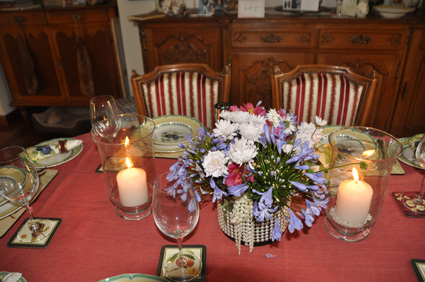
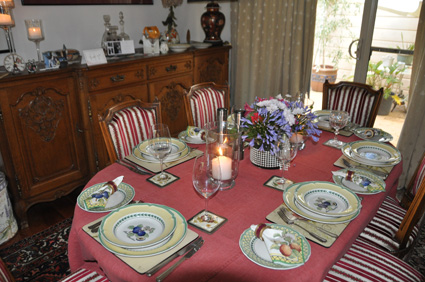
We make many decisions because palliative care godfather Professor Ian Maddocks says Oli must not sleep in the room alone  anymore.  So, the therapeutic recliner chair which Olivier had made for his late wife Colette  is brought down the hallway from the main bedroom and we place it alongside the bed.  I begin thinking up a mental roster of all the healthy strong adult sons in our family who can stay overnight to give me a good night’s sleep. This will be crucial for me to cope all day as Oli’s carer.  The beautiful French dining room suite, the setting for fabulous dinner parties and family events, now shrinks to a mere metre diameter and is shoved alongside the curtain by the kitchen’s specimen shelving.

Thus, our versatile home becomes a comfortable living environment for Olivier and from his vantage point he can watch me happily cook and clean and prepare our meals.  This is the theory, but the reality soon unfolds to be quite a different scenario.

However, for the first night we sleep together and cuddle into each other in a sweet moment, which softens the shock of what happens next.

He accidentally rips out his sub-cut line which carries morphine into his body 24/7. I call the ambulance to come and re-insert it at 1am and there I sit for an hour in the chair waiting.  They come, and I fall asleep once more by 3am, but at 5.55am, his pain management machine buzzes and sitting as it is in its leather pouch, I don’t know what to do.  “Take it out and switch it off,’’ says Oli, frustrated, too, that the constant noise like a hive of bees is keeping him awake.

Not surprisingly when the RDN S nurse, Donna arrives at around 8.30am, I book an overnight nurse for tonight. It will be one of two nights provided free by the government.

An agency nurse named Julie arrives at 11pm and I am in awe of her attendance when I learn in the morning that she has sat at the end of our marital bed watching Olivier. I return to sleep in our main bedroom, which we vacated six weeks ago because the low height of the bed was impossible for Olivier.

We have slept in bedroom No 2 for six or eight weeks because that poster bed can be lifted with blocks. Julie is a gem and I hire her for the second night in a row.

None of the above would be possible without the amazing RDNS nurses, who arrive morning and night to prepare my husband for his day. They come again in the evening to prepare him for bed and this army of nurses, who embody the qualities of Florence Nightingale, have been the key to my ability to cope with the constant demands of being carer.

Professor  Maddocks (see separate story on this “living angel’’, calls in from time to time and a string of others form a caring brigade.  A physiotherapist from Domicillary Care checks out the house and soon an array of aids arrive. This time there will be no returns because back in December we took delivery of these things, but Olivier responded so well to the second type of chemotherapy , that we returned them all.

Senior palliative care nurse is English-born Donna, and there is Fran, an elegant mother of five, who arrives at 8am each time, and almost every evening,  there is Erica at the doorstep sometime after 9pm.  This morning Andrew, a senior palliative care nurse of 30 years’ experience is a surprise arrival and tends to Olivier with the professionalism and gentleness of the women. Overnight, we have sons and friends who sleep alongside him to help him move in and out of bed as he needs.

Olivier and I am so thankful to them because they all make it possible for Olivier to remain at home with me.